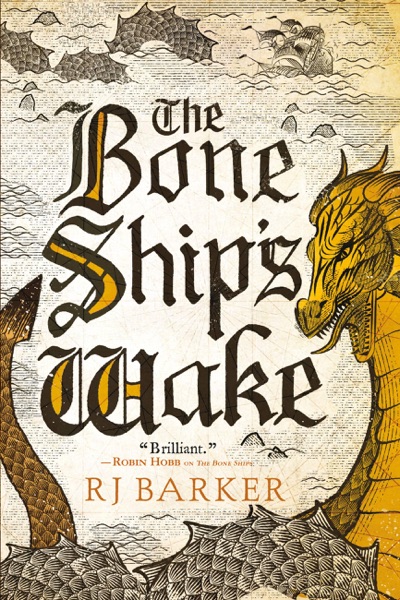
The Book in Brief
Boarding a foundering brownbone, Tide Child finds its hold packed with prisoners, most already dead. The trail leads to a state operation run by Meas’s own mother, the Thirteenbern Gilbryn: the sick, the old and the unwanted — along with the whole population of Meas’s hidden sanctuary at Safeharbour — are being seized and worked to death producing a poison meant to kill the keyshans so the hunt can begin again. As Meas presses past safe limits, Joron’s bond with the Gullaime enables what no conventional boneship can do, and rescue becomes open battle against their own nation. The truth comes out but Safeharbour’s people are not saved, and Meas, branded traitor, surrenders herself to buy her crew their freedom — leaving Joron the black fleet and an outlawed command.
Important Characters
Joron Twiner: Deckkeeper and developing commander whose empathy changes how Tide Child uses power.
Lucky Meas Gilbryn: Shipwife, strategist and reformer prepared to betray her class’s expectations.
The Gullaime: An avian windtalker whose personhood and history challenge the Isles’ exploitation.
Farys: A crew member whose growth reflects Tide Child’s transformation into a genuine community.
Solemn Muffaz: Tide Child’s deckmother and disciplinarian, a giant of a man and a steadying presence among the condemned.
The Hag and the Bern: The sea god of the Isles’ faith, and the ruling women whose order is built on boneships.
The keyshan: Sea dragons whose return makes the origin of shipbone morally unavoidable.
What to Remember from the Previous Book
Call of the Bone Ships directly follows The Bone Ships. The new volume assumes the earlier relationships, betrayals and world rules are already familiar. The opening chapters supply context through action, but they do not retell the prior novel in full.
The Brownbone and Safeharbour
Chapters 1–4. Tide Child boards a foundering brownbone and finds its hold packed with prisoners, most dead or dying.
Chapters 5–8. Joron evaluates the crew’s improved discipline while remaining uncertain of his authority.
Chapters 9–12. Meas follows evidence that official reports have deliberately minimized.
Chapters 13–16. A wreck or survivor links the disappearances to organized abduction rather than ordinary piracy.
Chapters 17–19. The Gullaime reacts to signs that its own history is involved.
Tracing the Abductions
Chapters 20–23. The crew enters a port where law and commerce conceal the people profiting from disappearances.
Chapters 24–27. Joron uses his former low status to notice information officers overlook.
Chapters 28–31. Meas pressures a witness and accepts political consequences to keep the inquiry alive.
Chapters 32–35. The captives prove to be the Isles’ own discarded — the sick, the old, the unwanted — taken by the state itself.
Chapters 36–39. The enemy escapes with enough support to prove that the scheme reaches higher authority.
Chapters 40–59: Keyshan and Gullaime
Chapters 40–43. The Gullaime explains part of the connection among wind, sea dragons and its people.
Chapters 44–47. Tide Child encounters a keyshan under conditions that make simple hunting morally impossible.
Chapters 48–51. Joron chooses protection over the naval custom that would reward a kill.
Chapters 52–55. The crew’s decision isolates them from ships that still depend on the old economy.
Chapters 56–59. Meas converts the discovery into a plan to expose and interrupt the wider operation.
Chapters 60–78: The Rescue Campaign
Chapters 60–63. Tide Child pursues the abductors through dangerous water and hostile patrols.
Chapters 64–67. A landing or boarding action recovers evidence but costs the crew safety.
Chapters 68–71. Joron takes temporary command and proves capable of adapting Meas’s plan.
Chapters 72–75. The captives’ testimony reveals the conspiracy’s intended use of bodies and power.
Chapters 76–78. An authority Meas once served orders her to stop, making obedience incompatible with justice.
Chapters 79–96: Treason and Separation
Chapters 79–81. Meas commits Tide Child openly against the forces protecting the conspiracy.
Chapters 82–84. The crew uses weather, deception and ship handling to survive a larger fleet.
Chapters 85–87. Joron’s bond with the Gullaime enables an action no conventional boneship can match.
Chapters 88–90. The rescue fails to save Safeharbour’s people, and the political cost becomes irreversible.
Chapters 91–93. Meas gives herself up to the Hundred Isles to buy her crew and the black fleet their freedom.
Chapters 94–96. Joron inherits Tide Child and the whole black fleet, with the outlawed identity that will define the final voyage.
Ending Explained
The disappearances were not piracy but policy, ordered by the Thirteenbern herself — so exposing them cannot end the danger; it makes Tide Child the enemy of the state. Meas’s deliberate surrender transfers the trilogy’s center of command to Joron, who leads not as her copy but from the community the crew has built and from his insistence on treating Gullaime and keyshan as persons rather than instruments. The finale launches the last book’s objective — recover Meas while resisting the fleets and laws that define her as a traitor. The moral investigation has become a revolution at sea.
Themes and Analysis
Leadership from Below. Joron’s authority is shaped by remembering how command feels to the powerless.
Abolition and Reform. The conspiracy shows that individual cruelty is sustained by profitable institutions.
Nonhuman Personhood. The Gullaime and keyshan resist the categories used to convert living beings into resources.
Law Versus Justice. Meas becomes a traitor because the legal order protects the wrong being investigated.
Crew as Community. Tide Child changes when condemned people become responsible to one another.
Content Notes
This book contains naval warfare and graphic violence, child abduction and exploitation, enslavement and coercion, creature harm, torture, grief and captivity.