The Book in Brief
St. Preux, a tutor of lower social rank, confesses his love to his pupil Eloisa d'Etange. She returns it while insisting that he protect her virtue and reputation. Separation intensifies their correspondence, but secret meetings culminate in a sexual relationship whose discovery would destroy Eloisa within her aristocratic family.
Clara Orbe acts as friend, mediator, and practical protector. The lovers also intervene to help Fanny and Claud Anet, while St. Preux befriends the English Lord B----. When Lord B---- and St. Preux nearly duel, Eloisa's appeal and the men's eventual reconciliation prevent bloodshed. Her father nevertheless discovers the attachment and rejects St. Preux as socially unworthy.
St. Preux leaves for Paris, where his cultural letters mix satire with homesickness and he confesses a drunken sexual lapse. Eloisa's mother discovers the correspondence and dies after a period of grief, deepening Eloisa's remorse. Pressed by her father, Eloisa releases St. Preux and marries the honorable, rational Mr. Wolmar; Lord B---- sends the despairing lover on a voyage around the world.
Years later, St. Preux returns to find Eloisa a devoted wife and mother at Clarens. Wolmar knows the old history and invites him into the family, testing whether passion has become friendship. The household's ordered labor, education, garden, and hospitality embody Eloisa's moral project, but a visit to Meillerie reveals that memory remains dangerous.
Plans form for St. Preux to educate the Wolmar children and remain attached to Clarens. Before the reunion is complete, Eloisa jumps into the water to save a child during an outing near Chillon, becomes feverish, and dies. Her last letter admits that she still loves St. Preux but asks him to join the surviving family and ultimately marry Clara, leaving friendship and duty to continue what desire could not possess.
Important Characters
Eloisa d'Etange / Mrs. Wolmar: The heroine, whose first love for St. Preux survives beneath her later identity as wife, mother, and organizer of Clarens.
St. Preux: Eloisa's tutor and lover, intellectually gifted but emotionally unstable, later a traveler and prospective family educator.
Clara / Mrs. Orbe: Eloisa's cousin, closest friend, mediator, and the most practical voice in the correspondence.
Mr. Wolmar: Eloisa's rational, observant husband, who knows her history and attempts to transform the former lovers' bond into friendship.
Lord B----: An English nobleman who becomes St. Preux's loyal friend, rescues him from despair, and tests his conduct.
Baron d'Etange: Eloisa's status-conscious father, whose opposition makes marriage to St. Preux impossible and pushes her toward Wolmar.
Baroness d'Etange: Eloisa's affectionate mother, devastated by discovering the secret correspondence.
Mr. Orbe: Clara's husband and a participant in the negotiations surrounding the lovers.
Fanny and Claud Anet: A vulnerable young woman and her beloved, whom Eloisa and St. Preux help establish together.
Harriot and the Wolmar children: The younger generation whose care, education, and rescue give Clarens its future-oriented purpose.
Letter-by-Letter Summary
The headings follow the 163 physical letters of the four-volume Project Gutenberg edition; each unit's first number records physical sequence, and the Roman label reproduces the edition's own printed numbering, including its misprints.
Letter 1: Letter I. To Eloisa.
St. Preux says he must flee Eloisa because proximity has made his respectful love unbearable, asking only that she read his confession.
Letter 2: Letter II. To Eloisa.
Interpreting her displeasure as a sentence, St. Preux apologizes for writing yet pleads that his suffering deserves compassion rather than resentment.
Letter 3: Letter III. To Eloisa.
St. Preux promises a final appeal, reads Eloisa's altered looks as proof of shared feeling, and begs her not to condemn both of them to silence.
Letter 4: Letter IV. From Eloisa.
Eloisa admits she loved him from their first meeting but commands him to become virtuous or lose both her respect and access to her.
Letter 5: Letter V. To Eloisa.
Overjoyed by her confession, St. Preux accepts the moral law she imposes and vows to make himself worthy of her love.
Letter 6: Letter VI. Eloisa To Clara.
Eloisa asks the grieving Clara to return as companion and guardian, hinting that the presence of two women will make St. Preux's lessons safer.
Letter 7: Letter VII. Answer.
Clara recognizes Eloisa's danger, offers affectionate support, and sends her answer through the tutor while refusing to treat self-knowledge as innocence.
Letter 8: Letter VIII. [6] To Eloisa.
After two months of restraint, St. Preux complains that Eloisa bears their separation more firmly and asks for the reward promised to his obedience.
Letter 9: Letter IX. From Eloisa.
Eloisa distinguishes confessed love from moral ruin and imagines mutual study, cultivated minds, and controlled feeling as a possible happiness.
Letter 10: Letter X. To Eloisa.
St. Preux values possession of Eloisa's heart above physical possession, yet describes the contradiction of living only for the person whose absence consumes him.
Letter 11: Letter XI. From Eloisa.
Eloisa says separation confirms their fates are joined and uses writing to sustain the emotional union that circumstance forbids.
Letter 12: Letter XII. To Eloisa.
St. Preux argues that genuine love strengthens judgment and every humane feeling rather than reducing the lovers to appetite.
Letter 13: Letter XIII. From Eloisa.
Eloisa praises his willingness to sacrifice desire to honor but worries that even brief separation destabilizes their carefully imagined happiness.
Letter 14: Letter XIV. To Eloisa.
St. Preux responds wildly to a secret summons and describes his journey toward Clarens as both promised bliss and moral danger.
Letter 15: Letter XV. From Eloisa.
Eloisa orders him away for a time, asking obedience as proof of love and sending her heart with him despite the cruelty of the separation.
Letter 16: Letter XVI. Answer.
St. Preux submits but protests the secret departure and gift as an assault on his honor as well as an unbearable emotional sacrifice.
Letter 17: Letter XVII. Reply.
Eloisa rejects an honor that depends on concealment and requires a satisfactory explanation before allowing their intimacy to continue.
Letter 18: Letter XVIII. To Eloisa.
Having left without farewell, St. Preux describes each step as exile and chooses solitude because ordinary society has lost meaning without her.
Letter 19: Letter XIX. To Eloisa.
His practical business finished, St. Preux presses Eloisa to recall him and turns the delay into another imagined test of his devotion.
Letter 20: Letter XX. From Eloisa.
Eloisa gently rebukes his impatient imagination, promises recall when it is safe, and reminds him that quieter grief may be the deeper one.
Letter 21: Letter XXI. To Eloisa.
St. Preux answers with a portrait of Valais, finding moral beauty in rural labor and simplicity that he believes Eloisa will value.
Letter 22: Letter XXII. From Eloisa.
Eloisa reports that her father has praised the progress produced by St. Preux's teaching, creating a brief opening for his return.
Letter 23: Letter XXIII. To Eloisa.
St. Preux continues his Valais travel account, describing dramatic contrasts of climate, landscape, and custom while wondering what his future will be.
Letter 24: Letter XXIV. To Eloisa.
He refuses a proposed stipend that would make love look purchased, accepting useful labor in principle but not payment from Eloisa's family under false terms.
Letter 25: Letter XXV. From Eloisa.
Eloisa delights in his travel picture yet sees their hopes withering; she plans to view the beloved country without approaching him openly.
Letter 26: Letter XXVI. To Eloisa.
A sudden reversal destroys St. Preux's expectations, and from a precipice he writes in despair about the impossibility of ever being united.
Letter 27: Letter XXVII. From Clara.
Clara urgently summons St. Preux because Eloisa's separation, conflict with her father, and worsening illness have placed her life in danger.
Letter 28: Letter XXVIII. From Eloisa to Clara.
Recovering, Eloisa thanks Clara for saving her but says renewed life is poisoned by absence and by the decision made for St. Preux's supposed peace.
Letter 29: Letter XXIX. From Eloisa to Clara.
Eloisa then begs Clara not to return, blaming their indulgent secrecy for the fall that has made the lovers' promises impossible to fulfill.
Letter 30: Letter XXX. The Answer.
Clara answers with grief but refuses to define Eloisa solely by sexual transgression, urging future virtue and continued mutual consolation.
Letter 31: Letter XXXI. To Eloisa.
St. Preux asks Eloisa to explain her contradictory secrecy, since pleasure now produces guilt and he senses she still withholds essential facts.
Letter 32: Letter XXXII. Answer.
Eloisa admits their old transparent language has become evasive and proposes safer arrangements through Clara for more frequent meetings.
Letter 33: Letter XXXIII. From Eloisa.
A crowded gathering makes every glance alarming, and Eloisa passes a guarded hint about a future private encounter while forbidding questions.
Letter 34: Letter XXXIV. The Answer.
St. Preux replies by proving how minutely he observed her conduct and digresses on the honorable soldier whose history has become relevant to them.
Letter 35: Letter XXXV. From Eloisa.
Eloisa explains that her hint concerned the helpful Mrs. Orbe and looks forward to St. Preux sharing in the promised joy.
Letter 36: Letter XXXVI. From Eloisa.
Her parents' journey to Bern and Soleure will leave Eloisa freer, and she exults that meetings may occur at Clara's and in the fields.
Letter 37: Letter XXXVII. From Eloisa.
Once her parents depart, Eloisa mixes guilt at deceiving them with relief and invites St. Preux to the place where she hopes to regain peace.
Letter 38: Letter XXXVIII. To Eloisa.
St. Preux recalls the women's embrace and the lovers' renewed intimacy, wishing the intervals between their secret meetings could disappear.
Letter 39: Letter XXXIX. From Eloisa.
Eloisa interrupts the lovers' plans to respond to a humanitarian duty, reminding him that one day of pleasure must yield to another person's need.
Letter 40: Letter XL. From Fanny Regnard to Eloisa.
Fanny Regnard appeals to Eloisa for help with poverty, her sick father, and the threatened separation from Claud Anet.
Letter 41: Letter XLI. The Answer.
Eloisa sends immediate aid, promises a visit, and rejects desperate self-destruction while private benevolence remains available.
Letter 42: Letter XLII. To Eloisa.
St. Preux accepts Eloisa's commission at once and insists that service to the distressed is not a rival to their love but part of it.
Letter 43: Letter XLIII. To Eloisa.
At Neufchatel, he negotiates Claud Anet's release from service and asks whether Eloisa can meet him at the dairy-house during the delay.
Letter 44: Letter XLIV. From Eloisa.
Eloisa defends the rescue of Claud from corrupting service, reports Lord B----'s arrival, and assesses the Englishman's forceful but unpolished character.
Letter 45: Letter XLV. To Eloisa.
St. Preux describes his new friendship with Lord B----, then turns from travel and music back to the longed-for dairy-house meeting.
Letter 46: Letter XLVI. From Eloisa.
Eloisa mocks his fixation on the dairy-house and promises to behave modestly before Lord B---- so as not to attract him.
Letter 47: Letter XLVII. To Eloisa.
St. Preux says her attempt to appear unengaging has failed completely and carries her image into an uneasy sleep after Fanny's wedding festivities.
Letter 48: Letter XLVIII. To Eloisa.
He criticizes French song and praises Italian music for expressing passion, treating aesthetic judgment as another extension of intimacy.
Letter 49: Letter XLIX. From Eloisa.
Writing in secret, Eloisa dismisses his jealousy of Lord B---- but warns that her constrained situation limits how boldly she can help.
Letter 50: Letter L. From Eloisa.
Eloisa rebukes his drinking and jealousy, arguing that true love recognizes only the beloved and should not manufacture wounds from ordinary society.
Letter 51: Letter LI.
St. Preux is chilled by the reprimand, pleads that his heart never lacked respect, and submits to the severity he believes he deserves.
Letter 52: Letter LII. From Eloisa.
Eloisa welcomes his willingness to renounce the bottle, recalls his trembling conduct on the water, and restores a playful tenderness to the exchange.
Letter 53: Letter LIII. From Eloisa.
External obstacles again threaten the lovers' meeting, and Eloisa insists that the deepest pleasure comes from union of hearts rather than physical access.
Letter 54: Letter LIV. To Eloisa.
St. Preux enters the chosen retreat overwhelmed by memory, anticipating that the same walls will witness both fidelity and renewed happiness.
Letter 55: Letter LV. To Eloisa.
After the encounter, he begs to die at the summit of bliss and admits that the experience has transformed his understanding of their earlier love.
Letter 56: Letter LVI. From Clara to Eloisa.
Clara reports a serious quarrel between St. Preux and Lord B---- and warns that Eloisa's secret may be nearing exposure unless the dispute is ended.
Letter 57: Letter LVII. From Eloisa.
Eloisa condemns dueling as impulsive vanity rather than courage and orders St. Preux to preserve both lives and her honor.
Letter 58: Letter LVIII. From Eloisa to Lord B----.
Eloisa writes directly to Lord B----, placing her reputation in his hands and appealing to the generosity beneath his desire for revenge.
Letter 59: Letter LIX. From Mr. Orbe to Eloisa.
Mr. Orbe reports his negotiations with Lord B----, including the proposed meeting with chosen witnesses and the continuing danger of violence.
Letter 60: Letter LX. To Eloisa.
St. Preux explains how the confrontation ended without bloodshed, defending Eloisa's honor while recognizing Lord B----'s magnanimity.
Letter 61: Letter LXI. From Eloisa.
Relieved that both men live and have reconciled, Eloisa asks St. Preux to bring Lord B---- so that gratitude can replace fear.
Letter 62: Letter LXII. From Clara.
Clara describes Eloisa's father's furious rejection of a socially inferior match and urges that St. Preux be sent away until circumstances change.
Letter 63: Letter LXIII. From Eloisa to Clara.
Eloisa confirms that her father knows enough to destroy their hopes, recounts his painful shame and tenderness, and turns desperately to Clara.
Letter 64: Letter LXIV. Clara to Mr. Orbe.
Clara tells Mr. Orbe she will not marry while Eloisa's future is sacrificed, making her friend's welfare a condition of her own engagement.
Letter 65: Letter LXV. Clara to Eloisa.
Clara reports that St. Preux has departed with Lord B---- and that the immediate scandal has been contained, though Eloisa's safety has cost the separation.
Letter 66: Letter LXVI. To Eloisa.
From exile, St. Preux struggles to write and says remembered happiness has made continued life more painful rather than more bearable.
Letter 67: Letter LXVII. Lord B---- to Mrs. Orbe.
Lord B---- reports the journey to Mrs. Orbe, describing St. Preux's recurring despair and his inability to imagine life far from Eloisa.
Letter 68: Letter LXVIII. Lord B---- to Eloisa.
Lord B---- privately asks Eloisa to support a plan for redirecting St. Preux, fearing that a refusal would destroy the hopeful effect of friendship.
Letter 69: Letter LXIX. Eloisa to Clara.
Eloisa asks Clara whether she should accept the plan, unable to distinguish a duty to preserve St. Preux from another form of betrayal.
Letter 70: Letter LXX. Answer to the Preceding.
Clara acknowledges the cruelty but advises separation and purposeful activity, promising to act from duty rather than merely indulging despair.
Letter 71: Letter LXXI. Eloisa to Lord B----.
Eloisa thanks Lord B---- for protecting and educating St. Preux, entrusting the lover's unrealized capacities to his friendship.
Letter 72: Letter LXXII. From Eloisa.
Eloisa then urges St. Preux not to wound her by rejecting Lord B----, asking him to love the friend whose worth can shape his future.
Letter 73: Letter LXXIII. From Clara.
Clara reproaches Eloisa for turning endurance into performance and reminds her that practical fortitude matters more than eloquent suffering.
Letter 74: Letter LXXIV. From Lord B---- To Eloisa.
Lord B---- reports that an accidental disclosure has brought St. Preux to reason and justifies keeping him briefly under close supervision.
Letter 75: Letter LXXV. To Clara.
St. Preux writes Clara in shame after learning more of Eloisa's situation, resolving not to leave without a final explanation.
Letter 76: Letter LXXVI. From Eloisa.
Eloisa gives St. Preux permission to pursue a worthy destiny and places what remains of her future in his honorable keeping.
Letter 77: Letter LXXVII. To Eloisa.
Revived by her confidence, St. Preux embraces Lord B----'s plan and departs immediately for the wider world of Paris and public life.
Letter 78: Letter LXXVIII. To Eloisa.
Arriving in Paris, St. Preux contrasts the great city's social distance with his former dependence and renews his duty to humane action.
Letter 79: Letter LXXIX. To Eloisa. [20]
He describes Paris as a desert of masks, criticizing fashionable sociability because it hides persons beneath roles and borrowed opinion.
Letter 80: Letter LXXX. From Eloisa.
Eloisa insists that separation cannot break their inward union and says gratitude to Lord B---- should be expressed through conduct rather than thanks.
Letter 81: Letter LXXXI. To Eloisa.
St. Preux reflects on national characters and happiness, conceding that a heart ruled by worthy love may carry its best society within itself.
Letter 82: Letter LXXXII. To Eloisa.
He claims to be adapting to Paris without surrendering judgment and says Eloisa's influence revives his nobler sentiments.
Letter 83: Letter LXXXIII. From Eloisa.
Eloisa describes a moving scene at home and reminds him that many people now deserve his gratitude and attention.
Letter 84: Letter LXXIV. To Eloisa.
St. Preux defends his criticisms of Paris, interprets Eloisa's supposed hatred of two suitors as jealous love, and urges their dismissal.
Letter 85: Letter LXXXV. From Eloisa.
Eloisa sends a miniature portrait as a lover's talisman and reports that the unwanted suitors have left.
Letter 86: Letter LXXXVI. To Eloisa.
St. Preux sketches the manners of Parisian women, contrasting fashionable gallantry with the singular sincerity he attributes to Eloisa.
Letter 87: Letter LXXXVII. To Eloisa.
He reports meetings with acquaintances and worships Eloisa's portrait, using the image to bridge the physical distance between them.
Letter 88: Letter LXXXVIII. To Mrs. Orbe.
Writing to Clara, he reviews the French opera and argues that spectacle and criticism have replaced emotionally truthful music.
Letter 89: Letter LXXXIX. From Eloisa.
Eloisa rejoices that the portrait has rekindled his voice and explains how the painter altered her clothing while attempting to preserve her character.
Letter 90: Letter XC. To Eloisa.
St. Preux analyzes the portrait more soberly, praising its modest dress while distinguishing a likeness from the living moral presence he loves.
Letter 91: Letter XCI. To Eloisa.
St. Preux confesses that drunken companions led him into sex with a prostitute, treating the bodily betrayal as a crime against both himself and Eloisa.
Letter 92: Letter XCII. The Answer.
Eloisa forgives the lapse as heartless debauch rather than infidelity but rebukes the social and philosophical errors that made such self-degradation possible.
Letter 93: Letter XCIII. From Eloisa.
Eloisa discovers that her mother has taken the lovers' letters and, refusing to build safety on a lie, orders St. Preux to stop writing.
Letter 94: Letter XCIV. From Mrs. Orbe.
Clara describes the mother's devastation and accuses St. Preux's obstinacy of draining Eloisa's former moral energy from the household.
Letter 95: Letter XCV. To The Baroness D’Etange.
St. Preux appeals directly to the Baroness, renouncing his hopes and begging her to recover rather than die under the weight of their secret.
Letter 96: Letter XCVI. To Mrs. Orbe,
He sends the renunciation to Clara and hardens himself against feeling, believing that only stubborn endurance can replace the sensibility that ruined them.
Letter 97: Letter XCVII. From Mrs. Orbe.
Clara praises his generosity but warns that self-destruction would make him unworthy of the woman for whom he claims to sacrifice.
Letter 98: Letter XCVIII. From Eloisa.
After her mother dies with Eloisa's name on her lips, Eloisa assumes the guilt, rejects further contact, and attempts a final farewell.
Letter 99: Letter XCIX. To Mrs. Orbe.
St. Preux writes Clara from shattered hope, questioning whether their love caused the death and whether either lover has a right to continue living.
Letter 100: Letter C. The Answer.
Clara refuses to abandon him, argues that fixed love may survive suffering, and warns that persistence will change rather than preserve Eloisa.
Letter 101: Letter CI. From Lord B----.
Lord B---- angrily calls St. Preux back from suicidal isolation, framing his intended death as ingratitude to a friend who still needs him.
Letter 102: Letter CII. The Answer.
St. Preux agrees to one more meeting and encloses Eloisa's request that he release her so her father may arrange another marriage.
Letter 103: Letter CIII. From the Baron D’Etange.
Baron d'Etange threatens the socially inferior lover and demands an answer to his daughter's plea, treating paternal rank as unquestionable authority.
Letter 104: Letter CIV. The Answer.
St. Preux rejects the Baron's insults but obeys Eloisa, formally restoring her freedom to marry even while condemning the coercion behind it.
Letter 105: Letter CV. From Eloisa.
Eloisa reports that honor has betrayed them and collapses under the prospect of the forced marriage their mutual obedience has enabled.
Letter 106: Letter CVI. From Eloisa to Mrs. Orbe.
Recovering from fever and altered appearance, Eloisa tells Clara she hopes lost beauty will deter Wolmar and wonders whether lovers can communicate beyond the senses.
Letter 107: Letter CVII. The Answer.
Clara explains the desperate interview she arranged during Eloisa's delirium and urges her not to create imaginary terrors beside the real ones.
Letter 108: Letter CVIII. From Eloisa.
Eloisa accepts that she will always love St. Preux but assigns her continued life to Clara, her father, and the lover's future welfare.
Letter 109: Letter CIX. The Answer.
Clara welcomes Eloisa's return to reason and proposes controlled future contacts that may comfort St. Preux without reopening the forbidden relationship.
Letter 110: Letter CX. From Mrs. Orbe.
Clara announces that Eloisa is married to Wolmar and asks St. Preux to prove that his attachment can become pure, disinterested friendship.
Letter 111: Letter CXI. From Eloisa.
As Mrs. Wolmar, Eloisa explains that marriage and religious duty require her to sacrifice the passion she can neither deny nor lawfully gratify.
Letter 112: Letter CXII. To Eloisa.
St. Preux mourns the irrevocable past yet says Eloisa's principled renunciation makes her more fully his moral ideal than before.
Letter 113: Letter CXIII. From Eloisa.
Eloisa describes Wolmar's worth and asks permission to continue a correspondence purged of secrecy, while recognizing how painful the final farewell remains.
Letter 114: Letter CXIV. To Lord B----.
St. Preux writes Lord B---- that life has become too heavy and rationalizes suicide as obedience to suffering rather than defiance of Providence.
Letter 115: Letter CXV. Answer.
Lord B---- calls the argument selfish and orders him to live for Eloisa's peace, dismissing death as beneath their friendship.
Letter 116: Letter CXVI. From Lord B----.
Lord B---- sends an urgent summons concerning a plan that can remove St. Preux from destructive idleness and demands an immediate answer.
Letter 117: Letter CXVII. Answer.
St. Preux submits entirely to Lord B----'s direction, claiming obedience as the first useful merit he can still offer.
Letter 118: Letter CXVIII. From Lord B----.
Lord B---- arranges a long voyage and practical responsibilities, hoping distance and activity will restore his friend's mind and body.
Letter 119: Letter CXIX. To Mrs. Orbe
St. Preux tells Clara he is beginning a voyage around the world, seeking in another hemisphere the peace Europe and memory denied him.
Letter 120: Letter CXX. From Mrs. Wolmar to Mrs. Orbe.
Years later, Eloisa asks Clara to join her at Clarens, where motherhood and friendship can complete the household life she has built with Wolmar.
Letter 121: Letter CXXI. Answer.
Clara joyfully accepts and reveals that Wolmar has long understood Eloisa's past, turning the supposed concealment into evidence of his confidence.
Letter 122: Letter CXXII. To Mrs. Orbe.
Returned from global travel, St. Preux describes colonial suffering and asks to precede Lord B---- so that he may see Clara and Clarens sooner.
Letter 123: Letter CXXIII. From Mr. Wolmar.
Wolmar invites St. Preux directly, declaring that Eloisa has disclosed her heart and asking him to examine his own before coming without fear.
Letter 124: Letter CXXIV. From Mrs. Orbe.
Clara encloses Wolmar's invitation, welcomes the traveler home, and assures him that her own friendship has survived every absence.
Letter 125: Letter CXXV. To Lord B----.
On the night of his return to Clarens, St. Preux records how seeing Eloisa as wife and mother transforms memory and vows to leave if attachment again becomes possessive.
Letter 126: Letter CXXVI. Mrs. Wolmar to Mrs. Orbe.
Eloisa tells Clara that the feared reunion has instead quieted her, crediting Wolmar's confidence with teaching her to deserve it.
Letter 127: Letter CXXVII. Answer.
Clara teases Eloisa's minute inspection of the returned lover and anticipates seeing how seven years of travel have changed him.
Letter 128: Letter CXXVIII. Clara to Eloisa.
After keeping St. Preux for a visit, Clara returns him to Eloisa with a comic report that he has been examined and found trustworthy.
Letter 129: Letter CXXIX. To Lord B----.
St. Preux describes Clarens's agriculture, labor, and provision for dependents, presenting useful work and benevolent management as a single domestic system.
Letter 130: Letter CXXX. To Lord B----.
He continues with Eloisa's gardens, household ordering, and guidance of taste, arguing that apparent naturalness is the product of careful moral design.
Letter 131: Letter CXXXI. Mrs. Wolmar to Mrs. Orbe.
Eloisa confesses to Clara that a new discovery about Wolmar has shaken her confidence and revived the weight of past faults.
Letter 132: Letter CXXXII. Answer.
Clara urges her to trust the inward testimony of reformed feeling and mocks status anxieties as small beside the family's real virtues.
Letter 133: Letter CXXXIII. Mr. Wolmar to Mrs. Orbe.
Wolmar travels to Etange and asks Clara to help manage the approaching return of Lord B---- and the emotional tests it may create.
Letter 134: Letter CXXIV. To Lord B----.
In Wolmar's absence, St. Preux feels greater rather than less restraint, fearing that old desire can make guilt vivid even without action.
Letter 135: Letter CXXXV. Mrs. Wolmar to her Husband.
Eloisa tells her husband that the household will be ready for his return but warns that his deliberate experiments risk the virtue he hopes to confirm.
Letter 136: Letter CXXXVI. To Lord B----.
St. Preux recounts a dangerous boat journey to Meillerie, where the landscape of the lovers' past nearly overwhelms both him and Eloisa before they return safely.
Letter 137: Letter CXXXV. [70] From Lord B----.
Lord B---- tells St. Preux that self-analysis is not enough and challenges him to turn eloquent moral knowledge into steady action.
Letter 138: Letter CXXXVI. To Lord B----.
St. Preux declares Meillerie the crisis that ended his folly, then praises Clarens's tenants for contentment founded on limited wants and secure work.
Letter 139: Letter CXXXVII. To Lord B----.
Observing visiting children, St. Preux describes Eloisa's educational methods and the quiet discipline through which Clarens avoids constant commands.
Letter 140: Letter CXL. From Lord B---- to Mrs. Orbe.
From the army, Lord B---- reports a missing letter and the campaign's absurd mixture of military courage, destruction, boredom, and sociability.
Letter 141: Letter CXLI. To Lord B----.
St. Preux urges Lord B---- to leave martial glory for Clarens and reflects on Wolmar's unbelief beside Eloisa's sincere religious life.
Letter 142: Letter CXLII. To Lord B----.
He presses Lord B---- to avoid another Paris delay and reports that preparations at Clarens lack only the absent friend's presence.
Letter 143: Letter CXLIII. To Lord B----.
St. Preux describes the vintage feast, where masters, servants, and laborers eat together and useful work ends in communal gratitude.
Letter 144: Letter CXLIV. To Mr. WOLMAR.
St. Preux thanks Wolmar for curing his former disorder and claims his only remaining desire is a future completion no human plan can grant.
Letter 145: Letter CXLV. To Mrs. Orbe.
Writing to Clara, he confesses renewed anxiety about Lord B---- and argues that only a woman equal to Clara could deserve the nobleman's loyalty.
Letter 146: Letter CXLVI. From Mrs. Orbe.
Clara answers with affectionate ridicule, exposing St. Preux's habit of committing a new folly and repenting of it the next day.
Letter 147: Letter CXLVII. From Mr. Wolmar.
Wolmar formally offers St. Preux a place as brother, friend, and paternal guide to the children, converting the dispossessed lover into family.
Letter 148: Letter CXLVIII. To Mr. Wolmar.
St. Preux privately warns Wolmar against Lord B----'s projected marriage, fearing that gratitude and defiance of convention may obscure lasting prudence.
Letter 149: Letter CXLIX. Mrs. Wolmar to Mrs. Orbe
Eloisa tells Clara that news from Italy concerns Lord B---- and sends a letter that must be opened only after Clara returns to Clarens.
Letter 150: Letter CL. Harriot to her Mother.
Harriot writes a playful child's complaint that the adults are scattered, Eloisa has been crying, and her absent mother must come home.
Letter 151: Letter CLI. Mrs. Orbe to Mrs. Wolmar.
Clara reports safe arrival at Lausanne, regrets Eloisa's absence, asks for the Italian news, and threatens to bring the wedding party to Clarens.
Letter 152: Letter CLII. Mrs. Orbe to Mrs. Wolmar
Clara's long follow-up mixes travel observations with an admission that St. Preux's return has made her see him differently.
Letter 153: Letter CLIII. Lord B---- to Mr. Wolmar.
Lord B---- tells Wolmar that St. Preux passed the test surrounding Laura and chose honor over the private advantage of securing life at Clarens.
Letter 154: Letter CLIV. Answer.
Wolmar accepts both men back, praises their conduct, and says his real book is the human heart rather than abstract philosophy.
Letter 155: Letter CLV. Mrs. Orbe to Mrs. Wolmar.
Clara surveys Geneva's civic life and hospitality while eagerly planning the returning company and the arrangement of rooms at Clarens.
Letter 156: Letter CLVI. From Mrs. Wolmar.
After seven years of direct silence, Eloisa asks St. Preux to judge the proposed family reunion by enduring principle, not merely present honorable feeling.
Letter 157: Letter CLVII. Answer.
St. Preux recognizes her hand, vows that only virtuous love remains, but refuses a reunion that would make him either a stranger or another immediate farewell.
Letter 158: Letter CLVIII. From Mrs. Wolmar.
Eloisa rebukes his fearful interpretation, renews the offer of family intimacy, and leaves for an outing near Chillon with an unexplained sense of dread.
Letter 159: Letter CLIX. From Fanny Anet.
Fanny reports that Eloisa leapt into the water to save a child, was rescued herself, and now suffers a fever whose outcome the physician cannot promise.
Letter 160: Letter CLX. From Mrs. Orbe.
Clara abruptly announces Eloisa's death, directs St. Preux to her final letter, and reminds him that obligations to the living remain.
Letter 161: Letter CLXI. From Mr. Wolmar.
Wolmar recounts Eloisa's final illness, composure, concern for the family, and request that St. Preux return to share and relieve their grief.
Letter 162: Letter CLXII. From Eloisa.
In her posthumous letter, Eloisa admits her love never died, accepts death as release from renewed danger, and asks St. Preux to join the family and love without crime.
Letter 163: Letter CLXIII. From Mrs. Orbe.
Clara asks the recovering St. Preux to cross the mountains before winter, help the bereaved household, and transform their common sorrow into mutual support.
Ending Explained
How does Eloisa die?: After jumping into the water to save a child near Chillon, she develops a fever and dies despite initially appearing to recover.
Did she stop loving St. Preux?: No. Her final letter admits the passion remained interwoven with her life, though she governed her conduct as Wolmar's wife.
What does she ask St. Preux to do?: She asks him to return to Wolmar, the children, and Clara, fulfill his duties to the living, and consider a lawful union with Clara.
Why is Clara's final letter important?: It refuses the lover's temptation to make Eloisa's death a private catastrophe; grief must become service to the surviving community.
Does Clarens survive?: The correspondence ends before a full future is narrated, but Wolmar and Clara explicitly invite St. Preux to help preserve the family Eloisa created.
Themes and Motifs
Passion and virtue: The novel asks whether desire can be disciplined into moral relation without being denied or destroyed.
Writing and self-creation: Letters record feeling while also intensifying it, making every correspondent both witness and author of identity.
Class and paternal authority: The Baron's rejection of St. Preux converts social hierarchy into the decisive force against the lovers' marriage.
Marriage and friendship: Wolmar and Clara create forms of trust that challenge the lovers' belief that romantic possession is the only complete bond.
Nature and social design: Valais, Meillerie, and Clarens join emotional landscape to arguments about labor, education, and ordered community.
Religion and death: Eloisa's faith makes mortality both a moral limit and the imagined place where divided love can finally be reconciled.
Content Notes
Includes sexual relationships outside marriage, coercive parental control, forced or unwanted marriage, suicidal ideation, alcohol and sexual exploitation, bereavement, serious illness, drowning peril, death, dueling threats, class prejudice, colonial violence, paternalism, and period gender and religious assumptions.
About the Book
Best for: readers who want the epistolary novel that shaped Romanticism — and who can meet its length and intensity on its own terms. Narrative shape: 163 letters in four volumes, from forbidden tutorial passion to the managed community of Clarens and a posthumous confession. Central contrast: desire disciplined into virtue versus a first love that survives every institution built to contain it. Overall assessment: 4/5 for accumulated power and influence, with real demands on the reader's patience. Source-checked scope: 163 distinct reading units in Project Gutenberg eBook #76639; no front matter was counted as narrative content.
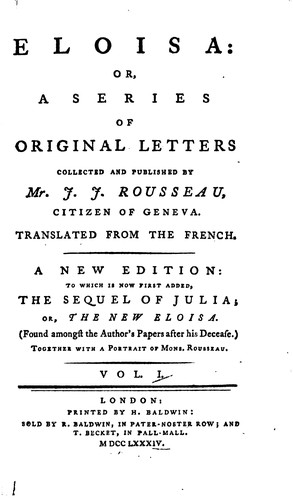
Primary text: Jean-Jacques Rousseau, Eloisa: or, A Series of Original Letters, William Kenrick translation, Project Gutenberg eBook #76639. The complete text contains 163 physical letters across four volumes, whose printed numbering carries occasional misprints. The review, plot account, ending analysis, and every structural recap in this guide were checked against that edition.
Selection evidence: Project Gutenberg Top 100 EBooks in the last 30 days — rank #30 with 91,933 downloads in the August 3, 2026 snapshot. Books already completed in the preceding batches were excluded.