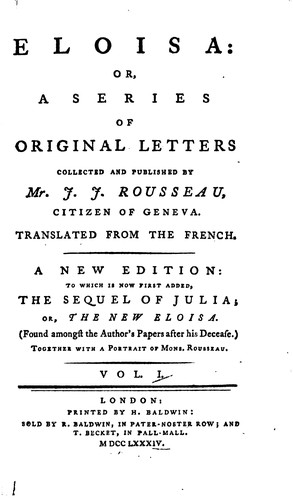
Rousseau's novel—better known as Julie, or the New Heloise—begins in the dangerously intimate correspondence between Eloisa and her tutor St. Preux. Their letters do not merely report a romance: they perform it, as each writer interprets the other's sincerity, demands new proofs, and converts private desire into a theory of virtue.
The four-volume arc is much stranger than a simple tragic love story. Parisian manners, music, dueling, travel, colonial violence, gardening, education, religion, domestic economy, and child-rearing all become tests of whether feeling can be made socially useful. Clarens, the household Eloisa builds with Wolmar, is both an attractive cooperative ideal and a closely managed system.
Clarens, the household Eloisa builds with Wolmar, is both an attractive cooperative ideal and a closely managed system.
The book's power lies in emotional and philosophical accumulation, but so does its difficulty. The lovers repeat themselves, threaten despair, and scrutinize every sensation at a length modern readers may find oppressive. W. Kenrick's 1761 translation also uses archaic spelling, anglicized names, and its own sometimes unstable letter numbering.
Eloisa's death resolves none of the novel's deepest tensions cleanly. She has made a real marriage, family, and moral community, yet her final letter admits that her first passion never died. The ending is moving because virtue has organized that passion without erasing it—and troubling because death becomes the only condition under which she can confess it without social guilt.