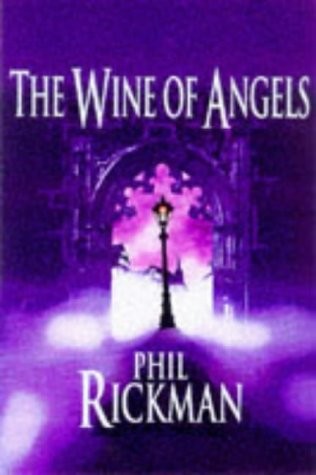
Phil Rickman begins The Wine of Angels with a village tradition being brought back to life for all the wrong reasons. A Twelfth Night wassail has been revived as heritage entertainment, complete with cider, shotguns and people playing at being ancient country folk. Then Edgar Powell fires his gun beneath an apple tree and dies in front of the assembled villagers. The scene is grotesque, faintly absurd and impossible to classify. It may be an accident, a suicide, a protest or something darker. That uncertainty becomes the governing mood of the novel.
The beauty and the danger grow from the same roots.
Months later, the Reverend Merrily Watkins returns to Ledwardine as its new priest-in-charge. She is widowed, newly ordained, short of money and accompanied by Jane, her fiercely intelligent fifteen-year-old daughter. Neither woman fits the image the village has prepared for them. Merrily is a former punk who smokes, swears, doubts herself and has no interest in performing saintliness. Jane is embarrassed by her mother’s vocation but fascinated by the pagan customs Merrily is expected to keep at a safe distance. Their arrival disturbs a community already divided between old farming families and prosperous newcomers eager to package its history for tourists.
The novel’s greatest achievement is Ledwardine itself. Rickman does not treat the village as an idyllic setting invaded by evil. The beauty and the danger grow from the same roots. Its black-and-white houses, church, orchard, pub and winding lanes are inseparable from old hierarchies, private grudges and stories that have been edited to protect the powerful. Even the apples carry competing meanings: crop, sacrament, tourist brand, folk symbol and repository of memory. The famous local cider gives the book its title, but the phrase also suggests grief, repentance and the human cost concealed beneath a picturesque surface.
Merrily is an excellent protagonist because her faith does not make her certain. She is professionally required to speak about meaning while privately wondering whether she has mistaken trauma, loneliness or ambition for a calling. Her late husband Sean died in a car with another woman, leaving Merrily to absorb both bereavement and betrayal. The enormous vicarage seems to exploit that vulnerability. Its cold rooms, unexplained sounds and recurring image of a hidden third floor are frightening precisely because Merrily cannot decide whether they are spiritual phenomena, psychological pressure or ordinary features of a neglected house.
Jane gives the novel a second, more instinctive route into Ledwardine’s mystery. She is drawn to Lucy Devenish, an eccentric local historian whom the village alternately dismisses as a witch and consults whenever it needs folklore. Jane’s experiences in the orchard resist Merrily’s Christian vocabulary, but Rickman avoids making their conflict a simple contest between enlightened paganism and repressive religion. Lucy can be perceptive and manipulative; Merrily can be sceptical and spiritually receptive; Jane’s attraction to old beliefs is mixed with adolescent risk-taking. The book is interested in what happens when belief becomes a way of reading a place rather than a set of rules.
The third major viewpoint belongs to Laurence “Lol” Robinson, a damaged former musician living at the edge of the orchard. Lol enters the story while carefully planning his suicide, and his slow return to agency becomes one of its most affecting threads. He has been defined for years by a criminal record and by the people who exploited his passivity. His love of Nick Drake could have made him a collection of melancholy references, but Rickman gives him humour, musical intelligence and a quiet capacity for kindness. His developing trust in Merrily never feels like a convenient romantic subplot. It grows from two people who recognise guilt and self-doubt in one another.
The central village dispute concerns a proposed play about Wil Williams, a seventeenth-century Ledwardine clergyman accused of witchcraft and later found hanging in the orchard. Playwright Richard Coffey and actor Stefan Alder interpret Wil’s persecution through their own experience as gay men. Old families object, ostensibly because the production will sensationalise local history. The argument raises one of the novel’s sharpest questions: who has the right to recover a buried life, and how much of that recovery is another form of appropriation? Every faction claims to be defending the past while reshaping it to meet a present need.
Rickman handles the supernatural with unusual restraint. There are dreams, voices, lights among the trees and moments that resemble possession or communion, but the book rarely confirms a single explanation. Human beings commit the identifiable crimes. That does not render the supernatural material irrelevant. Instead, the uncanny operates like pressure exerted by everything the village refuses to acknowledge. Readers can understand the orchard as haunted, psychologically charged, spiritually alive or all three without breaking the story.
The principal weakness is length. At more than six hundred pages in the Corvus paperback, the novel contains enough feuds, crimes, relationships and historical speculation for several mysteries. The first half develops atmosphere and character beautifully, but it also repeats suspicions and delays several revelations. A few antagonists are so unpleasant that they can feel like deliberate red herrings, and not every act of cruelty receives a satisfying reckoning. The final movement accelerates so sharply that some solutions arrive in a cluster after hundreds of pages of patient uncertainty.
The density also produces the book’s distinctive pleasure. By the time a girl disappears and the old stories begin to align with present violence, Ledwardine feels inhabited rather than assembled. Minor conversations in the Black Swan matter because the reader understands who is permitted to speak, who is mocked and who is protected. Rickman’s mystery is less about finding one clever clue than learning the moral geography of a community.
The Wine of Angels is an atmospheric, character-led beginning to the Merrily Watkins series. It will frustrate readers who want a fast procedural or an unambiguous ghost story. For readers who enjoy Susan Hill, Andrew Michael Hurley or mysteries in which landscape, folklore and social history are as important as the culprit, it offers a rich and unsettling visit to a village that never quite stops watching its orchard.