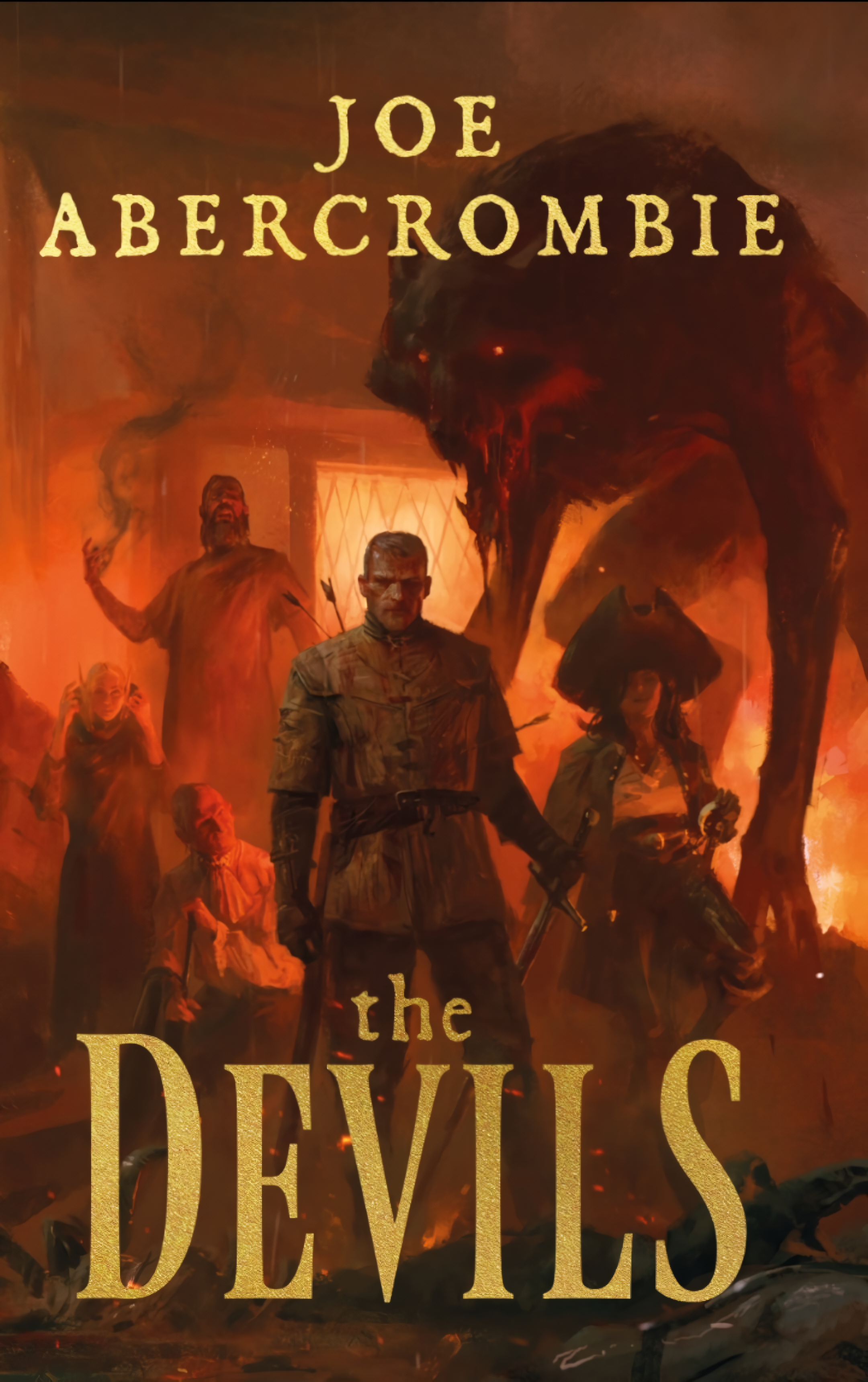
After nearly a decade away from anything not set in the First Law world, Joe Abercrombie returns with The Devils, and the news is mostly very good: it's his funniest book, one of his most purely fun, and — surprisingly, for the man they call Lord Grimdark — one of his most warm-hearted. It's also his most structurally uneven adult novel, which is the honest reason it lands at four stars rather than five. But as a series launch and a palate-cleanser, it's a blast.
The premise is the whole pitch and it delivers exactly what it promises. A congregation of monsters — a daylight-walking vampire, a Viking werewolf, a self-adoring necromancer, an immortal knight who cannot die and cannot stop hurting, an invisible elf, an ex-pirate, and the flustered monk unlucky enough to command them — are chained by the Church into escorting a foul-mouthed thief across a war-torn fake-medieval Europe to put her on the throne of Troy. Suicide Squad meets The Dirty Dozen by way of Hammer horror, with Abercrombie's signature banter turned up to a roar. If that sentence makes you grin, the book will not disappoint you.
What makes it more than a gimmick is the cast, and specifically how quickly Abercrombie makes you love them. The great trick of The Devils is that its literal monsters are the most decent people in it — more loyal, more honest, more humane than the smiling clerics and charming dukes who actually run the world. Jakob of Thorn, the immortal knight cursed to keep sinning every time he does the "good" violent thing, is prime Abercrombie: a weary conscience in a body that won't let him rest. Balthazar, the pompous necromancer who spends the book scheming to turn villain and accidentally grows a heart instead, gets the funniest lines and the most satisfying arc. And Vigga the werewolf is a genuinely inspired comic-tragic creation. The slow gelling of these misfits into a family is the engine that makes a very silly book land with real emotional weight.
The standout, for me, is the romance between Alex — the thief who is not at all who the Church thinks she is — and Sunny, the invisible elf who is quietly the kindest soul in the story. It's tender, patient, and beautifully written, and it marks how far Abercrombie has come in writing women and queer characters since the aggressively male First Law books. That a grimdark road-trip splatter-comedy contains one of the year's most affecting love stories tells you the heart under the gore is real.
Abercrombie's craft is as sharp as ever at the sentence and scene level. The action set pieces are spectacular and inventive — a spatially impossible haunted house, a burning ship boarded by fish-men, a graveyard last stand where a necromancer raises the plague-dead — and the dialogue crackles. The worldbuilding is a deliberate lark; Abercrombie has openly called it the "stupid version of our world," a Troy-descended fever-dream Europe that exists to be fun rather than rigorous, and taken in that spirit it works. The final-act reveals are sharp, cynical, and satisfying, and the ending is pure Abercrombie in a way I'd rather let land unspoiled — enough to say that monsters don't get tidy rewards, and the book has the nerve to mean it.
The honest caveats are real. This is Abercrombie's most episodic novel, and its structure — a linear string of self-contained set pieces, closer to a tabletop campaign than a tightly wound plot — can feel repetitive across 560 pages. The rhythm of "arrive somewhere, fight a themed monster, escape, repeat" delivers on spectacle but occasionally sags on momentum, and a couple of the middle-book detours (the bickering warring couple especially) feel like filler between the good stuff. The choice to deny POV chapters to two of the seven Devils — the vampire Rikard and, more damagingly, the ex-pirate Baptiste — leaves both thinner than they should be, and it robs one of the book's biggest late moments of the weight it needed, because we were never fully inside the character it turns on. And readers coming for the morally-grey psychological depth of The First Law or The Heroes should recalibrate: the characters here are vivid and lovable but broader, more archetype than the knotty, self-deceiving studies Abercrombie is famous for. This is a comedy-adventure first and a character tragedy second, where his best work reversed that order.
None of that sinks it. The four stars are a genuine four: The Devils is a fast, funny, gore-soaked, big-hearted romp that reintroduces one of fantasy's best prose stylists in a lighter register, launches a series with obvious room to grow, and smuggles a beautiful love story and a real thematic spine into what could have been an empty gimmick. It's not top-tier Abercrombie — the First Law standalones remain his peak — but it's the most fun he's been in years, and it's an easy, fast entry point for readers who've never touched his darker work.
Four stars: Lord Grimdark at his most playful, with a golden heart under the viscera. If "a squad of monsters does the Church's dirty work and slowly becomes a family" sounds like a good time, it absolutely is one — just go in for the fun and the feeling rather than the moral chess of his classics.