The Book in Brief
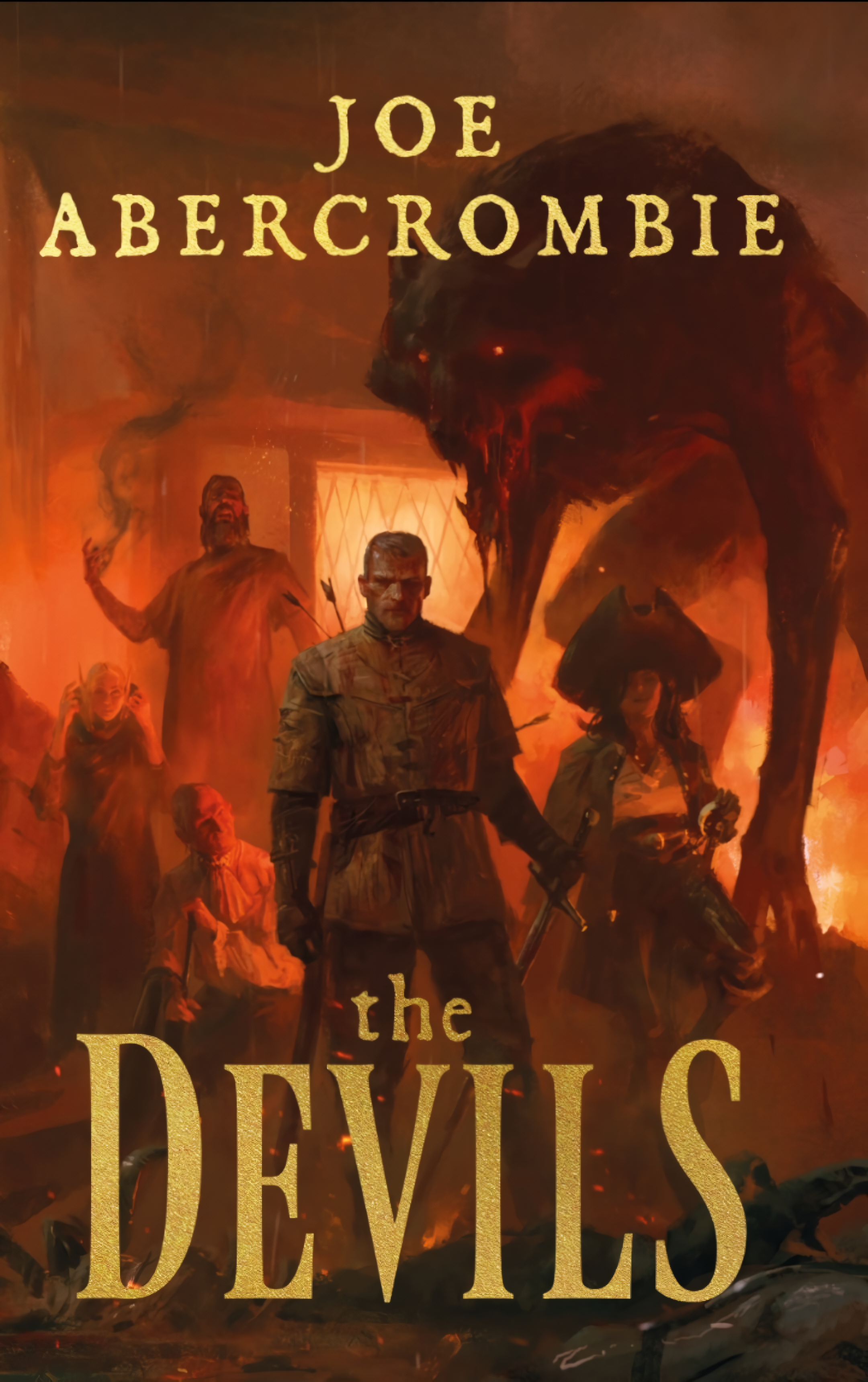
The Devils (2025) is Joe Abercrombie's thirteenth novel and the opening book of a brand-new series — his first adult work set outside the sprawling First Law universe in about a decade. It's exactly the kind of thing longtime readers hoped for and something genuinely new: a road-trip fantasy about a squad of literal monsters, press-ganged by the Church into doing its dirtiest work. The elevator pitch everyone reaches for — Suicide Squad meets medieval Europe, or The Dirty Dozen with Hammer-horror creatures — is accurate, but it undersells how much heart Abercrombie smuggles in underneath the gore and the jokes.
The setup is simple and irresistible. A hapless monk named Brother Diaz is handed command of the Chapel of the Holy Expediency, the Church's secret "thirteenth chapel," staffed by a vampire, a werewolf, a necromancer, an immortal knight, an ex-pirate, and an invisible elf. Their assignment: escort a foul-mouthed street thief named Alex across a war-torn continent and put her on the throne of Troy, because she is — supposedly — the empire's lost heir. What follows is a breakneck, blood-soaked, frequently hilarious quest that slowly reveals itself to be a story about found family, redemption, and what actually separates a monster from a person.
Important Characters
Brother Diaz: A timid, ambitious monk who comes to the Holy City expecting advancement and is instead put in charge of the Chapel of the Holy Expediency, a secret thirteenth chapel that handles the Church's black-ops work. The story's anchoring viewpoint, he slowly trades his vows for his humanity, falls for the werewolf Vigga, and ends the book serving as chaplain to the new Empress.
Alex: A cynical, resourceful street thief presented to the world as Princess Alexia Pyrogennetos, lost heir to Troy's Serpent Throne. Her secret is that she took over the real princess's identity after the girl died of disease, yet she grows a genuine conscience, survives every plot aimed at her, and finishes the book crowned Empress of Troy.
Jakob of Thorn: An immortal knight and onetime Templar, cursed by a witch so that death will not take him, healing from every wound and carrying each one as scar and pain. The group's military leader and weary conscience, he ends the book tackling Duke Michael from the top of the Pharos and, true to his curse, surviving the fall.
Vigga Ullasdottr: A crude, chaotic Norse werewolf with almost no short-term memory and occasional flashes of startling wisdom, at once the team's deadliest weapon and its worst liability. She begins an improbable romance with Brother Diaz, and in the finale she is driven into her wolf shape and kills Baptiste by accident.
Sunny: An elf who can vanish from sight by holding her breath, feared and shunned by nearly everyone despite being among the kindest souls in the story. Her slow-growing love for Alex shapes the final act, and she is taken away in chains after telling Alex she is the best person she has ever met.
Balthazar Sham Ivam Draxi: A vain, wordy necromancer who considers himself an unappreciated genius and spends much of the journey plotting to escape the papal binding. He keeps rescuing the group in spite of himself, turns down Eudoxia's offer of power out of loyalty to his monstrous found family, and still smiles in his cage, planning his next attempt at freedom.
Baron Rikard: An ancient, exquisitely mannered vampire who can bear daylight and pacify hostile crowds with his mesmerizing voice, though every use of that power ages him. He slaughters Eudoxia's four handmaidens atop the Pharos and ends the story grown old from spending so much of himself.
Baptiste: A roguish ex-pirate and all-purpose fixer with a tale ready for any occasion. She is the one core member of the Devils to die, killed by accident when Vigga transforms during the chaos in Troy, apparently while saving Brother Diaz.
Duke Michael of Nicaea: The charming nobleman whose timely rescue of Alex launches the entire scheme. He proves to be the conspiracy's true architect, having used Alex from the start to eliminate Eudoxia's sons and claim the Serpent Throne, until Jakob tackles him off the Pharos and into the sea far below.
Cardinal Zizka: The pitiless leader of the Church's Curia, who saddles Brother Diaz with his deadly appointment and directs the Chapel's dirty work. When Alex demands at the end that the Devils be freed, Zizka refuses and has them shipped back to their cells for the next time the Church needs them.
Eudoxia: The usurping sorceress-empress whose four treacherous sons hunt Alex across the continent, and who is believed dead. In truth she moved her soul into a new body and has been operating in Troy as Lady Severa; Balthazar refuses the place she offers at her side but walks away with her secrets.
Benedicta I: The child Pope of the Western Church, a girl of roughly ten who commands genuine and frightening divine power. She proclaims Alex the rightful heir and lays the papal binding on the Devils, a compulsion so strong that even a Duke of Hell cannot unmake it.
Duke Arcadius: The scholarly final survivor of Eudoxia's sons, who comes to Troy offering to join his claim to Alex's through marriage. On what should have been the wedding night he is frozen and shattered by the false handmaidens, the opening blow of the coup.
Setting: The "Stupid Version of Our World"
Abercrombie has been cheerfully dismissive about his own worldbuilding here, describing the aim as making the setting feel like a vague fever dream rather than rigorous alternate history. The result is a fantastical medieval Europe that rhymes with our own but diverges at the roots. Rather than descending from Greece and Rome, this civilization traces its lineage to mythical Troy and to Carthage and its "Witch-Engineers." The founding myths are inverted: the events of the Iliad and Odyssey are retold with the Trojans victorious, and Troy stands as the great eastern bastion of humankind.
Religion dominates everything, and it's a Christianity-analog centered on a female Savior. Crucially, the faith is in schism: a Western Church, led from the Holy City (a Rome stand-in) by a child Pope, Benedicta the First, a girl of about ten who nonetheless wields real and terrifying divine power; and an Eastern Church, centered on Troy and led by a Patriarch. Healing that rift — and thereby uniting humankind against a common enemy — is the political engine of the whole book.
That common enemy is the elves. In this world elves are not ethereal woodland beauties but a man-eating horde massing at the eastern borders, hungering for human flesh. Troy is the beacon that has held the line, and the Crusades of this world were fought against elves. Tellingly, the book's lone elf character, Sunny, pointedly behaves nothing like the propaganda about her kind.
Magic is everywhere and matter-of-fact: vampires, werewolves, necromancers, sorcerers, demons, and Dukes of Hell all exist. The monstrous heroes of the Chapel are bound to their mission by a papal binding — a magical geis laid on them by the Pope that makes plotting betrayal physically agonizing. Late in the book there are hints that the "divine" nature of this power may be more complicated than the Church claims. The journey runs from the Holy City eastward — through a stand-in for Venice, across the sea, and finally to Troy, whose skyline is dominated by an enormous fortress-temple-lighthouse called the Pharos, atop which burns a sacred flame.
The Cast
Brother Diaz is the point-of-view anchor and the audience's window into the madness — an ambitious but timid monk who came to the Holy City expecting a cushy promotion and instead got command of the Chapel. Perpetually flustered and out of his depth, he clings to prayer and, awkwardly, develops a genuine attraction to the werewolf Vigga.
Alex (Princess Alexia Pyrogennetos) is a cynical, resourceful street thief plucked from the gutter and told she's the lost heir to the Serpent Throne of Troy. She's the emotional heart of the book, and her secret — that she's a fraud who assumed the dead real princess's identity — is the story's load-bearing twist.
Jakob of Thorn is an immortal knight, a former Templar who fought in this world's Crusades and did terrible things before taking his current oaths. Cursed by a witch so that he cannot die — healing fast, carrying every wound as scar and chronic pain — he's the group's military spine and its weary conscience.
Vigga Ullasdottr is a Norse werewolf — crude, lusty, chaotic, and staggeringly violent, with the short-term memory of a goldfish and occasional flashes of unexpected wisdom. The team's ultimate weapon and its greatest liability.
Balthazar Sham Ivam Draxi is a vain, verbose necromancer who considers himself a persecuted genius. He spends much of the book scheming to break the papal binding and turn villain, only to grow, against his own will, a heart.
Baron Rikard is an ancient, exquisitely polite vampire who can walk in daylight and who charms and mesmerizes people with his voice (at the cost of rapidly aging himself). Baptiste is a roguish former pirate and jack-of-all-trades with a story for every occasion — and, tragically, the only member of the core team who dies. Sunny is an elf, feared and hated by nearly everyone, who can turn invisible by holding her breath and is quietly one of the most decent people in the book; her slow-blooming romance with Alex becomes central to the book's final act.
The villains are the smiling human beings: Cardinal Zizka, the ruthless head of the Curia who assigns Diaz his poisoned chalice; Duke Michael of Nicaea, the charming nobleman who "rescues" Alex and is the book's ultimate architect-villain; and the late usurping sorceress-empress Eudoxia and her four treacherous sons — Marcian, Constans, Sabbas, and Arcadius — who hunt Alex across the continent.
Part I — Worst Princess Ever
The novel opens in the filth and heat of the Holy City. Brother Diaz arrives expecting a career-making audience and is instead received by Cardinal Zizka, who informs him he's been made Vicar of the Chapel of the Holy Expediency — the Church's thirteenth chapel, its black-ops department, tasked with doing whatever evil or heretical thing is required to protect the faithful. It's a punishment dressed as a promotion; his predecessor died horribly. He's led down into the Chapel's dungeon to meet the congregation Zizka calls "the devils."
Meanwhile, street thief Alex botches an escape from debt collectors and is cornered, moments from having her teeth pulled, when the wealthy Duke Michael of Nicaea intervenes. He recognizes her — or claims to. Cleaned up and presented at the Church's palace, she's told a copper coin she's always carried matches his, "proving" she's Princess Alexia Pyrogennetos, heir to the Serpent Throne of Troy. Restoring her would help heal the East–West schism. A ritual "verifies" her royal blood while shrieking prophecies of fire and elf-invasion, and the child Pope Benedicta I declares her the legitimate heir, then lays the papal binding on the Devils, magically compelling them to protect Alex.
The convoy sets out and is almost immediately ambushed on the road by Eudoxia's bestial hybrid soldiers, led by her son Duke Marcian. Jakob takes command; the binding forces Balthazar to defend Alex by animating charred corpses. When the fight turns desperate, the team's last resort is released: Vigga, who transforms into a monstrous werewolf, slaughters the hybrids, and bites the head clean off Marcian. When she turns on Alex and Diaz, a fatally stabbed Jakob revives (as he always does) and commands her to stop. The wounded Duke Michael parts ways, telling Alex to trust his contact in Troy, Lady Severa. The attack, so soon, tells them they were betrayed from within the Holy City, and they resolve to reach Troy in secret.
Part II — The Best Monsters
To disappear, the group joins a company of pilgrims heading toward Venice under false names. This middle stretch is where Abercrombie does his character work: Alex and Sunny build a careful friendship; Diaz teaches Alex to read; Rikard quietly feeds on pilgrims; Baptiste charms everyone. It sours when Bishop Apollonia, traveling with the pilgrims, reveals she's been bribed by Duke Constans to betray Alex. Rather than fight, Baron Rikard defuses the hostile mob with a mesmerizing "glamour," letting the group slip away.
In Venice, they bargain with the crime lord Frigo for sea passage, the price being the retrieval of a mysterious box from a cursed illusionist's house. While Balthazar works a ritual from outside, Jakob, Sunny, and Vigga enter the spatially impossible house and are trapped in a looping dining room, forced to confront illusions of their worst memories. Alex discovers Balthazar has secretly been using the ritual to try to break his own binding, and punches him. Balthazar nonetheless breaks the spell and saves them; they deliver the box, and Frigo, recognizing Sunny as an elf, lets her go.
They set sail, and the ship is rammed and boarded by Duke Constans and his crew of aquatic hybrids. Constans challenges Jakob to single combat on the burning, sinking deck; Jakob is run through but uses his curse, grappling Constans and dragging him down into the sea as the ship goes under. Part II ends with the whole group scattered, shipwrecked, and presumed lost.
Part III — High Roads, Low Roads
The survivors wash ashore in separate groups, and Abercrombie cuts between their parallel struggles to reunite.
Diaz and Vigga wash up together; in a raw, tender moment Diaz comforts the weeping Vigga after her transformation, and the two — improbably — act on their attraction, Diaz abandoning his vows. Alex and Sunny survive, disguise themselves, and are hunted by mercenaries working for Duke Sabbas; Sunny's lethal competence shines as she poisons the camp and lures their werewolf enforcer to his death. Balthazar and Baptiste wash up on a raft and get entangled in a petty border war between a bickering married couple, learning that the ancient stone circle Balthazar needs for a locating ritual sits on their battlefield. Jakob and Rikard, also alive, are recruited as mercenaries by the same Count; the armies meet at the stone circle, and the estranged couple abruptly abandon their troops to passionately reconcile, comically dissolving the whole conflict.
At the circle, a desperate Balthazar summons Shaxep, a Duke of Hell, who tells him the binding cannot be undone even by a Duke of Hell — an ominous hint about the true nature of the child Pope's power. The reunited group pushes into the plague-stricken Barony of Kalyatta and shelters in the plague-abbey of Saint Demetrius, where Alex discovers Diaz and Vigga's relationship and offers forgiveness. Then Duke Sabbas, the "Angel of Troy," surrounds the abbey. The result is a spectacular graveyard last stand: Jakob duels Sabbas to buy time; Rikard reveals a monstrous form; and Balthazar pulls off a masterstroke, raising a horde of plague-dead to drag Sabbas and his sorceresses down into the earth. Bloodied but victorious, the group embraces its identity as a family of devils.
Part IV — Saint Natalia's Flame
The Devils finally reach Troy and are received in triumph by Lady Severa, who leads them up the immense Pharos. The city's wonders are shown to be built on horror: the late Empress Eudoxia's laboratory for her flesh-crafting "sarcomantic" experiments. Jakob, atop the lighthouse, finds his own name carved into the stone from a Crusade a century prior — a haunting confirmation of how long he's been dying.
The mission seems to be succeeding when Eudoxia's final surviving son, the scholarly Duke Arcadius, arrives and proposes marriage to Alex to unite their claims. Distraught, Alex confesses the truth to Sunny: she is not the princess at all. She's a common thief who took on the identity of the real Alexia after the true princess died of disease years earlier. She begs Sunny to run away with her; Sunny refuses, but tells her that what she was before doesn't matter — she can choose to be "something" now. Alex is crowned Empress of Troy.
Then the trap springs. On what should be her wedding night, Arcadius is frozen and shattered by Alex's new handmaidens — revealed to be Eudoxia's former apprentices. Alex realizes the whole coronation was engineered as a coup: she was always meant to eliminate the rival heirs and then die, clearing the throne for others. She escapes and lights the emergency signal atop the Pharos.
The ending, beat by beat:
- Seeing the signal from their departing ship, the Devils turn back. In the chaos, Vigga is forced into wolf form and accidentally kills Baptiste — the only core Devil to die, presumably while saving Brother Diaz. Balthazar doesn't even attempt a resurrection.
- Balthazar confronts Lady Severa and discovers she is Empress Eudoxia herself, who faked her death by transferring her soul into a new body. She offers Balthazar a place at her side and the ultimate knowledge he craves. Tempted, he refuses, choosing loyalty to his monstrous family over power.
- Atop the Pharos, Baron Rikard kills the four handmaidens.
- Alex tries to flee with Sunny but is intercepted by Duke Michael, who reveals the real conspiracy: he used Alex as a pawn from the very beginning to wipe out Eudoxia's sons and seize the Serpent Throne for himself. Jakob tackles Michael, and the two plunge from the top of the Pharos into the sea through the sacred flame.
- In the aftermath, Cardinal Zizka arrives in Troy to meet Empress Alexia — Alex keeps her throne, with Brother Diaz now serving as her chaplain. Alex, having grown into someone with a conscience, demands the Church free the Devils. Zizka flatly refuses: they're too dangerous. The Devils are chained in the hold of the Cardinal's ship to be returned to their cells until the Church needs them again.
- Jakob survives his fall, washing up in a fisherman's net, and reunites with Rikard, now aged into an old man from overusing his powers. Their survival is bittersweet and lonely.
Sunny says a heartbreaking goodbye to Alex, calling her the best person she ever met, and is taken away in chains with the others.
- In his cage, Balthazar smiles — he's come away with Eudoxia's knowledge and secretly intends to try again to break free.
An epilogue resets the cycle: back in the Holy City, a steadfast new nun is summoned by Zizka to become the new Vicar, and a replacement is called in for Baptiste. The Church's machine of expedient monsters will grind on with new blood. No matter how much they grow, monsters don't get happy endings.
What the Book Is About
Beneath the werewolf mayhem and the demon-summoning gags, The Devils is a remarkably coherent argument, and Abercrombie is characteristically unsentimental about it.
The book's central irony is that its literal monsters — the ravening werewolf, the corpse-puppeteering necromancer, the blood-drinking vampire — are more loyal, more honest, and finally more humane than the "holy" institutions that own them. The true villains are the smiling, well-bred human beings. Being a person, the novel insists, is a matter of choice and loyalty, not of species or soul.
Nearly everyone is chasing some version of redemption — Jakob most explicitly, doomed to keep sinning every time he does the "good" violent thing; Balthazar stumbling into a conscience he never wanted; Diaz losing his faith and finding his humanity; Alex trying to become worthy of a life she stole. Abercrombie grants real growth but withholds easy reward. The Devils save the day and are thanked with a return trip to their cages.
This is also Abercrombie's most pointed institutional satire: a Church that fights devils by keeping its own devils, that outsources its sins to expendable monsters so it can keep its hands clean. The papal binding — divine authority literally weaponized as a chain — is the book's sharpest image, and the hint that its "holy" magic may be a trick cuts even deeper.
And the warmth that made so many readers laugh and cry despite the cynicism comes from the slow gelling of these mismatched weirdos into a family — the Diaz/Vigga romance, the Balthazar/Baptiste near-miss, and above all the Alex/Sunny love story, widely praised as the book's most fully realized relationship and a marker of how far Abercrombie has come in writing women and queer characters since the very male First Law.
Structure
The Devils is told in third-person limited across multiple rotating POVs — chiefly Brother Diaz, Alex, Jakob, Vigga, Balthazar, and Sunny. Notably, Baron Rikard and Baptiste never get POV chapters, a choice that leaves both comparatively underdeveloped (and, for Baptiste, made her offscreen death land as a missed opportunity). The novel is divided into four parts plus an epilogue, running to roughly five dozen short chapters, each with a wry title. The overall shape is a classic linear quest — the "mismatched weirdos on the road" structure Abercrombie has said is his favorite to write.
Ending Explained
How does The Devils end?: Alex keeps the throne as Empress Alexia after the plots against her collapse, with Brother Diaz staying on as her chaplain. Duke Michael, exposed as the schemer who used her to clear away Eudoxia's sons, is tackled off the top of the Pharos by Jakob, and Baron Rikard destroys the four murderous handmaidens. Baptiste dies in the chaos, killed by accident when Vigga is forced into wolf form. The surviving Devils are repaid with chains; Cardinal Zizka refuses to free them, and they are shipped back toward their cells for the next time the Church wants its dirtiest work done.
Is Alex really the lost princess in The Devils?: No, and that is the story's load-bearing twist. Alex admits to Sunny that the genuine princess died of disease years earlier, and that she, a street thief, stepped into the dead girl's identity. Sunny refuses to run away with her but insists that her past doesn't matter, because she can choose what to become now. Alex is crowned Empress of Troy regardless, and by the end she has become someone with a conscience.
Who is the real villain in The Devils?: The climax delivers two reveals, and both villains are human. Lady Severa, the trusted contact in Troy, is Empress Eudoxia, who escaped death by transferring her soul into a fresh body; she tempts Balthazar with power and knowledge, and he turns her down out of loyalty to his family of monsters. The deeper architect is Duke Michael of Nicaea, who planned everything from the beginning: Alex was his pawn for wiping out Eudoxia's sons, after which she was meant to die and leave the Serpent Throne open for him.
How does Baptiste die in The Devils?: When the Devils see Alex's signal and turn back, Vigga is forced into her wolf shape amid the fighting and kills Baptiste by accident, apparently in the act of saving Brother Diaz. Baptiste is the only member of the core team to die, and Balthazar never even attempts a resurrection. The epilogue underlines the loss, with the Church calling in a replacement for her alongside a new Vicar.
Does Jakob of Thorn survive the fall from the Pharos?: Yes. Jakob tackles Duke Michael from the top of the Pharos, and both men plunge through the sacred flame into the sea. Since a witch's curse prevents him from dying, Jakob washes up alive in a fisherman's net and finds Baron Rikard again, whose overuse of his powers has left him an old man. Their reunion is bittersweet and lonely rather than heroic.
Do the Devils go free at the end of The Devils?: No. Alex, now ruling as Empress, demands that the Church release them, but Cardinal Zizka refuses because they are too dangerous, and the Devils end the book locked below decks on his ship for the voyage back to their cells. Sunny bids Alex a heartbreaking farewell, telling her she is the best person Sunny has ever known, before being led off with the others. Balthazar smiles in his cage, since he has carried off Eudoxia's knowledge and secretly plans another attempt to break free, while an epilogue shows a new Vicar being summoned and Baptiste's replacement called in, resetting the cycle ahead of the sequel, The Heretics.
About the Book
The Devils was published on May 6, 2025 by Gollancz in the UK and on May 13 by Tor Books in the US, running 536 and 560 pages respectively. The hardcover is a handsome object, with illustrated character-portrait endpapers, an annotated map, and full-page interior illustrations.
It's the first book of a planned three-book series. Abercrombie has been explicit that this is not a single story in three parts like his earlier trilogies but a set of interconnected, self-contained adventures — more like a detective series, where each book is its own case featuring some of the same characters, with some churn in the central cast between books. The sequel, The Heretics, is slated for May 2027, and features a new, more dangerous priest in charge and a fresh plot involving an Inquisition, ancient tombs, and witches — plus a teased talking cat.
The book marks Abercrombie's return after a four-year gap. He debuted in 2006 with The Blade Itself, launching the First Law trilogy that made him a defining figure in grimdark fantasy. That world grew to include the standalones Best Served Cold, The Heroes, and Red Country, the Age of Madness trilogy, and the Sharp Ends collection; he also wrote the YA Shattered Sea trilogy. The Devils is his first adult work outside the First Law universe in about a decade, and is frequently recommended as a good entry point to his writing.
The Devils was a major commercial success, debuting at No. 1 on the Sunday Times bestseller list in the UK and entering the New York Times Hardcover Fiction list at No. 5. It holds a strong reader average of about 4.2 on Goodreads across tens of thousands of ratings, and won the 2025 Dragon Award for Best Fantasy Novel. Critically it was received warmly, if not unanimously — praised as fast, funny, and rollicking, with a few dissenting reviewers finding the episodic pacing chaotic and the characters a touch thinner than the morally-grey studies of the First Law. Nearly everyone singled out the Alex/Sunny queer romance as the book's standout. In June 2025, James Cameron's Lightstorm Entertainment acquired the film rights, with Cameron set to co-write the adaptation with Abercrombie.
Readers should know going in that the book is violent, profane, and darkly comic throughout, contains sexual content, and ends on a bittersweet, cycle-resetting note rather than a triumphant one — its heroes save the day and are chained back up for their trouble.