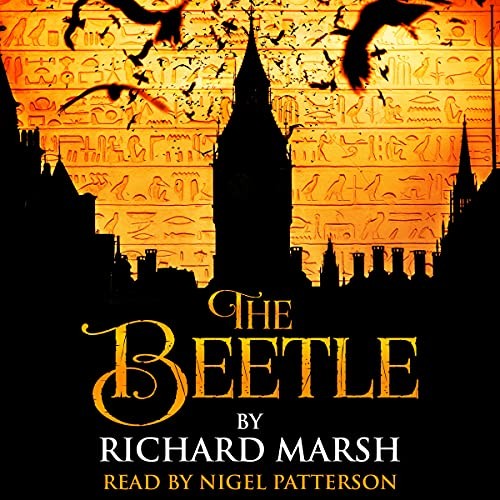
The Beetle begins with Robert Holt, unemployed and homeless, entering an open window for shelter. Inside, an ambiguously gendered foreign stranger paralyzes him through gaze and voice, then sends him naked to burglarize the home of politician Paul Lessingham. Holt's helplessness establishes the novel's central terror: the Beetle does not merely attack bodies but occupies will, speech, memory, and identity.
The narration passes from Holt to inventor Sydney Atherton, Marjorie Lindon, and investigator Augustus Champnell. Each voice changes the genre. Holt supplies nightmare testimony; Atherton brings romantic jealousy and dangerous chemical experiments; Marjorie reveals the limits placed on an independent woman; Champnell converts scattered supernatural incidents into a pursuit by cab, rail, and telegraph.
The novel's portrayals of Egypt, Arabs, gender variance, and non-Christian religion are saturated with imperial and racist fear. Those elements require direct acknowledgment rather than being excused as atmosphere. Even with that limitation, Marsh's control of escalation remains impressive. The finale refuses complete certainty: Marjorie survives the wreck, the Beetle disappears amid inexplicable residue, and the survivors can describe what happened without proving what kind of being pursued them.