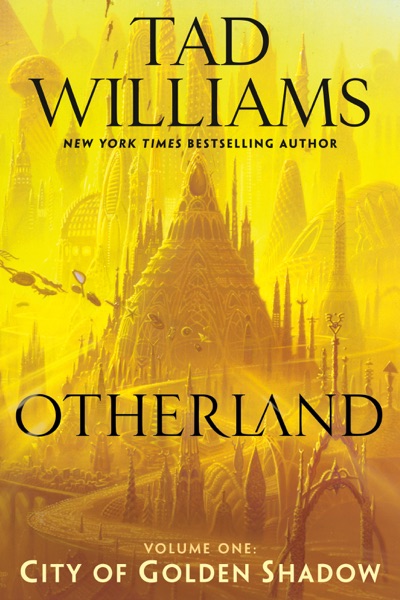
Otherland: City of Golden Shadow begins as several different novels at once: a First World War nightmare, a near-future family drama in South Africa, a military-base mystery, a fantasy game adventure and a conspiracy thriller. Tad Williams lets these stories develop independently before revealing that the same impossible golden city touches them all. The method demands patience, but it gives the eventual convergence unusual weight; the reader has lived with each character’s private crisis before those crises become one shared emergency.
Renie Sulaweyo provides the novel’s strongest emotional center. Her investigation begins because her young brother Stephen collapses after visiting a forbidden area of the Net. The technology may be futuristic, but Renie’s motives are immediate and ordinary: she is a teacher trying to support a difficult household, protect a child and understand a system designed to hide responsibility. Her friendship with !Xabbu keeps the investigation humane. He is not simply a mystical guide; his desire to preserve San memory gives the book’s questions about simulated worlds a cultural and moral dimension.
Otherland represents the concentration of imagination itself in the hands of people rich enough to own the infrastructure.
Williams’s late-twenty-first-century Net is convincing because it is both astonishing and shabby. Immersive worlds coexist with advertising, restricted access, technical failures, pornography, surveillance and unequal equipment. The wealthy can buy sensory realism, privacy and entire artificial kingdoms, while ordinary users accept inferior access and greater risk. Otherland is therefore frightening before its precise purpose is known: it represents the concentration of imagination itself in the hands of people rich enough to own the infrastructure.
The virtual settings allow the novel to move between genres without losing its central argument. Paul Jonas crosses a distorted Western Front, a chessboard war, a pulp version of Mars and a Chinese imperial romance. Orlando Gardiner encounters the golden city through a fantasy role-playing game. These episodes are visually extravagant, yet the repeated changes are not decorative detours. Each world tests whether identity survives when bodies, histories and even physical laws can be rewritten.
The cast is large, but Williams distinguishes the main viewpoints through vulnerability. Paul has almost no reliable memory. Orlando is powerful as the barbarian Thargor but gravely ill outside the game. Mister Sellars can manipulate the Net from a prison-like existence inside a ruined body. Martine is an expert user whose blindness changes how she experiences data. Even John Dread’s menace comes from the contrast between his polished electronic presence and his appetite for domination in the physical world.
The book’s greatest strength is accumulation. Small anomalies recur: children who will not wake, a fragment of impossible code, a shining city, a black mountain and a man who appears inside simulations that should be sealed. What initially looks like coincidence becomes evidence of a private network, a secretive circle of the world’s richest people and a project called the Grail. The mystery grows through partial knowledge rather than a single explanatory speech.
That structure is also the clearest limitation. Much of this long first volume is preparation. New characters continue to appear after the central danger is established, viewpoint changes sometimes interrupt urgent scenes, and the heroes do not enter Otherland together until very late. Readers expecting a self-contained adventure may find the pace slow and the ending abrupt. Several villains are still more threatening than fully understood, while the Grail project remains deliberately undefined.
The payoff is nevertheless powerful. When Renie, !Xabbu, Martine, Orlando, Fredericks and the other visitors finally meet in Temilún, the separate stories lock together without becoming simple. The Atascos are murdered, the travelers lose the ability to disconnect, and Dread infiltrates their group. The final transition into a world of giant insects is not a resolution but a declaration of scale. City of Golden Shadow is best read as the first movement of one enormous novel: imaginative, humane and unsettling, but intentionally incomplete.