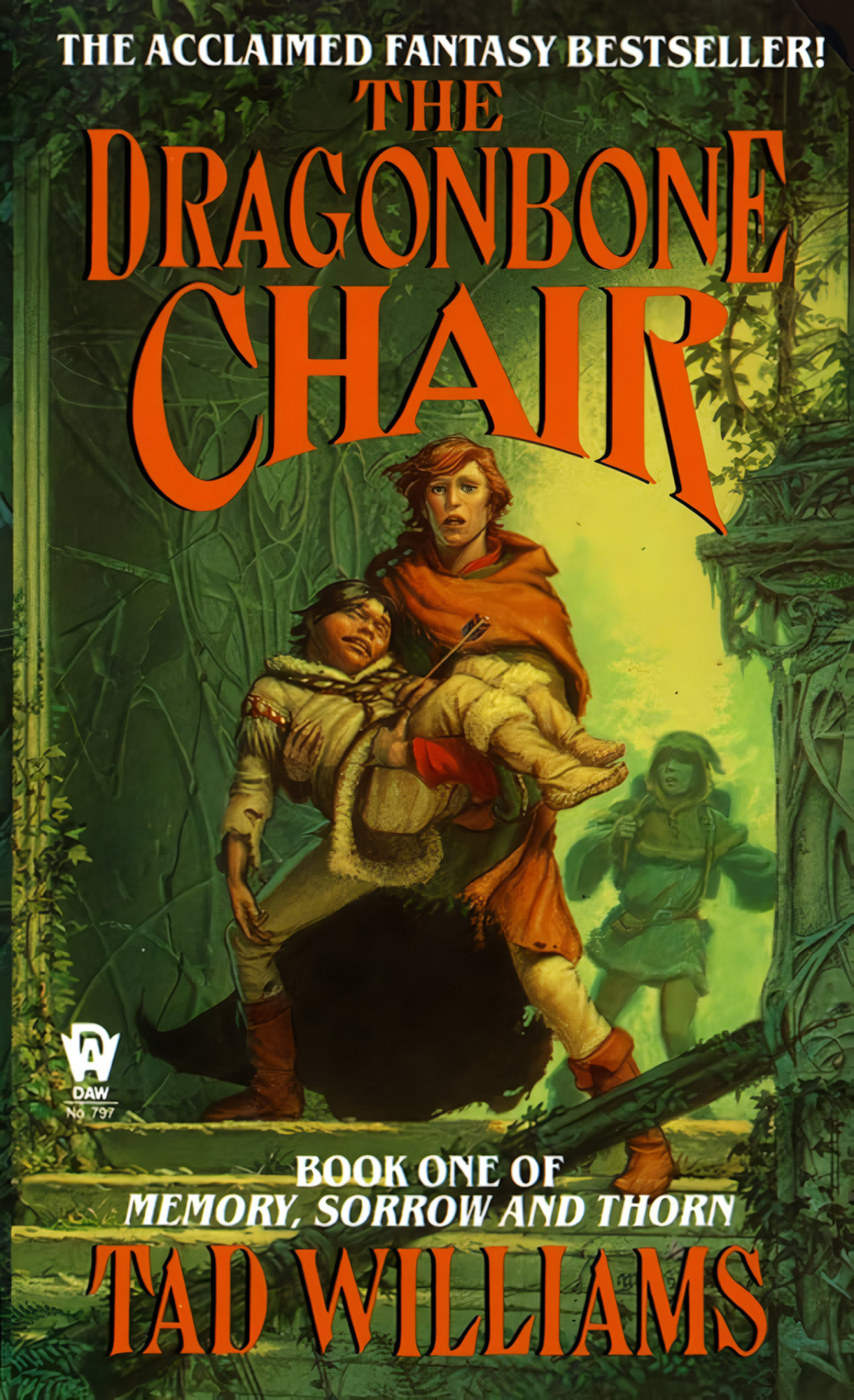
The Dragonbone Chair begins with a boy watching a beetle. That quiet opening is an honest declaration of Tad Williams's intentions. This is not a story eager to rush its kitchen boy into greatness. It wants the reader to understand Simon's chores, dreams and home before history tears all three away from him.
Simon is fourteen, awkward and frequently inattentive. He imagines himself becoming a warrior or magician but possesses none of the discipline required for either. His apprenticeship to Doctor Morgenes initially consists of reading, writing and cleaning. Williams allows him to remain immature for a long time, which makes his later endurance feel earned rather than granted by the conventions of heroic fantasy.
The Hayholt is the novel's greatest achievement. It is not simply a large castle but a structure built over the ruins of older kingdoms. Corridors, towers, burial chambers and forgotten tunnels preserve competing versions of the past. When Simon finally escapes, the reader feels the loss of a real home because Williams has spent nearly two hundred pages making its kitchens and hidden rooms familiar.
That patience is also the book's clearest weakness. The first section is extremely slow — I felt every errand, and several early chapters devote more attention to errands, stories and atmosphere than immediate plot. The middle contains long stretches of travel, while the councils at Naglimund deliver a great deal of history at once. Readers looking for constant action may find the novel difficult before Simon leaves the Hayholt.
The pace improves considerably once the danger becomes clear. Simon's flight through the ruins beneath the castle, his meeting with Binabik and the pursuit through Aldheorte turn the story into a compelling journey. Williams is especially good at making travel feel physically demanding. Hunger, cold, exhaustion and distance matter, and survival depends more often on help and persistence than swordsmanship.
Binabik gives the novel much of its warmth. He is funny and wise without becoming a simple comic guide, and his friendship with Simon develops through shared danger rather than instant loyalty. Qantaqa, his wolf companion, is equally memorable. Morgenes, Josua, Miriamele, Jarnauga and Jiriki gradually widen the story, while Pryrates provides an appropriately hateful human face for the older evil gathering around King Elias.
The central conflict is more complicated than a battle between good humans and evil immortals. The Sithi were driven from their cities by human conquest, and even Jiriki cannot dismiss Ineluki's anger as entirely unjustified. The Storm King's methods are monstrous, but the history behind his hatred prevents the past from becoming a comforting legend. Memory is dangerous because it can preserve truth, grievance or both.
Williams also resists making heroism glamorous. King John's celebrated reign contains conquest and suppression. Elias is manipulated, frightened and jealous rather than merely insane. Josua is principled but indecisive. Simon's first killing is ugly, and his encounter with the dragon leaves him scarred rather than triumphant. Old stories inspire the characters, but reality repeatedly exposes what those stories leave out.
The conclusion is exciting but deliberately incomplete. One legendary sword is recovered, Naglimund falls and Simon is transformed, yet almost every major conflict remains unresolved. The novel functions as the opening movement of a much larger work rather than a self-contained adventure.
For readers willing to accept its measured pace, The Dragonbone Chair is a deeply rewarding beginning. Its world feels old because its history continues to shape every road, ruin and political grievance. More importantly, it understands that an epic journey becomes meaningful only after the reader knows what the hero has lost.