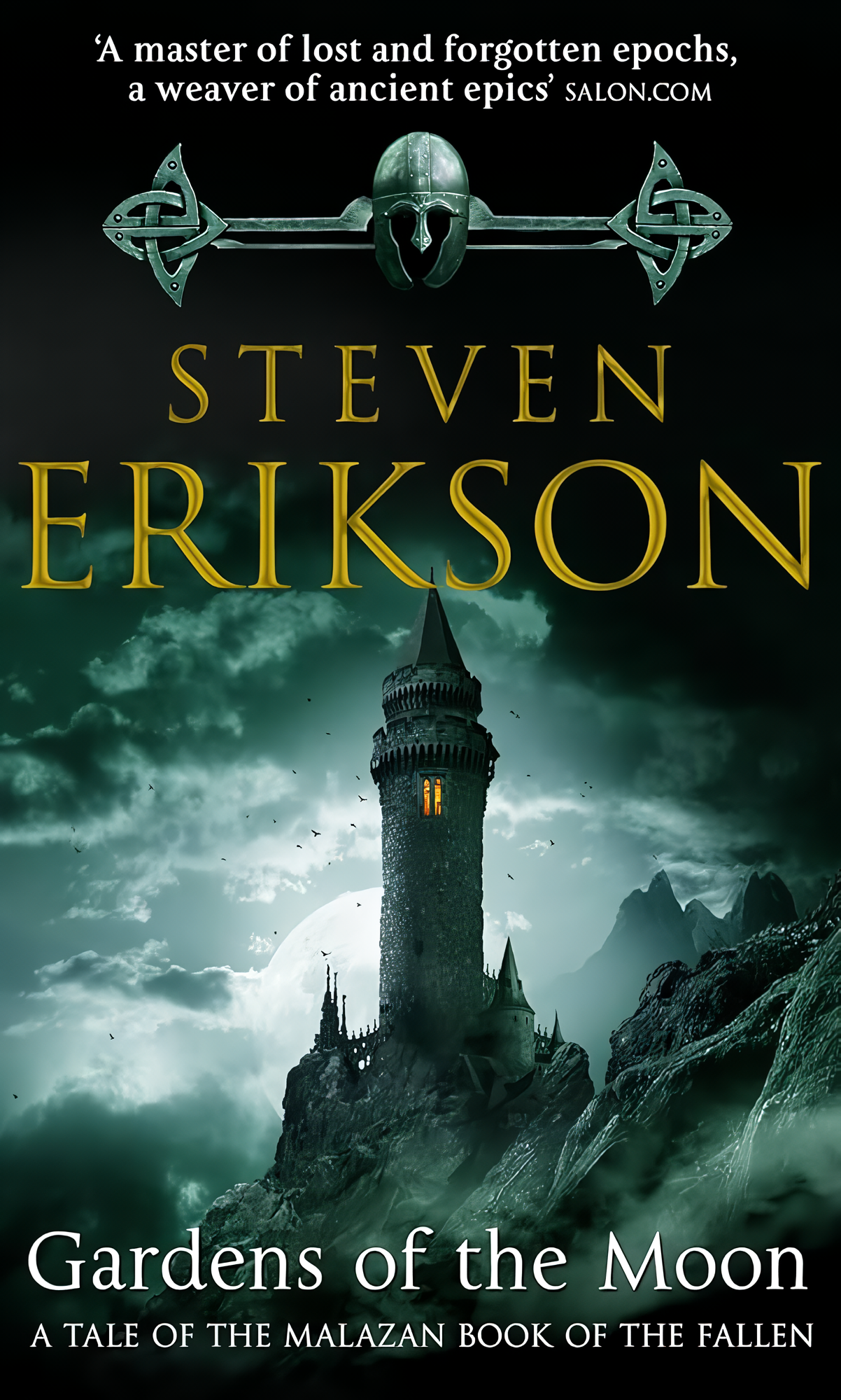
Gardens of the Moon has a reputation for being difficult, and that reputation is not entirely undeserved. Steven Erikson throws the reader into the middle of a war involving an empire, several ancient races, competing gods, assassins, sorcerers and soldiers who already understand a world that the reader does not. There is no gentle introduction and very little explanation.
That can make the opening hundred pages bewildering. Names, titles, Warrens and historical events arrive with such frequency that it is impossible to understand everything on a first reading. The best approach, I found, is to accept the confusion and concentrate on the characters and immediate conflicts. The larger picture gradually begins to form.
The novel's greatest strength is its sense of scale. The Siege of Pale establishes a world where magic can destroy armies and floating fortresses can dominate battlefields. Yet Erikson never allows the spectacle to completely overwhelm the people caught beneath it. The surviving Bridgeburners are exhausted soldiers who increasingly suspect that their own Empress wants them dead. Adjunct Lorn is both an instrument of the Empire and a woman slowly being destroyed by what that service requires.
Darujhistan provides a welcome contrast to the military storyline. The city feels ancient, colourful and lived-in, with gas-lit streets, rooftop thieves, assassins, politicians and secret mages all pursuing their own schemes. Kruppe, Crokus, Rallick Nom and Murillio initially appear disconnected from the imperial campaign, but their smaller stories eventually become essential to the survival of the city.
The Bridgeburners are the most immediately engaging part of the novel. Whiskeyjack's decency, Kalam's competence, Fiddler's nervous instincts and Quick Ben's seemingly endless collection of secrets give the book a human centre. Their loyalty is not directed blindly toward the Empire but toward one another and the soldiers who have already died.
Anomander Rake is another highlight. He could easily have been nothing more than an impossibly powerful fantasy figure, but Erikson gives him a weary sense of honour. Rake has lived for thousands of years and possesses enough power to challenge gods, yet his immortality has left him searching for causes that might still mean something.
The principal weakness is that emotional developments can feel rushed. Paran and Tattersail's relationship, for example, becomes important before it has been given enough time to develop. Several apparent deaths, transformations and revelations also arrive before the reader fully understands their significance.
The climax is intentionally chaotic. Nearly every plot converges at Lady Simtal's fête: the Bridgeburners, the Jaghut Tyrant, Lorn, Crokus, the Assassins' Guild, Darujhistan's secret rulers, Oponn and Anomander Rake. It is exciting, though some conflicts are resolved by powers that have only recently been introduced.
Despite its rough edges, Gardens of the Moon is a remarkable opening novel. It presents history as something fragmented and contested, rejects simple divisions between heroes and villains, and portrays compassion as more meaningful than power. It demands patience, but it rewards that patience with an enormous and distinctive fantasy world.