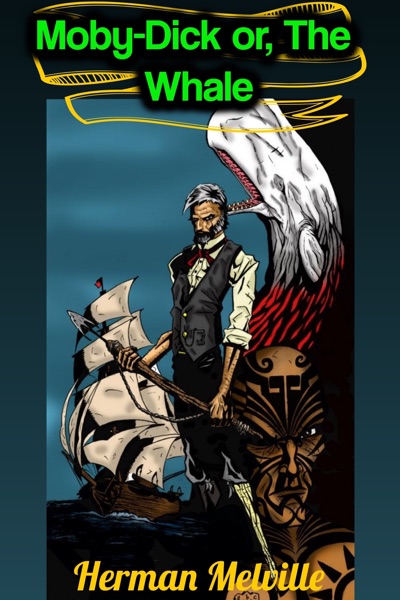
Moby-Dick is often reduced to Ahab chasing a white whale, but Ishmael's book is deliberately larger and stranger than its plot. It begins as a comic travel narrative, becomes an affectionate account of his friendship with Queequeg, and repeatedly leaves the chase to consider whale anatomy, images, law, labor, food, myth, and language. The digressions are not obstacles to the novel; they are Ishmael's attempt to build a form spacious enough for the world he survived.
Ahab supplies the forward pressure. His charisma converts private injury into collective purpose, and the gold doubloon nails desire to the mast in a form every sailor can read differently. Starbuck sees the moral and commercial madness clearly, but hierarchy, fear, profit, and Ahab's theatrical authority keep insight from becoming effective resistance.
Ahab supplies the forward pressure. His charisma converts private injury into collective purpose, and the gold doubloon nails desire to the mast in a form every sailor can read differently.
The novel's greatest counterforce is fellowship. Ishmael and Queequeg's friendship, the crew's multinational labor, the monkey-rope, and even the comic squeezing of spermaceti imagine survival as mutual dependence. Ahab instead treats every person and object as an instrument of his single interpretation, until ship, crew, compass, harpoon, and prophecy all enter the same fatal design.
The book contains racist language and nineteenth-century ethnographic assumptions even as it repeatedly attacks racial and religious prejudice. Its technical sections demand patience, but their accumulation gives the final chase extraordinary weight: the Pequod is not merely a vehicle carrying characters to an ending but an entire material and symbolic world.