The Book in Brief
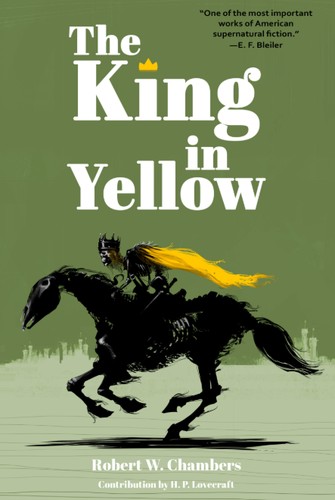
The first four stories occupy a loosely connected world haunted by a play called The King in Yellow. Reading it fractures minds or opens them to realities they cannot survive: Hildred Castaigne converts madness into a royal conspiracy, artists confront impossible transformations, an organist becomes a pursuing specter, and the Yellow Sign summons a corpse-like watchman.
The remaining pieces move through time-crossed romance, symbolic prose poems, artist garrets, the Siege of Paris, and comic or painful courtship. Recurring artistic communities provide continuity, but the book has no single plot or ending; each story closes its own emotional or supernatural argument.
Important Characters
Hildred Castaigne: The unreliable narrator of the opening story, convinced that the play reveals his royal destiny.
Mr. Wilde: The grotesque self-styled repairer of reputations who feeds Hildred's conspiracy.
Louis Castaigne: Hildred's sane cousin and rival within Hildred's imagined succession plot.
Boris Yvain: An artist whose marble-making solution transforms the emotional triangle in 'The Mask.'
Scott and Tessie: Artist and model whose possession of the Yellow Sign proves fatal.
Jeanne d'Ys: A medieval woman encountered by a modern traveler in a romance across time.
Severn, Jack, and Sylvia: The artists and abandoned woman at the center of 'The Street of the Four Winds.'
Clifford, Valentine, Selby, and Rue Barree: Figures in the later Parisian tales of art, vanity, parental pressure, and romantic refusal.
Story-by-Story Summary
The headings and sequence follow the ten stories of the complete Project Gutenberg edition.
Story 1: The Repairer of Reputations
In an imagined 1920 New York, the unreliable Hildred Castaigne believes a forbidden play has revealed his royal destiny. With the sinister Mr. Wilde, he plots against his cousin Louis until violence exposes the gulf between Hildred's grandiose narrative and reality.
Story 2: The Mask
Artist Boris Yvain's liquid turns living matter to marble, while Alec, Boris, and Genevieve are entangled by love and sacrifice. A petrified figure later returns to life, but the supernatural restoration cannot undo every emotional loss.
Story 3: In the Court of the Dragon
A Parisian churchgoer hears an organist whose music seems to pursue him beyond the sanctuary. The threatening figure finally reaches him in the church, collapsing physical escape and spiritual judgment into one nightmare.
Story 4: The Yellow Sign
Artist Scott and his model Tessie find the Yellow Sign and read the cursed play despite repeated warnings. The corpse-like church watchman comes for the sign, and both lovers die as the boundary between the play and their world breaks down.
Story 5: The Demoiselle d’Ys
Philip, lost in Brittany, enters what seems to be the medieval household of Jeanne d'Ys and falls in love with her. He wakes in his own time beside Jeanne's ancient grave, discovering that their brief romance crossed centuries.
Story 6: The Prophets’ Paradise
A sequence of symbolic prose poems stages conversations among Love, Truth, Fate, and Pierrot-like figures. Each parable turns desire or certainty into a paradox, creating an interlude rather than a conventional plotted story.
Story 7: The Street of the Four Winds
Artist Severn follows a starving cat into a Paris garret and discovers the body of Sylvia Elven, a woman tied to his friend Jack. The loyal animal remains beside Sylvia through the night, making grief and abandonment the story's final image.
Story 8: The Street of the First Shell
During the Franco-Prussian siege of Paris, American artists joke, flirt, and help their French friends under bombardment. The shelling shatters their bohemian routine, and West risks himself as the streets become a battlefield.
Story 9: The Street of Our Lady of the Fields
The American art student Clifford resists his clergyman father's attempt to pull him away from Paris and Valentine. Romantic misunderstandings resolve as the younger generation chooses affection over social and parental pressure.
Story 10: Rue Barrée
Selby and Clifford compete for the elusive Rue Barree, whose independence frustrates both men's vanity. The final Paris romance closes the collection on rejection, jealousy, and the comic limits of the artists' self-importance.
Ending Explained
Does the collection have one ending?: No. It is ten stories, not a continuous novel, and the recurring Yellow King material is concentrated in the early tales.
What is the King in Yellow?: Within the stories it is both the title of a dangerous play and a figure connected with Carcosa. Chambers deliberately withholds a systematic explanation.
Why do the final stories feel different?: The collection turns from cosmic and psychological horror toward Parisian artist life, war, and romantic comedy. That shift is part of the original book's structure, not missing material.
Themes and Motifs
Forbidden art: The play alters people who read it, making aesthetic experience physically and psychologically dangerous.
Unreliable reality: Madness, dream, haunting, and historical displacement repeatedly erase the line between perception and event.
Artists and models: The Paris stories test the selfishness, intimacy, and idealization built into artistic communities.
Loss beneath romance: Even comic courtship is shadowed by death, war, poverty, or irrecoverable time.
Content Notes
Includes suicide, murder, madness, corpses, supernatural horror, and wartime violence; period attitudes and offensive racial, ethnic, and religious stereotypes; some sexualized modeling and coercive or possessive courtship.
About the Book
Best for: readers tracing weird fiction to its roots — the Yellow Sign, Carcosa, and the play that unmakes its readers — and curious about the Parisian romances beyond them. Narrative shape: ten stories, four connected weird tales followed by prose poems and bohemian Paris. Central contrast: art as danger versus art as consolation. Overall assessment: 4/5 for the first four stories' lasting power against an uneven back half. Source-checked scope: 10 distinct reading units in Project Gutenberg eBook #8492; no front matter was counted as narrative content.
Primary text: Robert W. Chambers, The King in Yellow, Project Gutenberg eBook #8492. The complete text contains ten stories, with 'The Prophets' Paradise' counted as one unit. The review, plot account, ending analysis, and every structural recap in this guide were checked against that edition.
Selection evidence: Project Gutenberg Top 100 EBooks in the last 30 days — rank #46 with 88,155 downloads in the August 4, 2026 snapshot. Books already completed in the preceding batches were excluded.