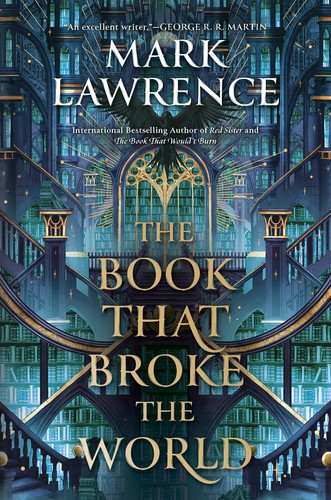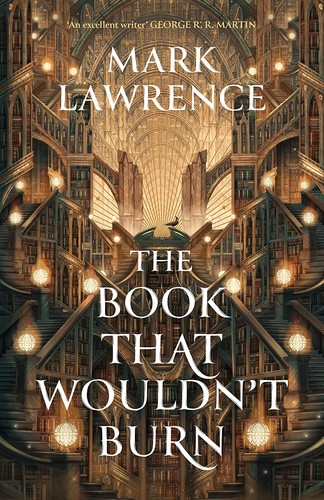
The Book in Brief
Livira, a desert child orphaned by a sabber attack, becomes a trainee librarian in Crath’s immeasurable library. Evar has grown up sealed inside one of its chambers with four Mechanism-trained siblings. A door — and the time-crossing Exchange — lets them meet, and their love uncovers the truth: Evar is canith, one of the “sabbers,” and both species are trapped in a war curated by the library’s ancient founders. As Crath falls under siege, Livira’s own book proves to be the unburnable volume Evar has always carried. She and Malar enter the machine bodies of the Assistant and the Soldier, saving lives at the cost of her human form.
Important Characters
Livira: A desert survivor who becomes a trainee librarian. Her curiosity, audacity, and refusal to accept official explanations drive the investigation.
Evar: A canith raised inside a sealed library chamber. His missing Mechanism memory and bond with Livira connect the novel’s timelines.
Malar: Human soldier scarred by the sabber attack. He protects Livira while struggling with the hatred produced by war.
Master Yute: Deputy Head Librarian and Livira’s mentor. His apparent humanity conceals a much longer history tied to the library’s creators.
Arpix: Livira’s fellow trainee and close friend. He supplies practical intelligence, emotional steadiness, and a less reckless approach to scholarship.
Clovis: Evar’s formidable sister, trained through the Mechanism for combat. Her protectiveness often appears as anger.
Kerrol: Evar’s perceptive brother. His knowledge and restraint make him the sibling most attentive to hidden motives.
Starval: One of Evar’s adopted siblings, shaped by a specialized Mechanism education and the family’s closed world.
Mayland: Evar’s brother, the Mechanism-trained historian long presumed dead, whose return proves decisive.
Yamala: Head Librarian of Crath’s library and Yute’s wife — a former Assistant who traded immortality for the power to act in the world.
The Assistant and the Soldier: Ancient machine-like servants whose surviving directives provide Livira and Malar with power at the cost of ordinary embodiment.
Prologue
A book survives an attempt to burn it. The incident establishes the novel’s central object as both physical mystery and challenge to ordinary causality: the book endures because its history does not move in a simple line.
Chapter 1
Livira’s childhood in the Dust is shattered when sabbers attack her settlement. Violence strips away the limits of her small world and begins the chain that will carry her to Crath.
Chapter 2
Livira wakes roped in a captive line and is marched east at spearpoint. Her instinct is not passive endurance but observation: she studies her captors, the landscape, and every possible route to safety.
Chapter 3
Malar and other soldiers encounter the survivors. Livira’s defiance irritates him, but her intelligence and will to live make her difficult to dismiss.
Chapter 4
The refugees travel toward Crath. Livira sees how the war has organized human society around fear of the canith, whom everyone calls sabbers.
Chapter 5
Crath overwhelms Livira with its walls, crowds, and hierarchy. The library dominates the city physically and politically, promising knowledge while restricting who may enter it.
Chapter 6
Livira finds a place among other displaced children and workers. She refuses to accept the future assigned to someone from the Dust and searches for a route into the library.
Chapter 7
Her unusual memory and problem-solving ability attract attention. The selection process for trainee librarians reveals that access to knowledge depends as much on patronage and tests as on curiosity.
Chapter 8
Master Yute examines Livira and recognizes her potential. He offers a path into the library, beginning a mentorship whose kindness will later be complicated by his secrets.
Chapter 9
Livira enters training and meets Arpix. The trainees learn rules designed to protect the collection, but Livira quickly notices that several rules also prevent questions about the library itself.
Chapter 10
The scale of the stacks becomes apparent. Routes, doors, and catalogues do not fully agree, suggesting that the institution is larger and stranger than its librarians admit.
Chapter 11
In a sealed chamber, Evar lives with four adopted siblings. Their entire world consists of the room, the books around it, and the Mechanism that has educated each of them.
Chapter 12
Evar’s siblings possess clear specialties, while his own experience in the Mechanism has left a painful absence. He senses that he learned something essential and then lost access to it.
Chapter 13
The siblings discuss escape and the dangers beyond their chamber. Clovis favors force, Kerrol caution, and Evar the uncertain hope offered by a door that should not exist.
Chapter 14
Evar approaches the mysterious doorway. Its appearance breaks the apparent permanence of his prison and creates the possibility that another person—or another time—lies beyond it.
Chapter 15
Livira advances in her training while testing the boundaries of Yute’s patience. Her willingness to enter forbidden spaces separates her from students who treat the library’s rules as natural law.
Chapter 16
She discovers inconsistencies in catalogues and historical accounts. Books preserve contradictory versions of the human–sabber conflict, undermining the certainty taught in Crath.
Chapter 17
Livira and Arpix follow clues deeper into the stacks. Their friendship grows through a balance of Livira’s recklessness and Arpix’s practical judgment.
Chapter 18
Livira opens the locked tome, speaks the Raven’s name and steps into Evar’s sealed chamber. Neither understands how the meeting is possible, but each recognizes the other as a person outside the closed story of home.
Chapter 19
Their first conversations establish differences in language, history, and assumptions about the library. Rather than retreat from the contradictions, Livira treats them as evidence.
Chapter 20
Evar hides the meetings from some of his siblings. The secrecy gives him an identity beyond the family and also increases the danger if the door is part of a trap.
Chapter 21
Livira returns to her duties carrying questions she cannot safely ask. Her experience with Evar makes official explanations of the library’s age increasingly implausible.
Chapter 22
Malar reenters Livira’s life in Crath. Their shared memory of the Dust binds them, but his military assumptions conflict with the curiosity the library has sharpened in her.
Chapter 23
Yute warns Livira about forbidden research without fully stopping her. His ambiguous protection suggests that he knows more about the anomalous doors than he will say.
Chapter 24
Evar describes the Mechanism and his siblings’ education. Livira realizes that the chamber may belong to a different period of the library rather than merely another region.
Chapter 25
The two begin using books and landmarks to compare their worlds. Small correspondences establish that the impossible meetings are structured rather than dreamlike.
Chapter 26
Livira encounters evidence of the Exchange, a process that can move people through versions of the library. The discovery turns an architectural mystery into a temporal one.
Chapter 27
Evar’s bond with Livira intensifies. His longing is inseparable from the possibility that she can explain the missing knowledge at the center of his identity.
Chapter 28
Threats within the stacks force Livira to rely on both Arpix and Malar. The library’s dangers are not incidental accidents; they are remnants of systems still carrying out ancient purposes.
Chapter 29
Livira enters the Exchange and experiences the library in another state. Familiar spaces appear altered by time, proving that the institution’s present is only one layer.
Chapter 30
She struggles to return and to communicate what she has seen. The librarians’ limited language for the event exposes how thoroughly knowledge of the Exchange has been suppressed.
Chapter 31
Evar investigates beyond the chamber and encounters evidence of beings his family fears. The outer library is both freedom and a landscape shaped by old warfare.
Chapter 32
Clovis challenges Evar’s secrecy. Her anger is rooted in protection, but it also repeats the controlling logic that keeps the siblings from choosing separate lives.
Chapter 33
Livira learns more about the assistants and soldiers that once maintained or defended the library. Their continued activity suggests that the institution is obeying commands from vanished masters.
Chapter 34
Yute’s history becomes harder to reconcile with an ordinary human lifespan. Livira begins to suspect that her mentor is not simply a scholar who discovered old secrets.
Chapter 35
Malar confronts evidence that complicates his hatred of sabbers. He does not surrender his grief, but certainty becomes harder to maintain when the enemy acquires individual faces.
Chapter 36
Livira and Evar compare stories of attack and persecution. Each culture remembers itself as the injured party, and the pair begin to see the war as a repeating system rather than a single grievance.
Chapter 37
Their affection becomes explicit. The impossible room gives them privacy from their societies, but it cannot protect them from the timelines pulling them apart.
Chapter 38
Livira studies a peculiar volume linked to Evar. Her own writing and the book’s contents begin to overlap, creating a causal puzzle with no clear first version.
Chapter 39
The Exchange’s disguise fails and Clovis attacks, exposing the truth Livira could not see: Evar and his siblings are canith, the people who destroyed her settlement.
Chapter 40
Livira reacts with anger and shock but refuses to reduce Evar to the attackers she remembers. The revelation tests whether knowledge can overcome a story written by trauma.
Chapter 41
Evar learns how humans describe the canith. He sees that Livira’s world has turned his people into monsters just as canith history has demonized humans.
Chapter 42
The pair choose to continue trusting each other. Their decision does not erase the war; it creates a small relationship that contradicts its absolute categories.
Chapter 43
The threat to Crath grows as canith forces approach. Library politics shift from scholarship toward defense, and officials treat the collection as both refuge and weapon.
Chapter 44
Livira tries to use the Exchange to understand where and when the invasion connects to Evar’s life. Each answer produces a new contradiction in the accepted chronology.
Chapter 45
Evar’s siblings divide over whether Livira represents hope or manipulation. Kerrol listens for hidden motives, while Clovis prepares to protect the family through violence.
Chapter 46
Yamala’s authority over the library becomes visible, and the distance between her office and Yute’s begins to matter.
Chapter 47
Yute admits part of his connection to the library’s origins. The mentor Livira trusted is revealed as an actor in a much older struggle, though his current loyalties remain uncertain.
Chapter 48
Livira learns of Irad, Jaspeth, and the ancient conflict associated with Yute and Yamala. The human–canith war appears increasingly like the afterlife of choices made by powerful predecessors.
Chapter 49
Malar must choose between military obedience and Livira’s plan. His decision to continue with her reflects loyalty to a person rather than to the abstractions that have governed his life.
Chapter 50
Evar confronts the limits of the Mechanism’s gifts. Specialized knowledge has made his siblings capable but has also deprived them of the freedom to form themselves through ordinary experience.
Chapter 51
Livira discovers that copies of the strange book can occupy different points in the library’s history. The volume’s survival depends on information passing around a loop.
Chapter 52
Her writing becomes part of that loop. The book Evar knows is not merely an artifact she finds; it is a message she is in the process of creating for him.
Chapter 53
The invasion and the library’s internal conflict converge. Livira can no longer treat research and battle as separate problems because control of history is shaping who will be killed.
Chapter 54
Evar ventures farther from the chamber and faces creatures associated with the library’s old defenses. The threat called the skeer demonstrates that not every danger belongs neatly to humans or canith.
Chapter 55
Clovis and Kerrol follow, bringing their specialized abilities into the open. Family cooperation becomes possible only after they accept that Evar’s choices cannot be fully controlled.
Chapter 56
Livira and Malar approach the ancient Assistant and Soldier. The machines offer a means to intervene across the library, but using them risks replacing their bodies with inherited functions.
Chapter 57
The crisis at Crath forces Livira to act before she understands every consequence. Her willingness to enter the Assistant turns intellectual curiosity into a bodily commitment.
Chapter 58
Malar enters or bonds with the Soldier. The role gives him power shaped by warfare, challenging him to use a weapon without becoming nothing more than its directive.
Chapter 59
Inside the ancient forms, Livira and Malar perceive the library differently. Doors, timelines, and commands appear as parts of a system still trying to complete unfinished orders.
Chapter 60
Yamala’s own history surfaces: she was once an Assistant, and gave up immortality for the power to act.
Chapter 61
Mayland confronts Yamala. The younger character refuses to remain a tool within the older conflict and kills her, breaking one line of control.
Chapter 62
The death disrupts but does not erase the machinery Yamala set in motion. The siege and the threats surrounding Evar continue because systems can survive their architects.
Chapter 63
Livira uses the Assistant to help save people during the attack. Her intervention demonstrates the value of the old technology while accelerating the loss of her ordinary physical existence.
Chapter 64
Malar acts through the Soldier to protect Livira and others. His choices begin to separate defense from the indiscriminate hatred he carried from the Dust.
Chapter 65
The book’s multiple versions move toward one another. Text, memory, and object converge, showing that the supposedly unburnable volume survives because its history is shared across time.
Chapter 66
Livira writes a warning or message into the book for Evar. The act transforms authorship into physical contact across absence: she cannot reach him directly, but her words can.
Chapter 67
The Assistant is damaged, and Livira loses the stable body through which she has acted. Her survival becomes uncertain, distributed between machine, library, and the message she leaves.
Chapter 68
Evar finds the broken Assistant and Soldier. He sees evidence of Livira’s actions but cannot perceive her remaining presence, turning their near reunion into another separation.
Chapter 69
Evar returns to find the skeer have all but destroyed the Assistant and the Soldier; Clovis and Kerrol arrive, and the siblings follow the skeer’s route out.
Chapter 70
Evar and his siblings prepare to follow the book’s trail and discover what happened to Livira. Unseen by him, Livira and Malar persist in altered form. The ending closes the causal loop around the book while opening the larger search that will drive the trilogy.
Ending Explained
The book cannot burn because it is a loop: Livira writes the volume Evar has always carried, and its copies converge across the Exchange until no single version can be destroyed. She and Evar never lived at the same time — the library overlapped their eras through the door and the Exchange. Evar and his siblings are canith, the “sabbers” of Livira’s childhood horror, and Yute and Yamala are surviving instruments of the library’s founding quarrel between Irad and Jaspeth. Livira is not simply dead: when the Assistant is damaged she loses her body, not her presence, and Evar leaves with her marked book, unable yet to see that she remains beside him.
Themes and Analysis
Knowledge Without Wisdom. The library contains vast information, yet its people continue inherited wars. Preservation alone cannot produce moral understanding.
History as a Weapon. Humans and canith each possess a record of victimhood. Partial archives make retaliation feel like justice.
Institutions and Forgotten Commands. The library’s servants and hierarchies continue purposes established by absent creators. Old intentions become dangerous when no one can question them.
Reading as Relationship. Livira and Evar know one another through stories, comparison, and eventually the book itself. Reading becomes a way of recognizing a person whom history labels an enemy.
Identity Beyond Assigned Function. Trainee, soldier, librarian, sabber, Assistant, and Mechanism-trained specialist are roles that promise purpose while narrowing choice. The characters’ growth depends on using skills without becoming reducible to them.
Cycles, Copies, and Causality. The book’s structure resists a single origin. Meaning is produced through repetition with difference, just as history can either repeat violence or revise it.
Content Notes
This book contains mass violence, child endangerment, war and siege, dehumanizing prejudice, captivity, grief and the loss or transformation of bodies.