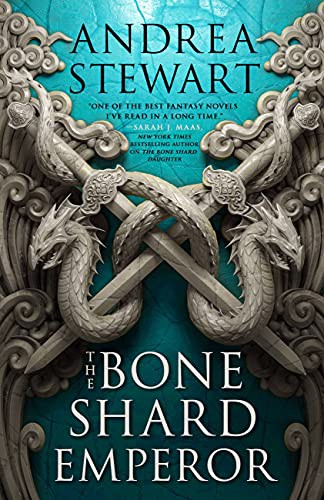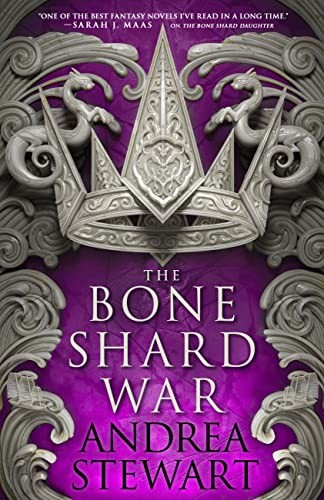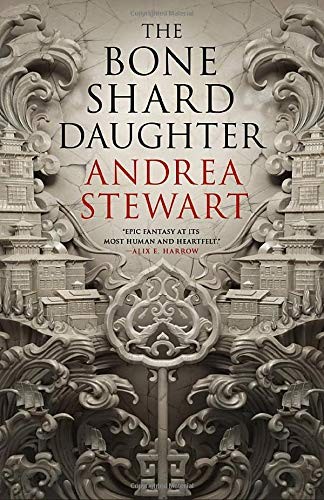
The Book in Brief
Emperor Shiyen rules the Phoenix Empire through constructs animated by bone shards cut from children. His daughter Lin, her memory largely erased by illness, competes with the foster son Bayan for the keys to the palace’s sealed rooms and the knowledge that will make her heir. Meanwhile the smuggler Jovis searches for his vanished wife Emahla, is hired to smuggle one child out of Deerhead’s Tithing Festival as the island sinks, becomes a folk hero through the tithing rescues that follow, and bonds with the growing creature Mephi. Lin steals her father’s keys, learns the shard commands, and discovers that the real Lin died as a child — she is a replica of Nisong, the emperor’s dead wife. Shiyen falls to his own machinery, and Lin takes the throne.
Important Characters
Lin Sukai: The emperor’s apparent daughter, whose investigation of the palace becomes an investigation of her own manufactured identity.
Jovis: A smuggler searching for his abducted wife who becomes famous for rescuing children from the bone-shard tithe.
Mephi: Jovis’s bonded ossalen companion, whose developing speech and power reveal that the empire’s old legends are incomplete.
Emperor Shiyen: A ruler who treats people, memories, and bodies as components in an imperial machine.
Bayan: Lin’s foster brother and rival for the succession, also trapped inside Shiyen’s experiments.
Phalue and Ranami: A governor’s daughter and her common-born partner, divided by privilege but drawn into the Shardless Few rebellion.
Sand / Nisong: A woman on Maila whose recovered memories expose the emperor’s replication program.
The Palace and the Smuggler
Chapter 1
Lin passes another of her father’s memory tests and is rewarded with a single key, reinforcing his control through access.
Chapter 2
Jovis’s search for Emahla brings him to Deerhead Island as signs of an approaching sinking appear.
Chapter 3
Jovis rescues a child during the evacuation and acquires the small creature he later names Mephi.
Chapter 4
Lin begins copying keys instead of waiting for her father to reward obedience.
Chapter 5
Phalue’s comfortable assumptions collide with Ranami’s account of hunger and imperial extraction.
Chapter 6
Sand’s repetitive life on Maila is disrupted when an injury weakens the fog surrounding her memories.
Chapter 7
Jovis’s rescues create a public legend that is useful to rebels and dangerous to the man inside it.
Chapter 8
Lin enters a forbidden room and learns that bone-shard commands can be altered rather than merely memorized.
Chapter 9
Mephi’s intelligence becomes impossible to dismiss as ordinary animal behavior.
Chapter 10
Ranami introduces Phalue to Gio and asks her to risk status rather than offer private sympathy.
Chapter 11
The emperor uses Bayan’s progress to keep Lin anxious, competitive, and dependent.
Chapter 12
Adrift in the Endless Sea with Mephi, Jovis passes wreckage that recalls the drowning of Deerhead Island.
Keys, Rebels, and Blue Sails
Chapter 13
Lin recruits the blacksmith Numeen to duplicate a key and gives him only part of the truth.
Chapter 14
Jovis follows reports of a blue-sailed ship while the Shardless Few try to recruit his reputation.
Chapter 15
Sand persuades another islander to test the limits of their supposedly ordinary existence.
Chapter 16
Phalue agrees to help the rebels but still believes she can preserve both her father’s power and Ranami’s trust.
Chapter 17
Lin steals a book of commands and starts subverting the major constructs that administer the empire.
Chapter 18
Lin’s dealings with the blacksmith Numeen deepen, and the risk she is running for his family becomes plain.
Chapter 19
Jovis and Mephi survive another rescue, and their physical bond becomes a source of power.
Chapter 20
Ranami pushes the Nephilanu plan from discussion toward action despite Phalue’s hesitation.
Chapter 21
Lin finds the record stating that Lin Sukai died at three years old.
Chapter 22
Bayan’s own uncertainty makes him more ally than rival, though neither heir can yet trust the other fully.
Chapter 23
Sand recovers fragments belonging to a life beyond Maila and suspects that her identity was imposed.
Chapter 24
Jovis learns that the blue-sailed ship travels toward Maila, a destination from which no one returns.
Chapter 25
The Nephilanu uprising begins, forcing Phalue to decide whether love can survive continued neutrality.
The Emperor’s Design
Chapter 26
Phalue turns against her father’s rule and helps the Shardless Few seize the island government.
Chapter 27
Jovis accepts rebel support while recognizing that Gio values his legend more than his private grief.
Chapter 28
Lin takes control of another governing construct and quietly reduces her father’s reach.
Chapter 29
The emperor explains enough of his replication work to make Lin fear what she will find beneath the palace.
Chapter 30
Bayan’s failing health suggests that Shiyen’s experiments consume heirs as readily as common subjects.
Chapter 31
Sand organizes the Maila residents around the possibility that the blue-sailed ship is their jailer.
Chapter 32
Jovis chooses to continue saving children even after evidence makes Emahla’s survival unlikely.
Chapter 33
Lin discovers that her memories, face, and presumed childhood were assembled from Nisong’s pattern.
Chapter 34
Phalue sits in on the Shardless Few’s planning under Gio and begins to see exactly what the rebellion means to ask of Nephilanu — and of her.
Chapter 35
Ranami presses Phalue to act against her own father, and the demand to betray both governor and family pushes their romance toward its breaking point.
Chapter 36
The Maila group prepares an ambush for the ship that maintains their captivity.
Chapter 37
Lin and Bayan make common cause against Shiyen, accepting that only one of them may survive it.
Chapter 38
The palace constructs receive conflicting commands as the emperor’s closed system begins turning inward.
Inheritance and Escape
Chapter 39
Lin reaches the emperor’s hidden laboratories and sees the bodily cost of his search for continuity.
Chapter 40
Bayan opposes Shiyen openly, giving Lin the time she needs to reverse the construct hierarchy.
Chapter 41
The confrontation kills Bayan and ends the competition that defined both heirs’ lives.
Chapter 42
Lin uses Nisong’s construct and her stolen knowledge to kill the emperor.
Chapter 43
Beneath the palace, Lin frees Thrana and recognizes the creature as kin to Mephi.
Chapter 44
The fog over Maila breaks with Shiyen’s death, restoring memories the replicas were never meant to possess.
Chapter 45
Sand claims Nisong’s name without surrendering the separate self she built in captivity.
Chapter 46
The Maila survivors seize supplies and sail toward an empire that does not know they exist.
Chapter 47
Jovis reaches Imperial Island and meets Lin while both are deciding what the emperor’s fall means.
Chapter 48
Lin offers Jovis a place in a reformed regime, and he accepts without giving the new ruler unconditional trust.
Chapter 49
Jovis sees Emahla’s eyes in Lin’s face, turning the apparent ending of his search into the trilogy’s next mystery.
Ending Explained
Lin wins the palace but cannot inherit Shiyen’s legitimacy: she is a made person built to Nisong’s pattern, so her claim has to rest on what she changes rather than on blood or memory. Sand’s decision to keep the name Nisong poses the same question from the other side — both women carry imposed material, and neither is reducible to the woman the emperor was trying to resurrect. And the resemblance between Lin and Emahla ties Jovis’s private search to the imperial experiments, making his service to the new emperor morally unstable: the woman offering him a future may be evidence about the woman he has spent seven years trying to find.
Themes and Analysis
Personhood and manufacture. The novel insists that origin does not cancel agency; created beings still make morally meaningful choices.
Empire as extraction. Bone-shard magic literalizes a state that converts citizens’ bodies and futures into administrative power.
Privilege and recognition. Phalue must learn that good intentions do not erase benefits produced by coercion.
Memory and identity. Lost, copied, and recovered memories raise the question of whether identity lies in history, body, or action.
Content Notes
This book contains child endangerment and forced medical procedures, body horror involving bones and animal constructs, mass death during island disasters, political violence, imprisonment and family death.