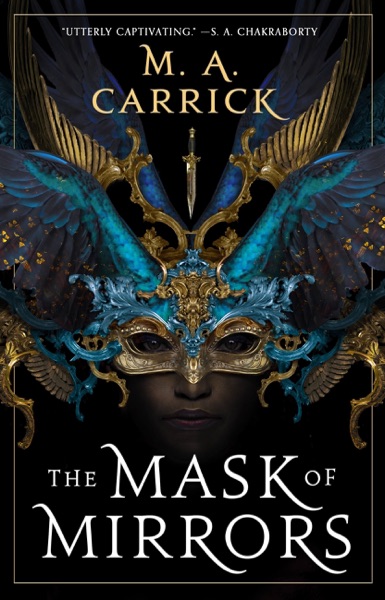
The Mask of Mirrors runs a con, a murder investigation, a narcotics plot and a dream-magic catastrophe through one city — and slowly reveals they were always the same design. Ren, a street-raised swindler, walks into House Traementis as the invented Alta Renata Viraudax and starts stealing an inheritance from a family that has nothing left but its name.
Every successful lie makes the family Ren is robbing feel more like the home she has never had.
What gives the machinery its heart is how badly the con works on its own architect. Every successful lie makes the family Ren is robbing feel more like the home she has never had, and Donaia, Leato and Giuna stop being marks somewhere around the point Ren stops noticing.
Nadežra is the real achievement. Its colonial politics, dueling magical traditions, masked festivals, policing and underworld all drive the plot instead of decorating it; Grey Serrado and Derossi Vargo are two different routes through the same rigged city, one wearing a badge and one running the docks. And a third figure in a hood keeps complicating both.
The first third is a steep climb — Vraszenian and Liganti vocabulary, four social registers, a pattern-deck cosmology — and readers who want momentum early will feel it.
Stay with it. By the riot and the Wellspring finale, every apparently idle social encounter has quietly become an alliance, a betrayal or a motive, and the last page lands a personal revelation that turns the trilogy’s strongest partnership into its most dangerous fault line.