How the book is structured
Empire of the Dawn picks up where Empire of the Damned left off. Gabriel de León — the Black Lion, the last silversaint of San Michon, now a sanctus-wrecked ghost of the man he once was — believes Dior Lachance was slaughtered in the snow at Dún Maergenn. He is still imprisoned at the vampire fortress now named as Sul Adair, still dictating his life story to the Empress's historian Marquis Jean-François of the Blood Chastain. In a separate cell across the river, his half-sister Celene Castia, the last of the Esani bloodline and known publicly as the masked killer Liathe, is dictating a parallel history of her own.
What the reader does not yet know — and what Jean-François slowly stops failing to notice — is that both confessions are partly performance. The third book brings the framing device fully into the foreground and then dismantles it.
The novel runs around 800 pages and uses the same shape as its predecessors: an opening section called "Sunset," a sequence of numbered Books with Roman-numeral chapters, and an Epilogue called "Dawn." The walk below follows the book's own chapter titles in order, but does not reproduce its Book and chapter numbering, which we have not been able to verify against a copy. The narrative now folds three timelines into each other almost continuously: the frame (the cells at Sul Adair), the recent past (the events after Maergenn — the road south, the siege of Augustin, the slaughter at Charbourg), and a thinner layer of deep past that finally fills in the Esani backstory the first two books were holding back.
Important Characters
Gabriel de León: The last silversaint, spinning out his confession while the Priorem gathers above the dungeons to rule on his death. In the history he narrates, he reforges Ashdrinker, sinks into the sangirè madness of his father's line, kills the Forever King, and drains Dior in the rubble; in truth, the whole telling is a stall he and Celene designed to lure every bloodline's eldest into one killable room.
Dior Lachance: The Redeemer's heir, risen from her shroud three days after Maergenn and carried by sea toward besieged Augustin and a prophecy-driven royal marriage. Revealed at the last as a duskdancer of the Moonsthrone royal line, she has been the moth slipping between the cells all along, and in the finale she takes her great white-wolf shape and destroys the gathered Priorem, the Empress first.
Celene Castia: The last Esani, dictating a rival history from her own cell and playing Gabriel's bitterest enemy, a hatred the ending exposes as theater the siblings agreed on months before. She schools Dior in sanguimancy at sea, fastens her teeth in Fabién Voss's weakened throat as Gabriel strikes the killing blow, and in the epilogue holds her bare hand out into the first true daylight.
Jean-François: The Chastain historian, increasingly unsettled as the siblings' accounts diverge and the transcribed griefs pile up. He records his own doom without knowing it; when the Moonsthrone army storms Sul Adair he flees as a hundred rats, is caught and reassembled, and finishes the trilogy locked in Celene's old cell, told he is now the prisoner who writes the history.
Fabién Voss: The Forever King, unveiled as the maker of Daysdeath, sustained through five obsidian fissures fed by the blood of each line's eldest. At San Maximille he shatters Gabriel by producing the living, turned Patience and offering alliance against Maryn's ritual; at Charbourg he tries to remake Gabriel as a Redeemer he can control, and dies with Ashdrinker through his heart.
Maryn: The child-bodied ancien whispering constantly in Dior's ear, steering her toward Augustin, the Fivefold Throne, and marriage to an imperial prince. Her ritual would not cure Daysdeath but trigger the Day of Judgement and the death of everything alive, and she is destroyed on the cathedral steps by a blade dipped in the Grail's blood and Dior's own sanguimancy.
Patience: Gabriel's daughter, whose death he narrated falsely for years because the truth was leverage in Voss's hands: the Forever King took her as an infant and turned her. In the told history she greets her father at San Maximille as a Princess of Forever and is burned away in his arms at Charbourg, though the final reveal counts her resurrection among the confession's inventions.
Phoebe á Dúnnsair: The duskdancer huntress who finds Gabriel on the march, convinces him Dior is alive, shares his bed, and then steals Ashdrinker in the night to carry the prophesied blade to Augustin. Enthralled by Maryn on arrival and freed by the ancien's death, she holds the cathedral steps through the slaughter, outlives her reported death, and rides out beside Gabriel at dusk.
Aaron de Coste: A freshly turned coldblood whose own aegis tattoos sear him from the inside and whose touch burns the husband he loves. He rips Ilon apart in the forge fight, wrestles Gabriel's thirst down on the road south, and is reported dying beside Baptiste on a single Voss spear, a heartbreak the ending quietly hands back to the living.
Baptiste Sa-Ismael: The one wholly human member of Gabriel's band, steady on the ride south while his marriage scorches him at every touch of his turned husband. Reported impaled alongside Aaron at Charbourg, he walks through the conclave doors alive with the Moonsthrone host in the finale.
Lachlan á Craeg: Highland silversaint and Phoebe's brother-in-law, the band's unwanted jester on the grim ride south. He falls for Charlotte de León at first meeting, is handfasted to her after the forge battle, stands with her against the Iron Maiden at Augustin, and proves in the finale to be alive and only lightly wounded.
Charlotte de León: Gabriel's cousin, the rider who saves the band at the pass into León country and inherits the barony when her freed grandfather dies of grief. She raises a León host for Augustin, is reported dead in the last stand with Lachlan, then reappears healing; in the epilogue she is pregnant and asks Gabriel to stand godfather.
Reyne á Maergenn: The princess of Maergenn who sails aboard the Dawnseeker at Dior's side and kisses her in the rigging after the sea battle, the tenderest thread in the book. She is killed at Augustin by the Iron Maiden, Kestrel Voss, a loss that tips Dior into her first change of shape, and hers is one of the few deaths the final reveal leaves standing.
Joaquin Marenn: An Unbound soldier who covers Gabriel's crawl beneath Augustin by drawing off a Voss patrol, then slips out of the narrated tale. He has been inside Sul Adair for the entire frame, wearing the face of the thrall Dario, ferrying meals to the cells and messages for the conspiracy.
Sunset
The opening reestablishes the cell. Jean-François at his writing desk, Gabriel pacing his cage, sanctus smoke drifting through the bars. The new pressure is that Margot Chastain's patience has finally run out — the Priorem, the council of the eldest of the five remaining bloodlines, is convening above the dungeons to formally rule on Gabriel's execution. In three short sub-sections that toggle between his cell and Celene's, Gabriel agrees to finish the story: the rest of Dior's road, the Battle of Augustin, the bloodbath at the Charbourg, and the betrayal that ended everything. That four-item list is, almost literally, the skeleton of the rest of the novel.
After Dior's funeral at Dún Maergenn, Gabriel rides south through a Highland blizzard with the newly turned coldblood Aaron de Coste — whose silver Aegis tattoos now burn him from the inside — his husband Baptiste Sa-Ismael (the only fully human member of the band), and Lachlan á Craeg, a Highland silversaint and Phoebe's brother-in-law. They carry three vials of Dior's blood and the shattered Ashdrinker. Gabriel intends to find Fabién Voss and die killing him. In a parallel timeline three days after the massacre, Celene narrates a very different scene: Dior opens her eyes in the cold-room at Maergenn. The Book closes on the deliberate Gospel echo, She is risen.
Parting Gifts
In the cell, Jean-François confirms that the Empress's mercy has expired; in the past, Gabriel says goodbye to a snowbound Maergenn, accepts Aaron's silver and Baptiste's saddlebags, and rides out with men he is certain will die because of him.
Heroes
The four ride south through Highland country still smoldering from the war with Blood Dyvok. Gabriel admits to himself that sanctus is no longer holding the thirst back. The chapter's title is bitterly ironic: Aaron's skin smokes in stray patches of sun, Lachlan keeps cracking jokes nobody wants, and Gabriel is unraveling.
Splintering
(two parts). Gabriel tells the others where they're really going: the Barony of León, his mother's people, to have Ashdrinker reforged at the family's silver-forge. The title refers both to the cracks running through the blade and to the cracks running through him.
The Damsel of Lionsmouth
The band reaches the high pass into León territory and is jumped by a starving wretched-pack. They are rescued by a mounted rider in León colors who turns out to be Charlotte de León, Gabriel's cousin and heir-presumptive to the barony. Charlotte's instant chemistry with Lachlan sets up later devastation.
She Is Risen
(two parts, Celene's POV). Three days after the funeral, Celene watches Dior's heart restart inside her own burial shroud. Maryn — the child-bodied Esani ancien, the so-called Mother of Monsters — explains that Dior is the prophesied child of the Redeemer, that she must be brought to the imperial capital of Augustin, and that she must "sit the Fivefold Throne with the Redeemer's Blade in hand" to end Daysdeath. Phoebe á Dúnnsair, Princess Reyne á Maergenn, and the freed Unbound all swear to Dior.
To the Dawn
(two parts). In the cell, Jean-François starts asking Celene the obvious questions about the resurrection; she is openly contemptuous of him. In the past, the survivors board the war-galley Dawnseeker and ride the cold currents south. Dior, raw and half-dead-still, stares at the horizon and asks Celene when she'll see Gabriel again.
Book Two splits cleanly into the two parallel journeys that drive the rest of the novel — Gabriel overland to the Barony of León to reforge his sword, Dior by sea aboard the Dawnseeker toward besieged Augustin. The structural conceit Kristoff has been hiding behind for two books begins to crack: Celene's account and Gabriel's start contradicting each other in small ways that Jean-François can't yet make sense of.
A Legend Living
Gabriel rides into a León countryside emptier than memory — half the villages abandoned, half flying his grandfather's banner with a strange new device sewn over the lion. Lachlan and Charlotte are openly inseparable now.
A Thousand Tons of Truth
(three parts). By the firelight, Aaron confesses the full scope of his coldblood thirst to Baptiste, who weeps because he is burned every time they touch. The chapter's title also refers to the truth Gabriel won't face yet: the sangirè madness that destroyed his father is taking him.
Patience
The title is the name of Gabriel's murdered infant daughter, whom he uses as a rosary against the thirst — Patience, coldblood. By the end of the book that phrase will mean something else entirely.
Unforgiven
(two parts, Celene POV). On the Dawnseeker, Celene starts drilling Dior in sanguimancy. She also tells the story of her own turning — by Laure Voss, during the burning of her childhood village, the night Gabriel ran. Her version of the Worst Day. Jean-François notices that her account doesn't match what Gabriel told him in book one.
Into the Dawn
(Celene POV). A storm at sea, a failed Voss raid on the galley, and Dior using her holy blood as a weapon for the first time — searing a coldblood boarder to ash. Up in the rigging afterward, Princess Reyne kisses Dior. Their love story is the purest thing in the trilogy until Maryn poisons it.
The stretch most reviewers call the saggy middle. Gabriel reaches his ancestral seat of León and discovers that his grandfather the Baron has been enthralled for years by something older and worse than Fabién Voss. Dior reaches Augustin and walks into the cobweb politics of the imperial court. Each protagonist enters what should be sanctuary and finds a vampire hidden inside the walls.
To the Abyss
(two parts). Charlotte rides them through the city gate. The household greets Gabriel as the prodigal returned. Within hours he notices that none of the servants will meet anyone's eye and that Baron Gerrard de León smells of grave.
Closer to God
(two parts, Celene POV). The Dawnseeker docks at Augustin. Dior is presented at the court of Empress Isabella; the Empress recognizes something in her that the court does not. Maryn whispers in Dior's ear constantly.
The Price
(two parts). Gabriel and Aaron prowl the cellars beneath León keep and find recently used blood-troughs. The Baron's seneschal slips a knife into Lachlan and dies for it.
New Eyes
(frame). Jean-François, increasingly rattled, confronts Gabriel about the inconsistencies between his account and Celene's. Sanctus-stoned, Gabriel only laughs at him.
The Province of Fools
(Celene POV). Dior is paraded through the besieged streets in front of a starving population. The mob's adoration begins to mutate into something Maryn can steer.
Fourth Dawn
(three parts, deep past). Celene tells Jean-François, for the first time, of Wulfric — the previous head of the Esani, her teacher, and (per Esani records Celene has read but Gabriel has not) Gabriel's biological father. These flashbacks are the closest the trilogy comes to giving Gabriel a paternal origin story.
Into the Lion's Den
(two parts). Gabriel confronts Baron Gerrard alone in his chambers and discovers that the Baron has been enthralled for decades by Ilon, the Father of Whispers — the eldest of the Blood Ilon line, hidden inside the de León family forge like a spider in a hearth.
Forgefire
(two parts). The fight in the forge is one of the trilogy's marquee set pieces. Aaron uses his vampire strength in earnest for the first time and is horrified by how good it feels. Ilon is dismembered and incinerated in the silver-furnace; Baron Gerrard, freed of the thrall, dies of grief within the hour. Charlotte becomes Baroness of León, and Ashdrinker is finally rewelded and reblooded.
Blood Is Blood
(two parts). Charlotte's first decree as Baroness is to raise a León host and ride south to Augustin with Gabriel. She and Lachlan announce their handfasting.
The Offering
(two parts, Celene POV). At court, the imperial astrologer reads the Redeemer's prophecy aloud and concludes that the Grail will only set the world aright if she is married to a son of the imperial line — i.e. Prince Philippe de Augustin. Maryn beams.
Mysterious Ways
(frame). A bitter exchange between Gabriel and Jean-François about whether the God of Light ever existed. By book three Gabriel's catch-all theological epithet is purely sarcastic.
Fallen Angels
(two parts). The León column rides south. Aaron and Baptiste have what they both think is a reconciliation. Sangirè is hammering harder on Gabriel; he drinks from a Voss thrall on the road and Aaron has to hold him down to make him stop.
Deep Enough to Drown In
Phoebe á Dúnnsair, the duskdancer Highland huntress, catches up to Gabriel on the road and tells him what he had refused to believe — Dior is alive in Augustin. She begs him to bring Ashdrinker, which she now suspects is the prophesied Redeemer's Blade. Gabriel refuses; he means to take Voss's head first. There is a long, raw sex scene that Kristoff and Jean-François argue about, on the page, in a meta-aside that lands somewhere between fan service and self-mockery.
Father of Whispers
(three parts, deep past). Cut against Phoebe's intervention, Celene tells Jean-François the long story of how Wulfric raised her in the Esani crypts after the burning of her village — and how she came to believe she was Wulfric's daughter, only to find out she is in fact Gabriel's full half-sister by their mother and her curse.
In Nothingness
(four parts). Phoebe steals Ashdrinker from beside the sleeping Gabriel in the smallest hours and rides for Augustin. Gabriel wakes, finds the sword gone, swears bloody murder, and rides on toward Voss anyway. In Augustin, Maryn — sensing what is coming — begins to enthrall Phoebe the moment she arrives in the city.
Where the novel detonates its midpoint bomb. Gabriel's army catches up with Fabién Voss in the ruined town of San Maximille. Voss does not fight him. He opens a litter and produces a girl in white silk — Gabriel's daughter, Patience, not dead at all but turned coldblood and raised as a Princess of Forever in Voss's court. It is the worst gut-punch since the original Worst Day, and it shatters everything Gabriel thought he was riding for.
The Heart of the Matter
(three parts). The León army deploys before San Maximille in the grey false-dawn. Voss rides out under a parley banner and produces Patience. Gabriel falls off his horse.
Every Day and Not Enough
Inside the Voss pavilion, Patience kisses her father on both cheeks and calls him Papa in a voice he half-remembers. Voss explains the Esani prophecy as the Esani themselves understood it: the breaking of Daysdeath is not Daysdeath ended but the Day of Judgement triggered — the end of the mortal world so that the damned souls of vampires might plead their case before God instead of burning automatically in Hell. Voss, as the Redeemer's mortal half-brother and therefore already promised damnation either way, opposes the plan and proposes an alliance with Gabriel.
One Last Day As a Lion
Gabriel cannot fight a war on Voss's side and cannot fight one against his own daughter. Lachlan and Charlotte refuse to bend the León host to the King of the Dead, so Gabriel sends them away with the column. Quietly, he palms Charlotte a folded letter and tells her to read it only after she has crossed the river — a moment whose meaning only becomes clear much later.
A Saint Godless
(three parts). Aaron, Baptiste, and the Unbound soldier Joaquin Marenn stay with Gabriel. With a Voss honor-guard, they ride for Augustin via the pumpworks tunnels under the city — Voss's plan being to slip Gabriel in before Maryn can complete her ritual.
Come the Blood-Red Dawn
(Celene POV). In Augustin, Maryn presents the now-enthralled Phoebe to Dior and tells her that Gabriel has gone over to Voss body and blade. Dior is destroyed by the news.
Like Dark at Dawning
(Celene POV). Princess Reyne is struck down in the open fighting by Kestrel Voss, the Iron Maiden — and watching her die is what tips Dior into her first transformation. With Reyne gone, the only voice in Dior's ear besides Maryn's is Celene's, and Celene, at this point in her narrative, is still publicly Maryn's devotee.
What follows is the longest set piece in the trilogy. The Dead arrive at Augustin in their hundreds of thousands. Dior, queened by grief and Maryn's whispering, agrees to a hasty marriage to Prince Philippe to satisfy the prophecy's "faithful hand." Then the secret Celene has been chewing on for the entire trilogy finally drops, and Dior begins to suspect the prophecy itself is a lie.
A Sort of Stratagem
(two parts, Celene POV). The royal wedding of Dior and Philippe is rushed forward into a single afternoon between bombardments. Helping Dior dress, Celene finally tells her what she has wrested from Wulfric's preserved memory: Maryn's ritual ends not just Daysdeath but everything that lives.
Darkest Hour
(two parts). Gabriel and Aaron crawl through the canal pumpworks beneath Augustin while Joaquin distracts a Voss patrol overhead. They surface inside the cathedral district during the wedding mass.
One More Taste of Heartbreak
Gabriel watches Dior take her vows on the cathedral floor. He cannot reach her without exposing himself. He recognizes Phoebe at Dior's elbow and recognizes that something is wrong with her eyes.
A Handful of Words
(two parts). Disguised in the stolen armor of a wedding guard, Gabriel pushes through the celebrants on the cathedral steps and stabs Maryn with a blade he has anointed in the last vial of Dior's blood. Maryn's ancien form scatters into a swarm; Dior, drawing on everything Celene has taught her, holds the swarm together with sanguimancy until it burns.
The Stone-Cold Edge of the Knife
(two parts). The Battle of Augustin proper begins. Voss launches the assault he has been holding back; the Dead pour over the walls. Dior, now queen-consort of an empire in flames, orders the canal water beneath the city superheated and consecrated. Sanctified steam scalds the Dead by the thousands.
Tarnished Silver
(four parts). The chapter with the highest body count in the trilogy. Kestrel Voss — the Iron Maiden, Fabién's eldest daughter — leads the elite Voss assault on the cathedral square. Phoebe, freed of Maryn's compulsion the moment Maryn died, holds the steps. Lachlan and Charlotte make a last stand against the Iron Maiden together; Phoebe and Lachlan are reported dead, Charlotte is reported dead, and Aaron drags a weeping Gabriel off the field. Fabién Voss himself takes the cathedral, kills Prince Philippe, seizes Dior, and rides north into the dark toward the ruined cathedral-city of Charbourg, where the Redeemer was once murdered.
Friendship
(two parts, frame). Jean-François, increasingly distressed by the body count he has just transcribed, asks Gabriel whether any of his friends were still alive at sunrise. Gabriel, smiling for the first time in two hundred pages, says only: Friends are like teeth, Historian. Mine come out easy. The chapter title turns out to be quietly load-bearing.
The trilogy's climax happens in two layered movements. First: Gabriel, Aaron, Baptiste, Celene, and Joaquin pursue Voss to Charbourg, where Daysdeath itself was made. There they discover that Voss is the architect of Daysdeath, that he means to remake Gabriel in the Redeemer's image by force-feeding him the Grail's blood, and that the ritual depends on Patience. The Forever King dies. Aaron and Baptiste die together on a single blade. Gabriel, broken by the sangirè, drinks Dior to death.
Then the floor falls out. The closing chapters reveal that almost everything the reader has just read — including Dior's death, Patience's resurrection, half the named deaths in Book Five, and the entire sibling-feud framing of the trilogy — was a calculated lie the de León-Castia siblings have been telling Jean-François for three books. Their actual plan was to get themselves captured, draw the whole Priorem into one place at Sul Adair, and let the army of the Moonsthrone storm the conclave through its own sewers.
A Land Godless
(two parts). The road to Charbourg, through country where nothing has grown in twenty-seven winters.
Charbourg
At the ruined cathedral, Gabriel sees what Daysdeath actually is — five vast obsidian fissures radiating from the murder-site of the Redeemer, each fed by the blood of the eldest vampire of one of the five bloodlines. Voss made the world dark for himself.
Broken Steel
(two parts). Inside the cathedral, Voss nails Dior to a great iron wheel and tries to force-feed Gabriel her blood from a stone bowl, intending to make him into a new Redeemer he can control. The ritual fails — the Grail's blood heals Gabriel instead of cursing him further. Morgane, Fabién's second daughter, taunts her father for having been duped by the demon that prophesied this whole arrangement; Fabién kills her on the altar.
The Dream Be Dead
Aaron and Baptiste die together, impaled on the same Voss spear, hand in hand. It is the most surgical heartbreak Kristoff has ever written.
No Man of Woman Born
(two parts). Celene clamps her teeth into Voss's weakened throat from one side; Gabriel drives the reforged, blood-anointed Ashdrinker through the Forever King's heart from the other. Voss's blood blows the altar apart. Patience, caught in the explosion, falls into the spilled holy blood of the Grail and is burned to ash in her father's arms.
Unraveling
Gabriel, buried in cathedral rubble and bleeding out, is dug free by Dior. She presses her wrist to his mouth to save him. The sangirè takes him at the moment of contact. He drinks her until her heart stops. He weeps, in his own narration, while telling Jean-François this.
Absolution
(frame). Jean-François, openly devastated, sets down his quill. Gabriel says quietly that Fabién's death has not brought the dawn — only the death of the eldest of every bloodline can. The Empress wants her history; the conclave assembled in the great hall above will be the next to die. Slowly, Jean-François begins to suspect what he has just transcribed.
The Battle of Augustin
(three parts, frame and uncovered past). The Battle of Augustin of the title is no longer the battle the reader watched in Book Five — it is the battle happening in the present, above the dungeons, now. The Moonsthrone army (the Highland court allied with Dior, marshaled in secret over the months Gabriel was telling his story) breaches Sul Adair through its slopway — its sewage outflow.
Red Ice
(two parts, present). The "thrall" called Dario, who has been bringing food to Gabriel's cell for the entire third book, is revealed to be Joaquin Marenn in disguise. Dior — who has been visiting Gabriel and Celene the whole time, in duskdancer moth-form, slipping between their cells, carrying messages — drops her shape inside the conclave hall.
Sharp As Three Swords
(two parts, present). Dior shifts again into the massive white wolf, the duskdancer form she inherited from her father, and rips through the assembled Priorem. The Empress Margot Chastain loses her head to Dior's jaws. The eldest of every line dies in the space of a chapter. Phoebe, Lachlan, Charlotte, Aaron, and Baptiste — all reported dead in the narrated history — burst through the doors with the Moonsthrone host, none of them more than freshly wounded.
Treachery's Fruit
(present). Jean-François, the only Priori-blood still standing, dissolves into his verminshape — a hundred rats — and tries to flee. Gabriel and Celene catch the rats, reassemble him, and lock him into Celene's old cell. In a last beat of black comedy, he is told that he is now the prisoner being asked to write the history.
Toward the Fall
(present). With every line's eldest dead, the five obsidian fissures at Charbourg begin to close. The sky over Sul Adair, for the first time in twenty-seven winters, shows a thin grey lightening at the horizon.
Dawn
The epilogue is a sequence of quiet vignettes from a world tilting back toward the sun. Celene, on the battlements at noon, slowly extends her bare hand into the new daylight; smoke rises from her palm, and she pulls it back, but the sun is real. Charlotte, healing, tells Gabriel that she is pregnant by Lachlan and asks him to stand as godfather. Phoebe and Gabriel ride out together at dusk. The trilogy's last image is Gabriel, broken, addicted, exhausted, watching a horizon that for the first time in his adult life is genuinely growing brighter, and admitting to himself that he has won — for whatever the price of the lie of victory was worth.
What was actually true
Because so much of the third book is later revealed to be misdirection, it's worth listing — as a recap of the recap — what survives the final reveal as literal fact versus dramatic license added by Gabriel and Celene to keep Jean-François writing for as long as the Moonsthrone needed.
True. Fabién Voss engineered Daysdeath. The Esani plan via Maryn was never to end Daysdeath but to trigger the Day of Judgement. Wulfric was Gabriel's biological father. Dior is a duskdancer, daughter of Conor á Lachlan (Phoebe's late husband) and therefore a member of the Moonsthrone royal line — which is how the trilogy's only standing human army was able to come for the conclave. Patience really was taken by Voss as an infant and turned. Maryn really died at Augustin. Voss really died at Charbourg. Charbourg, the five fissures, and the role of every bloodline's eldest in sustaining Daysdeath are all real. The eldest of every line is now dead, and the sun is returning.
Lies, or performance. The Worst Day of Patience's death (Gabriel's framing) was always more complicated than he told it; in his narrative to Jean-François he leaned into the version where Patience died with her mother because the truth — that Voss had taken her — was leverage Voss could still use. Gabriel really was fed Dior's blood in the rubble at Charbourg, and the sangirè really did take him and drain her to death — the lie is that she stayed dead. She rises again, which is the proof that she is the Redeemer. Reyne, though, is genuinely dead. Phoebe, Lachlan, Charlotte, Aaron and Baptiste are not. The siblings' venomous hatred of each other was, by the end, theater — they made peace months ago and used the historical record itself as a weapon. Joaquin (the cell-runner Dario) was their courier inside Sul Adair. Dior was the moth on the cell wall the whole time.
This is the choice that has divided readers. Some find the long-con structurally brilliant and the only ending that could have honored a trilogy about unreliable narration; others feel that pulling every named death and every emotional blow back as feint cheapens the journey. Both reactions are present in roughly equal measure in the post-publication discourse, and Kristoff himself — whose author bio still ends He does not believe in happy endings — has been pointedly ambiguous about which camp he expected.
Ending Explained
How does Empire of the Dawn end?: The true Battle of Augustin happens in the present, above the dungeons of Sul Adair. Gabriel and Celene allowed themselves to be captured so the entire Priorem would gather in one place, and the Moonsthrone army breaches the fortress through its sewage outflow. Dior takes her massive white wolf duskdancer shape and tears through the conclave; the Empress Margot Chastain dies in her jaws, and the eldest of every bloodline is killed. With no elder blood sustaining the fissures at Charbourg, Daysdeath starts to lift and the sky shows its first grey lightening in twenty-seven winters.
What is the twist at the end of Empire of the Dawn?: The confessions Gabriel and Celene have been dictating are revealed as partly performance, built to keep Jean-François transcribing while the Moonsthrone gathered its strength in secret. The siblings had made peace months earlier; their venomous feud was theater, several of the most devastating deaths in their account were invented, and the cell-runner Dario was Joaquin Marenn in disguise. Dior herself had been inside Sul Adair all along in duskdancer moth-form, slipping between the cells with messages. Once the assault is over, Jean-François tries to flee as a hundred rats, is caught and reassembled, and becomes the new prisoner ordered to write the history.
Is Dior really dead in Empire of the Dawn?: No. Dior survived the slaughter at Dún Maergenn, waking inside her burial shroud three days after her own funeral, and Maryn hailed her as the prophesied child of the Redeemer. At Charbourg the sangirè truly did drive Gabriel to drain her until her heart stopped, but she rose a second time, which proves she is the Redeemer. She spends the frame story hidden as a moth, then takes her white wolf form to destroy the Priorem.
Which characters really die in Empire of the Dawn?: Princess Reyne is genuinely dead, struck down by Kestrel Voss in the fighting at Augustin. Maryn also truly dies there; Gabriel stabs her with a blade coated in Dior's blood, and her death matters doubly because her ritual would have ended everything that lives, not just Daysdeath. Fabién Voss dies at Charbourg, and in the present-day assault the Empress and the eldest of every remaining bloodline are slain. Phoebe, Lachlan, Charlotte, Aaron, and Baptiste, whose deaths the siblings wrote into their account, all turn out to be alive and only freshly wounded.
How does Fabién Voss die in Empire of the Dawn?: At the ruined cathedral of Charbourg, Voss nails Dior to an iron wheel and tries to force her blood into Gabriel, intending to remake him as a Redeemer he can command, but the blood heals Gabriel rather than deepening his curse. Celene fastens her teeth on Voss's weakened throat while Gabriel drives the newly rewelded Ashdrinker, anointed in Dior's blood, through his heart. The Forever King's blood detonates, blowing the altar apart. Voss dies exposed as the architect of Daysdeath itself, having darkened the world through five obsidian fissures at Charbourg fed by the blood of each bloodline's eldest.
What happens to Gabriel de León at the end of Empire of the Dawn?: Gabriel survives, hollowed by sanctus and the sangirè but victorious. In the epilogue Charlotte, healing, tells him she is pregnant with Lachlan's child and asks him to stand godfather, while Celene tests the new daylight against her bare palm on the battlements. Gabriel rides out with Phoebe at dusk. The trilogy leaves him broken, addicted, and exhausted, watching a horizon that is at last genuinely growing brighter, and conceding to himself that he has won.
About the Book
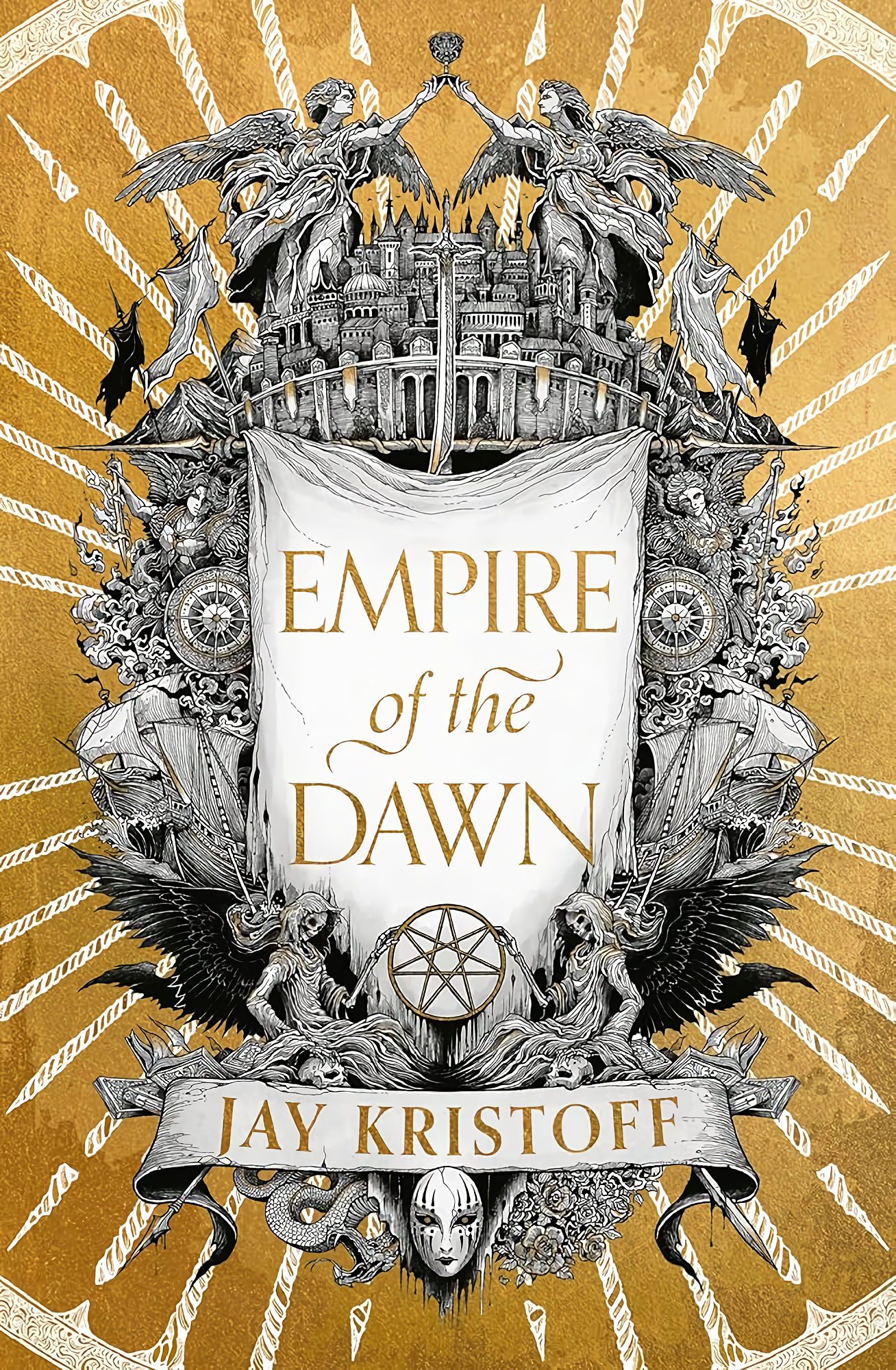
Empire of the Dawn is the third and final volume of Jay Kristoff's Empire of the Vampire trilogy. It was published on November 4, 2025 by St. Martin's Press in the United States and on November 6, 2025 by HarperVoyager in the United Kingdom, in a hardback of roughly 800 pages. The unabridged audiobook runs about 34 hours and 41 minutes, narrated by Damian Lynch and Shakira Shute. The novel debuted as an instant New York Times bestseller and reached the Sunday Times bestseller list in its first week on sale.
Interior illustrations for Dawn are by Gonzalo Mendiverry, replacing Bon Orthwick, who illustrated the first two volumes and is credited on book three as the trilogy's designer. The change in stylistic register — from Orthwick's woodcut-influenced linework to Mendiverry's more painterly realism — has been widely discussed.
Jay Kristoff is the New York Times, USA Today, Sunday Times, and #1 international bestselling author of, among other works, The Nevernight Chronicle (Nevernight, Godsgrave, Darkdawn), the YA SF Illuminae Files with Amie Kaufman, the Lifelike trilogy, and The Aurora Cycle. He has won eight Aurealis Awards. With Empire of the Dawn, the Empire of the Vampire trilogy is now complete.
If you've read the whole trilogy and want our recaps of the earlier books, our chapter-by-chapter summaries of Empire of the Vampire (book one) and Empire of the Damned (book two) are also on the site.