Masters of the Universe reached Prime Video globally on July 22, 2026, immediately after its theatrical run. That gives the franchise a fresh search surge, but most reading recommendations still point toward comics, tie-ins or undifferentiated space opera. The more useful question is narrower: which prose novels create worlds where a sword can matter beside a starship, “magic” may be forgotten technology, and heroic fantasy operates on a planetary scale?
This list follows that collision rather than surface nostalgia. Every entry meaningfully combines at least two normally separated traditions: medieval or mythic adventure, advanced technology, interplanetary travel, psychic or divine power, ruined machinery, and civilizations unable to explain the tools they inherited. Some are exuberant adventures with princesses, robots and rebels. Others examine the colonial or religious assumptions hidden inside the idea that a technologically superior visitor must look like a sorcerer.
The ranking favors books that sustain the mixture throughout the story. A fantasy novel with one buried spaceship does not qualify, nor does ordinary science fiction whose characters merely carry decorative blades. The highest choices make genre uncertainty central to character and world-building. Together they offer the prose-fiction equivalent of Eternia: places where muscle, myth and machinery occupy the same frame without apologizing for the combination.
Selection note. This ranking rewards a continuous fusion of heroic fantasy and speculative technology. The list contains classics as well as modern books, and the cautions identify older works whose gender or colonial assumptions have aged poorly.
10
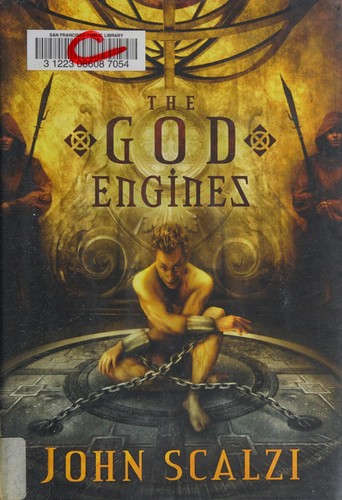
The God Engines
John Scalzi · 2009
Science-fantasy collision Starships cross space by enslaving and torturing beings that are literally gods
Closest Masters connection Cosmic technology and supernatural power are parts of the same physical system
Main difference A bleak theological horror novella with almost none of the franchise’s bright adventure
Best for Readers who want a dark novella, militant religion, cruel cosmic systems, a compact moral reversal and science fiction that treats gods as material facts.
Captain Ean Tephe serves the Bishopry Militant with complete faith. His ship travels because a captured god has been chained into its engine and compelled to move it. The arrangement is ordinary within his civilization: religion provides political authority, cosmic beings provide propulsion, and cruelty becomes a sacrament. A secret mission forces Tephe to confront how unstable that hierarchy may be.
Scalzi ranks tenth because he uses the science-fantasy premise to remove comfort rather than create a playground. There are soldiers, ships, blades and divine forces, but each familiar heroic element has been stripped of innocence. The novella is short enough to read in one sitting and sharp enough to make the image of god-powered technology difficult to forget. Readers seeking Eternia’s colorful fellowship should look higher. Readers intrigued by Skeletor’s combination of sorcery and machinery may appreciate the most merciless version of that fusion.
Know before you start. The book includes torture, slavery, religious abuse, graphic violence and a profoundly bleak worldview. It is closer to horror than heroic adventure.
9
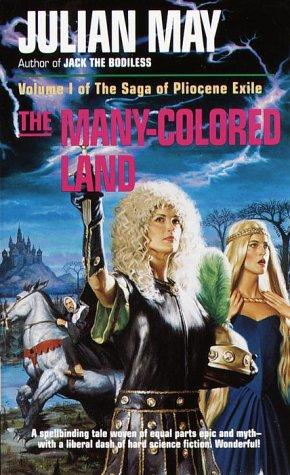
The Many-Colored Land
Julian May · 1981
Science-fantasy collision Future misfits travel six million years into the past and find psychic alien races behind humanity’s myths
Closest Masters connection Advanced devices, mental powers and archetypal warriors coexist in a brightly mythic landscape
Main difference A large ensemble time-travel epic whose opening spends substantial time assembling its cast
Best for Readers who want a long completed saga, time travel, large casts, psychic powers, myth explained through extraterrestrial history and old-school speculative ambition.
In the twenty-second century, people who cannot or will not adapt to a peaceful galactic society may choose permanent exile through a one-way time portal. Group Green expects Pliocene wilderness. Instead, its members encounter the Tanu and Firvulag, alien rivals whose psychic abilities, armor and social roles resemble the gods, elves and monsters of later human folklore.
May builds science into legend without draining either of wonder. Torcs amplify mental powers, future knowledge collides with feudal captivity, and travelers discover that dissatisfaction with utopia does not prepare them for being absorbed into someone else’s heroic age. The novel ranks ninth because much of the first section introduces individual exiles before the central adventure takes hold, and several sexual and social assumptions reflect its era. Once the strands meet, the Saga of Pliocene Exile offers an enormous playground of psychic knights and alien myth.
Know before you start. The novel includes enslavement, sexual coercion, eugenic ideas, warfare and dated depictions of gender and sexuality. It is the first volume of four.
8
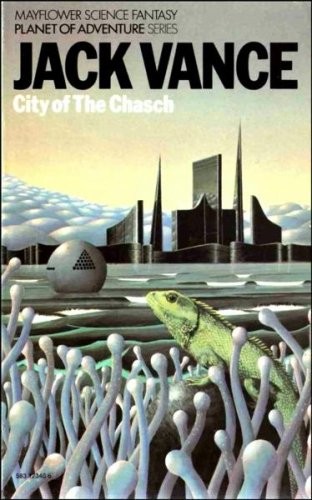
City of the Chasch
Jack Vance · 1968
Science-fantasy collision A stranded astronaut crosses a planet where alien species, human tribes and lost technologies have become a sword-and-planet civilization
Closest Masters connection A capable outsider moves through colorful kingdoms, strange creatures and dangerous technology
Main difference A lean pulp adventure with a cooler tone and conspicuously dated attitudes
Best for Readers who want a fast classic, strange planets, compact chapters, sword-and-planet travel and a four-book sequence that continually changes scenery.
Adam Reith survives the destruction of his scout craft above Tschai and finds himself cut off from rescue. The planet contains several alien peoples and human societies, each with its own myths about power and origin. Reith must travel, bargain, fight and improvise while attempting to understand a history whose rulers benefit from keeping ordinary people ignorant.
Vance supplies invention at high speed: unusual cities, costumes, customs and technologies appear with little exposition and rarely overstay. The series is a foundational example of planetary romance, and its episodic encounters resemble the way Masters of the Universe can move from palace to wasteland to machine-filled lair without changing genres. It ranks eighth because Reith’s competence can flatten the people around him, especially women, and the colonial outsider-knows-best pattern is hard to ignore. Read as vivid pulp history, it remains influential and entertaining.
Know before you start. The novel includes slavery, violence and dated racial, gender and colonial assumptions. Modern editions may use the alternate title The Chasch.
7
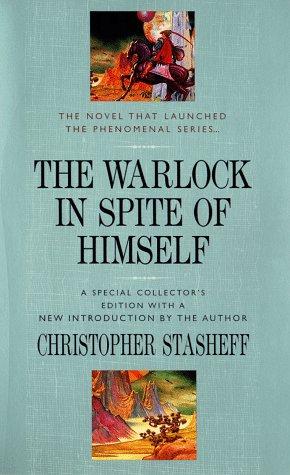
The Warlock in Spite of Himself
Christopher Stasheff · 1969
Science-fantasy collision An interstellar field agent lands on a deliberately feudal colony populated by apparent witches, ghosts and elves
Closest Masters connection A man of advanced technology operates among sorcerous powers with a robot horse at his side
Main difference A Cold War–era political adventure whose humor and ideas about government show their age
Best for Readers who want vintage science fantasy, a robot steed, political intrigue, telepathic “witches,” brisk adventure and a long-running series.
Rod Gallowglass arrives on Gramarye as an agent working to connect lost human colonies with a democratic interstellar society. The planet’s medieval order initially looks like historical reenactment carried too far. Then Rod encounters telepaths, legendary creatures and forces attempting to manipulate the kingdom from beyond it. His computer companion Fess disguises itself as a horse, giving the novel perhaps the list’s purest single image of technology wearing fantasy clothing.
Stasheff treats apparently supernatural events as questions to investigate without making them feel less marvelous. Rod’s tools do not automatically solve a society organized by custom, psychic talent and political resentment. The book ranks seventh because its faith in benevolent intervention, its battle-of-ideologies plot and some gender comedy belong firmly to 1969. It is nevertheless a direct ancestor of the wisecracking, gadget-assisted hero who carries modern assumptions into a sword-and-sorcery kingdom.
Know before you start. The novel includes dated gender roles, paternalistic politics, violence and mental manipulation. Later books expand and occasionally revise its continuity.
6
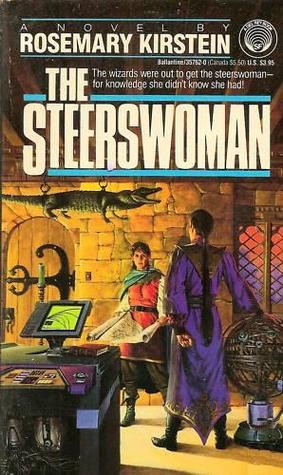
The Steerswoman
Rosemary Kirstein · 1989
Science-fantasy collision A sword-carrying scholar investigates “magic” whose hidden logic is technological
Closest Masters connection Warriors, wizards and mysterious devices coexist while access to knowledge determines who holds power
Main difference An epistemological mystery that reveals its genre through observation rather than cosmic spectacle
Best for Readers who want a woman scientist-adventurer, a warrior-poet companion, hidden technology, rigorous deduction and a smart continuing series.
Rowan belongs to the Steerswomen, traveling scholars required to answer questions truthfully as long as others return the courtesy. Her investigation of smooth blue jewels attracts violent attention from wizards who normally conceal everything about their craft. Outskirter warrior and poet Bel joins her journey, combining Rowan’s relentless inquiry with the practical ability to survive attacks.
Kirstein makes the border between magic and science a puzzle the reader can solve slightly ahead of the characters. Swords, inns and spell-casting wizards establish a fantasy surface, but Rowan’s scientific method exposes evidence of a much larger technological history. It ranks sixth because the first volume is intimate and investigative rather than planet-spanning. The pleasure comes from watching knowledge challenge authority, making it an excellent match for readers who wonder what Eternia’s heroes would discover if they stopped accepting “magic” and “machine” as separate explanations.
Know before you start. The book includes violence, attempted murder and institutional suppression of knowledge. Four volumes are published, but the planned larger series remains unfinished.
5
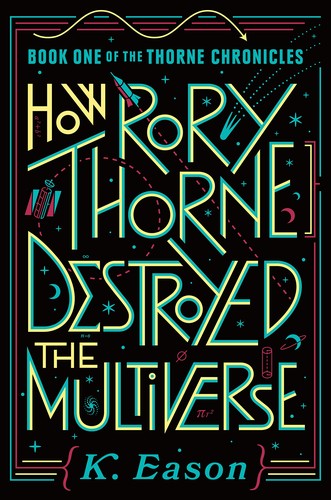
How Rory Thorne Destroyed the Multiverse
K. Eason · 2019
Science-fantasy collision A fairy-blessed princess uses arithmancy, diplomacy and science aboard an interplanetary station
Closest Masters connection Royal fantasy archetypes operate inside a spacefaring civilization full of political villains and improbable technology
Main difference A witty feminist court adventure that wins through negotiation more often than force
Best for Readers who want a clever princess, space diplomacy, fairy blessings, supportive retainers, political puzzles and an accessible two-book sequence.
Rory Thorne receives thirteen fairy gifts and one curse, but her story soon leaves the traditional kingdom behind. After political upheaval, she is sent toward an arranged marriage on a distant station. The regent controlling her intended’s government is not eager to surrender power. Rory applies the gifts of fairies, training from her household and an ability to see the relationships inside complex systems.
Eason ranks fifth because the mixture never becomes a reveal. Fairy-tale narration, faster-than-light travel, royal etiquette and mathematical magic all belong to the same world from the beginning. Rory has heroic courage, yet the novel’s most satisfying confrontations depend on detecting lies and building coalitions. That makes it a strong recommendation for readers who enjoy Teela’s competence or the political life around Eternos as much as combat. The voice is playful, but its argument about agency is serious.
Know before you start. The novel includes political imprisonment, threats of forced marriage, family death and warfare. Its arch narrator and fairy-tale asides are intentionally conspicuous.
4
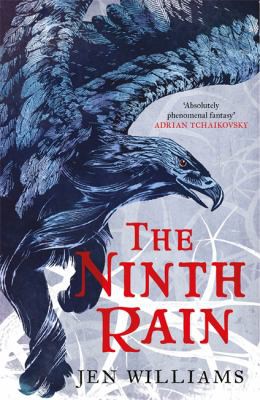
The Ninth Rain
Jen Williams · 2017
Science-fantasy collision Witches, vampire-like Eborans and ancient war-beasts face the return of an extraterrestrial invading force
Closest Masters connection Ruined fantasy civilizations must reactivate old technology and unite spectacularly different heroes
Main difference A darker, sprawling British epic with horror elements and a trilogy-length invasion plot
Best for Readers who want witches, queer characters, monstrous archaeology, eccentric scholars, alien invasions and a completed epic with enormous creatures.
Lady Vincenza “Vintage” de Grazon investigates artifacts left by the Jure’lia, invaders who have attacked the world of Sarn in repeated cycles. She travels with Tormalin, one of the dying Eborans, whose people once fought beside enormous war-beasts. Fell-witch Noon escapes imprisonment and brings a volatile power the group may need when evidence suggests another invasion is beginning.
Williams makes science-fiction machinery feel archaeological inside an epic-fantasy landscape. The heroes do not possess a clean manual for the defenses their ancestors used, and the cultural institutions that survived the last war have decayed. That tension—bright powers, monstrous enemies and heroic relics hiding grim historical costs—fits Eternia remarkably well. It ranks fourth because the first volume is a major commitment and its body horror is much stronger than the screen anchor suggests. The completed trilogy continually enlarges the fusion rather than abandoning it.
Know before you start. The novel includes imprisonment, addiction-like blood hunger, body horror, sexual coercion, war and graphic violence. Some editions were initially easier to find in the UK.
We reviewed this: read our full review of The Ninth Rain →
3
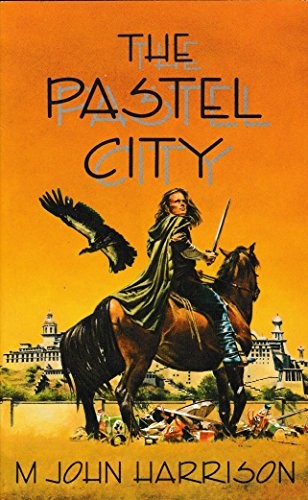
The Pastel City
M. John Harrison · 1971
Science-fantasy collision Knights defend a dying city with scavenged energy weapons while ancient machines awaken beneath a far-future wasteland
Closest Masters connection Swords, royal succession and colorful heroes coexist with technology nobody can rebuild
Main difference A melancholy dying-earth novel that distrusts the heroic patterns it initially appears to celebrate
Best for Readers who want dying-earth atmosphere, decadent cities, poetic prose, ancient machines, weary knights and a short gateway into a demanding sequence.
The old Queen of Viriconium faces rebellion, and the surviving Methven—warriors associated with a vanished king—are called back into service. Tegeus-Cromis considers himself a better poet than swordsman but rides with the group through rust deserts and ruined landscapes. Their opponents uncover weapons and brain-stealing automatons from civilizations whose science has become indistinguishable from sorcery.
Harrison provides the visual grammar of science fantasy in concentrated form: armored riders cross technological ruins, antique blades meet energy weapons, and dynastic struggle occurs beneath the debris of deep time. The novel ranks third because it also questions the stability of those images. Heroes are tired, history is unreliable and the world feels too old to support another uncomplicated legend. Later Viriconium books become even stranger and less conventional, but this first volume can stand as a compact adventure.
Know before you start. The book includes warfare, grotesque automata, death and intentionally remote characterization. Later volumes change tone sharply and resist simple continuity.
2
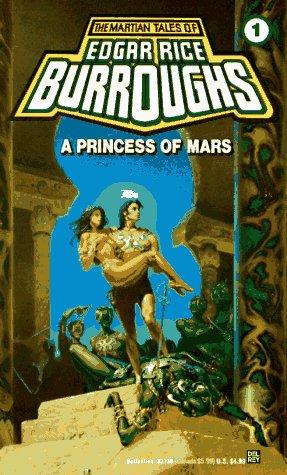
A Princess of Mars
Edgar Rice Burroughs · 1912 in serial form; 1917 in book form
Science-fantasy collision A Civil War veteran is transported to Mars, where swords, airships, strange biology and planetary romance share one adventure
Closest Masters connection A supernaturally strong hero crosses a bright alien world of princesses, monsters, warriors and advanced machines
Main difference Foundational pulp whose racial hierarchy, masculinity and treatment of Indigenous people require historical distance
Best for Readers who want the foundational planetary romance, nonstop pulp adventure, aerial fleets, giant creatures, heroic feats and a short public-domain classic.
John Carter enters a cave in Arizona and awakens on Barsoom, a Mars of low gravity, armed tribes, ancient cities and airborne fleets. His Earth-born body grants unusual strength. He allies with the Tharks, becomes devoted to Dejah Thoris and repeatedly moves between capture, duel, escape and large-scale war.
The novel ranks second because much of the later sword-and-planet tradition—including the imaginative lineage that leads to Eternia—is already present. Burroughs never pauses to justify why blades remain important around radium weapons and flying craft. Physical daring, romance and marvelous geography create their own coherence. That historical importance does not erase the book’s hierarchy of “races,” its savior narrative or its stereotypes. Modern readers should approach it as an enormously influential artifact whose momentum and invention coexist with serious limitations.
Know before you start. The novel includes racism, colonial assumptions, violence, captivity and dated gender roles. The 1912 serial and 1917 book publication dates are both commonly cited.
1
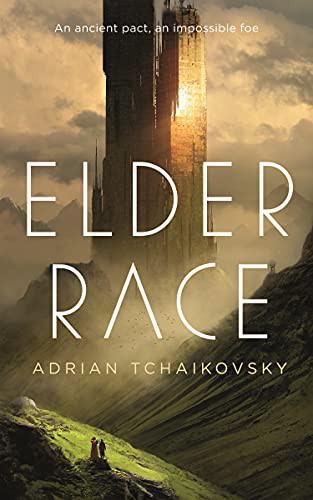
Elder Race
Adrian Tchaikovsky · 2021
Science-fantasy collision A princess seeks help from a “wizard” who is actually a stranded anthropologist equipped with advanced technology
Closest Masters connection Heroic fantasy and science fiction describe the same danger from opposite sides
Main difference An intimate, emotionally precise novella about communication, depression and the ethics of intervention
Best for Readers who want the most precise genre blend, a one-sitting novella, a compassionate treatment of depression, dual perspectives and a complete story with a sequel available.
Lynesse Fourth Daughter believes an ancient pact entitles her people to request aid from Nyrgoth Elder, the sorcerer in his tower. Nyr is Nyr Illim Tevitch, a junior anthropologist left to observe a human colony after contact with his own civilization has failed. His equipment translates as magic to Lyn, while the “demon” threatening her land does not fit comfortably within either person’s explanation.
Tchaikovsky structures the book so genre becomes viewpoint rather than fact. Lynesse experiences a quest full of duty, legend and supernatural terror. Nyr experiences broken machinery, professional restrictions and clinical depression managed by technological intervention. At one point, their perspectives occupy parallel columns, allowing the same conversation to reveal how vocabulary conceals shared fear.
It ranks first because the collision produces more than scenery. Nyr must decide whether noninterference remains ethical when real people ask for help, and Lynesse must work with a supposed wizard who cannot embody the certainty her story requires. The action includes swords, armor, drones and scientific analysis, but mutual translation is the essential heroic skill. It captures everything delightful about science fantasy while asking who benefits when superior technology is mistaken for destiny.
Know before you start. The book includes depression, emotional suppression, violence and colonial-observer ethics. Its compact length leaves parts of the wider universe deliberately unexplained.
Which Masters of the Universe Read-Alike Should You Read First?
Where to start. Start with Elder Race if you want the cleanest meeting of sword quest and advanced science. It is short, funny, thoughtful and complete. Choose A Princess of Mars when you want to encounter the foundational pulp engine behind so much sword-and-planet adventure, provided you are prepared for its dated worldview.
Read The Pastel City for rusted technology and weary knights, or The Ninth Rain for the biggest modern trilogy on the list. How Rory Thorne Destroyed the Multiverse is the most welcoming option for readers who prefer princesses, cleverness and diplomacy. The Steerswoman offers the most satisfying mystery about whether “magic” is simply knowledge held by the wrong people.
Choose The Warlock in Spite of Himself or City of the Chasch for vintage series fiction, with the cautions that accompany their era. The Many-Colored Land rewards readers willing to invest in a long ensemble saga. Save The God Engines for a night when “spaceships powered by gods” sounds less like colorful spectacle than a reason to examine how power turns suffering into infrastructure.
Science fantasy works when it refuses to treat wonder as an error to be corrected. A laser does not invalidate a sword, and explaining a sorcerer’s device does not necessarily make it less magical. The strongest books use the collision to reveal that every culture tells stories about its tools—and that technological authority can be every bit as mythic as kingship.
Elder Race ranks first because it lets fantasy and science fiction speak at once without forcing either to surrender. A Princess of Mars provides the genre’s propulsive foundation, while The Pastel City studies the ruins that heroic confidence leaves behind. Together, the ten books prove that Eternia’s famous mixture is not incoherent. It belongs to a deep, inventive tradition in which the future has always carried a sword.