HBO's Lanterns has a premise designed to pull two large audiences through the same door. Hal Jordan and John Stewart are intergalactic law officers, but the case drawing them together is a murder in the American heartland. The scale is cosmic; the dramatic grammar is terrestrial crime fiction. Instead of beginning with armies crossing the stars, the series begins with two investigators asking what happened, who benefits and how far the evidence can be trusted.
That combination has a long but surprisingly underused history in science fiction. A detective story assumes that the world can be reconstructed from traces. Science fiction is free to alter bodies, memory, time, law, geography and even the definition of a person. Put the genres together and the investigator must first determine which rules make a crime possible before identifying who broke them. A corpse aboard a mindship may have been copied. A murder victim may return in a new body. An entire orbital democracy may be manipulated without a single conventional ballot being stolen.
This ranking favors novels in which investigation is the central method rather than a decorative subplot. The closest matches combine institutional law enforcement with a large speculative system and a conspiracy that reaches beyond the first body. Others trade the Green Lantern Corps for private detectives, citizen investigators or sentient ships. Every selection, however, understands the pleasure at the heart of Lanterns: the universe can be unimaginably large, and a good case can still narrow it to motive, opportunity and one detail that refuses to fit.
Selection note. This list prioritizes investigators whose jurisdiction has become speculative. The highest-ranked books ask police or agents to preserve law across orbital habitats, alien legal systems or compromised colonies. Lower entries retain the mystery structure but replace official cosmic cops with private eyes and unwilling amateurs.
10
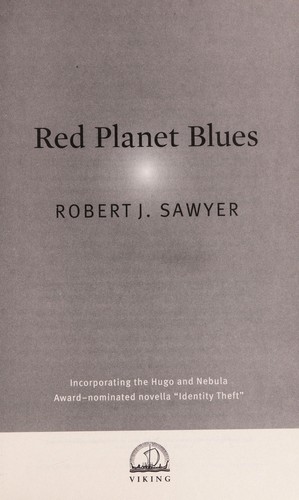
Red Planet Blues
Robert J. Sawyer · 2013
Jurisdiction New Klondike, a rough Martian settlement sustained by the trade in valuable alien fossils
Impossible crime Murder and fraud in a town where wealthy prospectors can transfer their minds into nearly indestructible artificial bodies
Closest Lanterns connection A frontier detective works where extraordinary technology has not improved ordinary motives
Best for Readers who want an accessible mystery, Mars, mind transfer, old-fashioned private-eye narration and science fiction that explains its ideas clearly.
Private investigator Alex Lomax makes a living in the only town on Mars where prospectors still hope to strike it rich. The best discoveries can buy a transfer into a synthetic body, creating a class of people who are physically powerful, socially privileged and not quite as immortal as they believe. A decades-old fossil find and a new killing pull Lomax through competing claims, false identities and local history.
Sawyer deliberately builds a planetary version of a gold-rush mystery. Mars matters, but greed, jealousy and control of evidence remain recognizable. It ranks tenth because Lomax is a conventional private eye rather than an officer in a cosmic institution, yet the book shares Lanterns' frontier logic: the farther law travels from its center, the more it depends on one flawed investigator deciding that the case still counts.
Know before you start. The tone is deliberately pulpy; the novel includes murder, sexual bargaining, body inequality, fraud and dated hard-boiled attitudes.
9
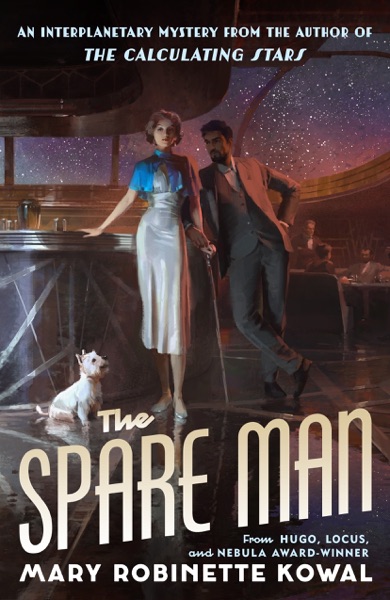
The Spare Man
Mary Robinette Kowal · 2022
Jurisdiction A luxury passenger liner traveling between Earth and Mars
Impossible crime A murder aboard a closed vessel where surveillance, celebrity and interplanetary jurisdiction complicate every alibi
Closest Lanterns connection A contained Earth-style investigation unfolds inside a much larger spacefaring society
Best for Readers who want a space-cruise mystery, a loving married couple, disability representation, dry humor and a lighter tone without low stakes.
Inventor and heiress Tesla Crane is attempting an anonymous honeymoon with retired detective Shal Steward when a passenger is killed and Shal becomes the obvious suspect. Tesla has money, technical expertise, chronic pain and a service dog named Gimlet; none of those advantages persuade ship security to look beyond the easiest arrest. She begins investigating before a second crime can lock the official theory into place.
Kowal models the novel on sophisticated cocktail-era mysteries, then uses space travel to add new limits on movement, privacy and evidence. The marriage is affectionate, the dog is functional rather than ornamental and the cocktails are real recipes. It ranks ninth because Tesla is an amateur, but her insistence on investigating around an institution that has settled too quickly resembles the tension between individual judgment and official authority promised by Lanterns.
Know before you start. The story includes murder, chronic pain, panic attacks, medical trauma, ableism, alcohol and a law-enforcement agency making coercive assumptions.
8
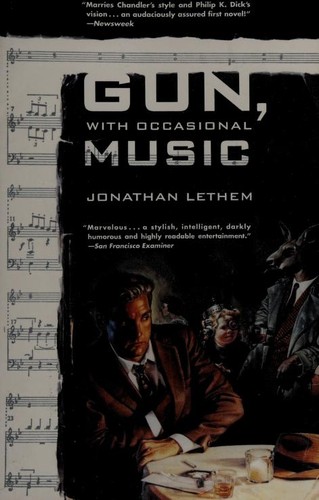
Gun, with Occasional Music
Jonathan Lethem · 1994
Jurisdiction A distorted near-future Oakland populated by evolved animals, precocious baby-heads and citizens whose karma functions as legal currency
Impossible crime A routine murder hides behind altered minds and a society trained to dislike questions
Closest Lanterns connection Noir investigation reveals that the world's strangest rules are part of the conspiracy rather than mere scenery
Best for Readers who want experimental noir, compressed prose, bizarre worldbuilding, talking animals and satire that becomes more unsettling as it clarifies.
Private inquisitor Conrad Metcalf accepts a case involving a murdered urologist and immediately collides with the Office of the Inquisitor. Citizens use regulated drugs to control emotion, asking questions is socially suspect and a gun may play music while being fired. Metcalf nevertheless follows the old procedure: irritate the powerful, test every story and keep moving after official patience expires.
Lethem treats noir as an alien artifact reconstructed by someone who remembers its rhythms but not its boundaries. The absurdity is funny until the reader realizes that language and curiosity have been politically weakened. It ranks eighth because the setting is Earthbound and deliberately surreal, yet few novels better demonstrate how a speculative detective must investigate the rules of reality along with the crime.
Know before you start. The novel includes murder, police abuse, drug dependence, sexual coercion, misogynistic noir conventions and intentionally unexplained absurdities.
7

The Tea Master and the Detective
Aliette de Bodard · 2018
Jurisdiction The Xuya universe, where sentient mindships move through deep spaces that can damage human perception
Impossible crime A body recovered from a dangerous region of space may contain evidence of murder, trafficking or something stranger
Closest Lanterns connection An eccentric investigator and a more disciplined partner approach a cosmic mystery through clashing methods
Best for Readers who want a short space mystery, sentient ships, Vietnamese-influenced worldbuilding, prickly investigators and emotional consequences beneath elegant prose.
The Shadow's Child is a damaged mindship earning a living by brewing tailored drug infusions for travelers. Scholar Long Chau hires the ship to retrieve a corpse for research, then identifies signs that the death was not accidental. Their partnership echoes Holmes and Watson without merely changing the costumes: the ship is a person, space itself affects cognition and trauma changes what each partner can tolerate.
De Bodard compresses an enormous civilization into a novella-length investigation. Tea, memory, family structures and ship consciousness carry as much weight as the forensic problem. It ranks seventh because Long Chau is not a police officer and the case is intimate, but the unusual investigator pairing makes it a strong match for readers interested in how Hal and John may challenge each other's assumptions.
Know before you start. The novella includes war trauma, corpse handling, addiction-like dependence, family abuse and a protagonist capable of severe interpersonal cruelty.
6
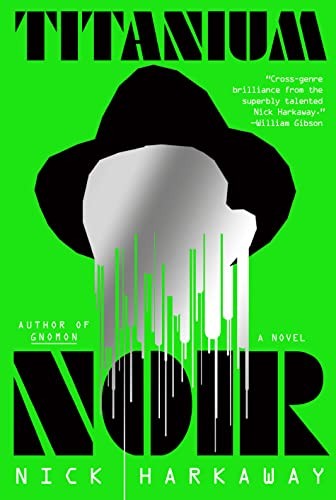
Titanium Noir
Nick Harkaway · 2023
Jurisdiction A near future where expensive genetic treatments create enormous, long-lived humans known as Titans
Impossible crime A murdered Titan appears to have aged and changed in ways the treatment should not permit
Closest Lanterns connection A detective investigates a superhuman elite whose power places it partly outside ordinary law
Best for Readers who want stylish prose, biological superhumans, class satire, detective narration and a mystery that treats enhanced bodies as evidence.
Cal Sounder works as a consultant on crimes involving Titans. When the body of Roddy Tebbit is found, the physical evidence makes no sense: he is a Titan, but not one whose history or condition fits the official records. Cal's investigation leads toward the family that controls the enhancement technology and toward his own relationship with one of its most powerful members.
Harkaway asks what superheroic bodies would look like inside a class system rather than a heroic mythology. Size, longevity and strength are products, and the people who own the product also influence the institutions meant to investigate them. It ranks sixth because the scale is municipal rather than galactic, but its combination of murder, superhuman power and compromised authority is extremely close to the grounded side of Lanterns.
Know before you start. The novel includes murder, extreme body modification, wealth inequality, family abuse, violence and a romantic history complicated by power.
5
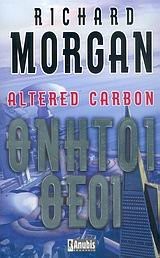
Altered Carbon
Richard K. Morgan · 2002
Jurisdiction Twenty-fifth-century Earth, where human consciousness can be stored and placed into replacement bodies called sleeves
Impossible crime A wealthy man hires an investigator to prove that his apparent suicide was murder after his backup consciousness is restored
Closest Lanterns connection A hardened officer crosses jurisdictions to investigate a death distorted by technology and elite power
Best for Readers who want cyberpunk noir, body-swapping, an antihero investigator, dense action and a mystery integrated with the technology.
Former envoy Takeshi Kovacs is transmitted from another world and sleeved into a new body to investigate Laurens Bancroft's death. Bancroft cannot remember the hours preceding the shooting because his most recent backup predates it. Police believe suicide; Bancroft's restored self rejects that conclusion. Kovacs enters a Bay Area where bodies are temporary, wealth buys continuity and violence can be both reversible and permanently traumatic.
Morgan builds a genuine detective problem from the social consequences of mind storage. If a victim returns, what has been murdered? If a body has a previous owner, whose habits remain? It ranks fifth because its violence and cynicism are much harder than HBO's likely adventure tone, but it remains one of the clearest demonstrations of science fiction changing every assumption beneath a murder case.
Know before you start. The book includes graphic violence, torture, sexual violence, sex work, misogyny, substance use and prolonged threats to bodies and identity.
4

The Mimicking of Known Successes
Malka Older · 2023
Jurisdiction Giant platforms circling Jupiter after humanity has made Earth uninhabitable
Impossible crime A man disappears from an isolated rail platform, leaving evidence that may connect academic work, ecological restoration and murder
Closest Lanterns connection An official investigator and an intellectual former partner reunite over a case with planetary implications
Best for Readers who want a compact mystery, queer romance, gaslamp atmosphere in space, academic settings and hopeful ecological science fiction.
Investigator Mossa follows signs of a missing man to Valdegeld University, where Pleiti studies the ecosystems humanity hopes one day to rebuild on Earth. Mossa and Pleiti share a romantic past and very different habits of thought. The case begins with a single absence on a remote platform and expands into a question about who controls the future imagined for an entire species.
Older blends a cozy academic mystery with rigorous attention to infrastructure. Trains, heating, food and habitable space are not background; they define which movements and crimes are possible. It ranks fourth because the central partnership is closer to Holmes and Watson than two equal police officers, but its combination of old feelings, investigative friction and cosmic setting makes it an unusually inviting Lanterns companion.
Know before you start. The novella is gentle by crime-fiction standards but includes murder, ecological collapse, grief, institutional secrecy and emotionally reserved protagonists.
3
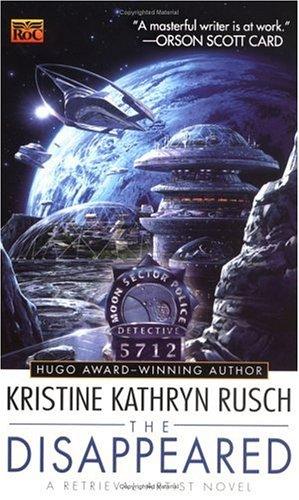
The Disappeared
Kristine Kathryn Rusch · 2002
Jurisdiction The Moon and a multi-species legal order in which human visitors can unknowingly violate alien law
Impossible crime Families vanish to escape punishments that remain legal under treaties even when humans consider them grotesque
Closest Lanterns connection Law officers must choose between institutional jurisdiction and the moral reality of the people they are ordered to recover
Best for Readers who want a long-running series, lunar police procedure, alien legal systems, moral dilemmas and cases whose consequences continue across books.
Detectives Miles Flint and Noelle DeRicci encounter cases shaped by interspecies agreements. Human authorities have promised to respect alien laws, including penalties that can reach relatives or last generations. People who flee those judgments become the Disappeared, hidden by specialist Retrieval Artists. When separate incidents converge, Flint begins questioning whether enforcing the treaty can be distinguished from delivering victims.
Rusch makes jurisdiction the speculative concept. The mystery is not simply where someone went, but which law has the right to define that person's guilt. It ranks third because it directly examines what intergalactic policing costs when different civilizations do not share assumptions about punishment, family or proportionality. Readers curious about the authority behind a Green Lantern badge should find its questions especially sharp.
Know before you start. The novel includes threats to children and families, extreme alien punishments, kidnapping, death, institutional injustice and deliberately uncomfortable legal compromises.
2
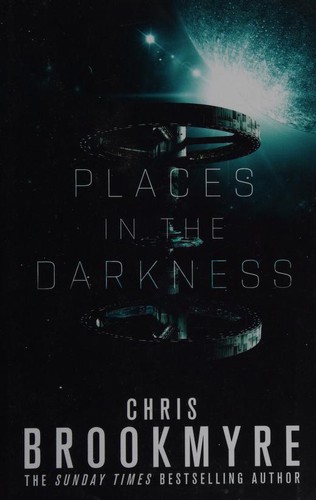
Places in the Darkness
Chris Brookmyre · 2017
Jurisdiction Ciudad de Cielo, an orbital city constructing humanity's first generation starship
Impossible crime The station's first officially recognized murder exposes corruption, black markets and unreliable memory
Closest Lanterns connection Two mismatched law officers investigate a grounded killing whose conspiracy threatens a cosmic project
Best for Readers who want a fast standalone, two clashing investigators, an orbital city, corruption, memory technology and a conspiracy with large stakes.
Alice Blake arrives from Earth to examine corruption on a station proud of its clean public record. Nikki “Fix” Freeman, a former LAPD homicide detective embedded in Ciudad de Cielo's practical compromises, is assigned to a gruesome death. One views the station through regulation, the other through all the arrangements that allow it to function when regulation is inadequate.
Brookmyre uses the murder to tour the darkness beneath an idealistic project. The station exists to carry human civilization to another star, yet its people reproduce inequality, vice and bureaucratic self-protection before the ship has even launched. It ranks second because the Blake-Freeman pairing and the expanding institutional conspiracy may be the closest procedural analogue to Lanterns' promise of two officers, one murder and consequences far larger than the crime scene.
Know before you start. The novel includes murder, sexual content, exploitation, police corruption, drugs, violence and revelations involving manipulation of memory.
1
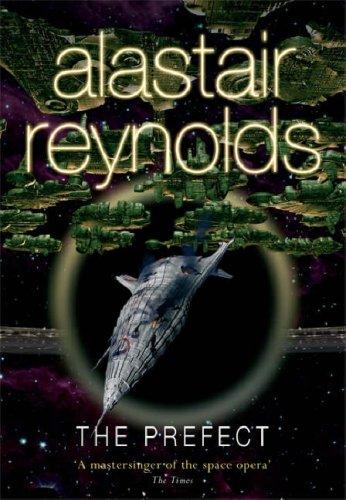
The Prefect
Alastair Reynolds · 2007; later United States editions use the title Aurora Rising
Jurisdiction The Glitter Band, ten thousand orbital habitats whose citizens vote continuously through networked democratic systems
Impossible crime The destruction of a habitat appears connected to an attempt to subvert the machinery governing an entire civilization
Closest Lanterns connection A specialized interplanetary police force investigates mass murder while confronting the limits of its own authority
Best for Readers who want the closest institutional match, hard science fiction, orbital habitats, democratic systems, artificial intelligence and a substantial conspiracy.
Tom Dreyfus is a field prefect in Panoply, the small institution responsible for maintaining voting integrity and public order across the Glitter Band. An apparent attack on one habitat leads Dreyfus and his deputies toward weapons, artificial intelligence and an adversary capable of exploiting the very systems that allow billions of citizens to govern themselves.
It ranks first because Reynolds makes cosmic policing the complete subject rather than a character label. Panoply has powerful tools but carefully limited legitimacy; Dreyfus must decide when an emergency justifies force and when that justification becomes the threat. The investigation retains the pleasures of evidence, interviews and concealed motive while expanding until the crime scene is a civilization. For readers hoping Lanterns will balance procedural detail with enormous science-fiction stakes, this is the natural starting point.
Know before you start. The novel is dense and terminology-heavy; it includes mass death, body horror, coercive interrogation, weapons of mass destruction and debates over emergency authority.
Which Science Fiction Mystery Should You Read First?
Where to start. Start with The Prefect for the fullest cosmic-cop experience: a defined law-enforcement institution, multiple officers, orbital jurisdictions and a case that threatens public order. Choose Places in the Darkness if the central appeal is two mismatched investigators learning how much the other sees that they do not.
Read The Disappeared for alien law and a continuing series. The Mimicking of Known Successes is the warmest and shortest choice, while Altered Carbon is the hardest-edged. Titanium Noir brings the investigation closest to superhero fiction by treating genetically enhanced giants as a protected elite.
For something formally unusual, choose The Tea Master and the Detective or Gun, with Occasional Music. The Spare Man offers the most traditional closed-circle entertainment, and Red Planet Blues is the lightest route into planetary private-eye fiction.
Science-fiction detectives are compelling because they cannot take the category of evidence for granted. A body may be rented. A witness may be a ship. A disappearance may be compliance with one legal system and persecution under another. Before solving the crime, the investigator must understand the world well enough to know what has actually been violated.
The Prefect ranks first because it makes that problem institutional. Tom Dreyfus protects a democracy whose technology creates both his jurisdiction and its greatest vulnerability. Places in the Darkness provides the strongest partner dynamic, and The Disappeared asks the hardest questions about enforcing law across cultures. Together, these novels suggest the richest possibility in Lanterns: cosmic power is less interesting than the judgment required to use it on one difficult case.