Ranked · Post-Apocalyptic
The Top 10 Post-Apocalyptic Novels About Cults, False Prophets, and Violent Faith Like 28 Years Later: The Bone Temple
by E. M. Larkin
A ranked guide to zombie churches, purity doctrines, charismatic saviors, sacred technology, ritual control, and belief weaponized after the end
28 Years Later: The Bone Temple expands its infected Britain through Dr. Kelson, Samson and the violent mythology surrounding Sir Jimmy Crystal’s followers. The January 2026 film has generated broad zombie and horror interest, yet most recommendation pages still target outbreak speed or general post-apocalyptic survival. This list follows the sequel’s more distinctive reading trail: communities that convert catastrophe into scripture, hierarchy and permission to hurt.
Every ranked novel features organized belief after collapse. The faith may be an explicit church, a purity doctrine, a leader’s private cosmology, a founding myth or a culture that treats technology and reproduction as sacred. The list does not claim that religion automatically becomes violent. It asks what happens when people with scarce evidence grant one authority the power to explain why the world ended and who deserves to inherit it.
The ranking favors charismatic leadership, ritualized cruelty and characters who must distinguish genuine communal meaning from stories designed to preserve control. Zombies appear in several choices, but the highest books show why cult logic can be more durable than any monster: it gives fear a moral vocabulary and teaches survivors to police one another.
Selection note. These books are ranked for post-apocalyptic belief systems, coercive authority and violence justified as salvation. Some are explicitly religious; others show secular leaders and survival customs hardening into faith.
10
The Gracekeepers
Kirsty Logan · 2015
Apocalyptic faith A drowned world divides land-dwellers and sea people through ritual, taboo and competing ideas of purity
Closest The Bone Temple connection Scarcity gives funeral practice and inherited belief the power to determine who belongs
Main difference A lyrical, romantic water-world novel with little graphic cult violence
Best for Lyrical dystopia, a floating circus, queer longing, ritual world building and a completed standalone
North performs with a floating circus and a bear, while Callanish lives alone as a gracekeeper who conducts sea burials. Their paths cross in a world where island communities guard land, damplings remain mobile and religious custom turns geography into moral rank.
Logan ranks tenth because its faith systems are quieter than Sir Jimmy’s cult, but the novel shows how catastrophe creates categories that later generations mistake for nature. Ritual can comfort, exclude or hide desire. It is the gentlest entry and the best reminder that post-apocalyptic belief is not always fraudulent even when institutions use it harshly.
Know before you start. Includes animal peril, pregnancy, social exclusion, death and body disposal. The dreamlike prose and multiple viewpoints favor atmosphere over thriller pace.
9
The Doloriad
Missouri Williams · 2022
Apocalyptic faith A matriarch rules an incestuous family she believes must repopulate an apparently empty world
Closest The Bone Temple connection A leader turns survival and lineage into a grotesque doctrine that licenses control over bodies
Main difference An experimental literary horror with almost no conventional action or explanatory world building
Best for Grotesque literary horror, authoritarian family, posthuman bodies, black comedy and formally challenging prose
On the outskirts of a ruined Central European city, the Matriarch presides over children conceived with her brother and raised inside a decaying family system. She imagines herself the architect of humanity’s future even as the household’s bodies, memories and loyalties refuse her plan.
Williams makes false prophecy domestic. The Matriarch’s authority depends on the claim that no alternative community exists, which converts ignorance into obligation. It ranks ninth because the book is deliberately opaque and static, but its blend of ruined world, ritualized family violence and repopulation myth is among the list’s most disturbing.
Know before you start. Includes incest, rape, disability abuse, graphic bodily imagery and extreme family violence. The novel is intentionally disorienting and emotionally abrasive.
8
The Living Dead
George A. Romero and Daniel Kraus · 2020
Apocalyptic faith A global zombie catastrophe produces opportunists, authoritarian enclaves and competing explanations for the dead
Closest The Bone Temple connection The infected become material around which survivors build spectacle, ideology and political power
Main difference A vast ensemble epic with many institutions rather than one concentrated cult
Best for Epic zombie fiction, social satire, multiple continents, institutional collapse and Romero’s most expansive prose statement
Romero’s posthumously completed novel follows medical workers, officials, media figures, sailors and ordinary survivors through outbreak and aftermath. The dead are dangerous, but human systems repeatedly adapt by exploiting fear, denying evidence or inventing hierarchies suited to whoever controls a refuge.
The novel ranks eighth for scale. It shows cult behavior as one branch of a broader political response: apocalypse rewards anyone who can turn uncertainty into audience. Kraus preserves Romero’s interest in social institutions, though the many perspectives make the book less intimate than The Bone Temple.
Know before you start. Includes graphic gore, mass death, racism, sexual violence and cruelty. The novel is long, bleak and completed after Romero’s death from his manuscript and notes.
7
The Book of Etta
Meg Elison · 2017
Apocalyptic faith Post-plague communities regulate gender, childbirth and historical memory as sacred resources
Closest The Bone Temple connection Survival doctrine hardens into social roles that leaders defend through coercion and inherited story
Main difference The second volume of a trilogy, best read after The Book of the Unnamed Midwife
Best for Feminist post-apocalypse, gender exploration, rescue missions, competing communities and a complete trilogy
Generations after disease killed most women and made birth extraordinarily dangerous, Etta raids slavers beyond the community of Nowhere. Their travels expose settlements with different systems for controlling sex, reproduction and gender, including a powerful underground society whose apparent protection contains its own demands.
Elison ranks seventh because no single prophet dominates; the cultic force lies in institutions treating bodies as collective property. Etta’s fluid identity makes those rules personal and politically difficult. The novel extends the question beyond obvious villains: even communities founded to protect the vulnerable can turn scarcity into compulsory destiny.
Know before you start. Includes sexual slavery, rape, forced reproduction, violence and transphobia. Reading the first Road to Nowhere novel is strongly recommended.
6
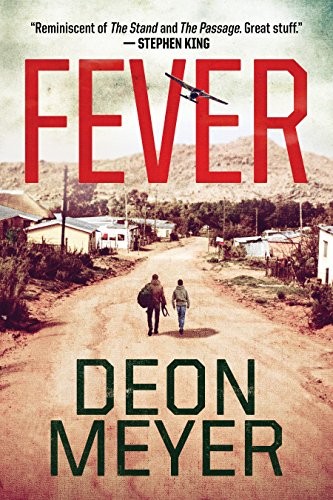
Fever
Deon Meyer · 2016
Apocalyptic faith A visionary father builds a South African settlement whose success attracts political and religious conflict
Closest The Bone Temple connection A humane founding story becomes vulnerable to leaders who claim moral certainty over a frightened community
Main difference A realistic nation-building and murder epic with no zombies or supernatural belief
Best for South African setting, detailed rebuilding, coming of age, political intrigue, crime mystery and a long standalone
After a pandemic kills most of humanity, Willem Storm and his son Nico help establish Amanzi as an inclusive refuge with water, skills and rules. Years later, Nico recounts the community’s growth knowing that his father will be murdered. Security, democracy, faith and ambition gradually converge around the unanswered crime.
Meyer shows how a legitimate community creates the stage on which a false prophet can operate. People need meaning as urgently as electricity, and political opponents can use religion to translate anxiety into allegiance. It ranks sixth because the novel’s scale and realism slow the cult plot, but the eventual conflict is a powerful study of belief weaponized against pluralism.
Know before you start. Includes pandemic death, murder, religious conflict, racism and warfare. The first publication was in Afrikaans in 2016; English editions followed.
5
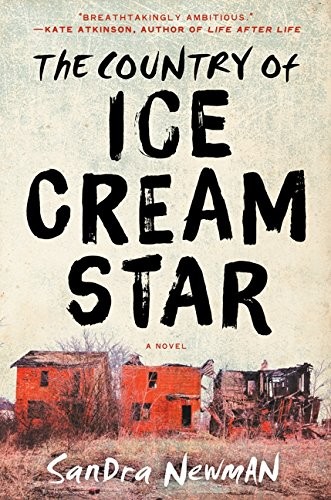
The Country of Ice Cream Star
Sandra Newman · 2014
Apocalyptic faith Children form tribes and myths in a world where disease kills everyone before adulthood
Closest The Bone Temple connection A generation without reliable elders turns survival history, rumor and authority into sacred explanation
Main difference A linguistically demanding literary epic whose invented dialect shapes every page
Best for Invented language, youth tribes, plague, quest narrative, American ruins and ambitious literary world building
Ice Cream Fifteen Star lives among the Sengles in a Massachusetts transformed by the disease called posies. With adults almost absent, youth cultures create law, war and memory from fragments. Ice’s search for a cure carries her through communities whose promises of salvation conceal new forms of power.
Newman ranks fifth because she makes apocalypse linguistically complete. Belief is embedded in how characters speak and therefore in what they can imagine as true. The result resembles The Bone Temple’s interest in children inheriting corrupted symbols, though its massive journey and invented dialect demand far more patience than a conventional zombie thriller.
Know before you start. Includes child death, sexual violence, slavery, warfare and medical exploitation. The dialect requires adjustment and may slow the opening substantially.
4
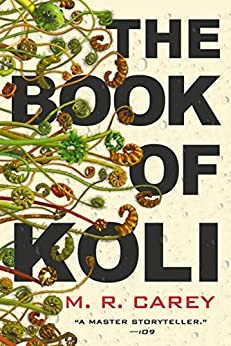
The Book of Koli
M. R. Carey · 2020
Apocalyptic faith A village treats surviving technology as sacred authority until a young man exposes the rules behind it
Closest The Bone Temple connection Leaders turn misunderstood remnants of the old world into ritual proof that only they may govern
Main difference A warm first-person science-fiction adventure with dangerous plants rather than zombies
Best for Approachable post-apocalyptic SF, lost technology, artificial intelligence, village secrets and a completed trilogy
Koli lives in Mythen Rood, protected from predatory nature by a small collection of old technologies said to choose their users. His desire for status leads him to challenge that story. Exile and an unexpected artificial-intelligence companion reveal a much larger world and the political work performed by village myth.
Carey ranks fourth because the false religion is materially testable: the sacred objects are machines, and access has been manipulated. Koli’s discovery does not make communal belief foolish; it shows why a protective story became useful and how usefulness became monopoly. The trilogy’s voice and relationships make the theme accessible without softening danger.
Know before you start. Includes exile, violence, transphobic social structures, child peril and killer plants. The dialect is much lighter than The Country of Ice Cream Star.
3
The Gospel of Z
Stephen Graham Jones · 2014
Apocalyptic faith A former biology teacher follows the woman he loves toward the Church of Z in a managed zombie society
Closest The Bone Temple connection A church promises meaning and transformation while concealing how the infected and their handlers are controlled
Main difference A compact, elliptical zombie mystery with a less conventional narrative rhythm
Best for Zombie conspiracy, biotech handlers, religious cult, compressed prose and an unusual post-outbreak setting
Ten years after Z Day, Jory Gray works on an assembly line producing genetically modified handlers capable of directing zombies. When Linse leaves for the Church of Z, Jory crosses a system of half-truths to find her. The undead have become labor, threat and theology at once.
Jones earns third place for making a zombie church the center of an epistemic mystery. Institutions claim to have domesticated the apocalypse, but every controlled body raises questions about who wrote the procedure. The prose withholds connective explanation, which some readers find haunting and others confusing; that ambiguity suits a world where gospel and operational secret overlap.
Know before you start. Includes gore, coercion, death and intentionally buried exposition. The book was first published in 2014 despite prominent later reissue dates.
2
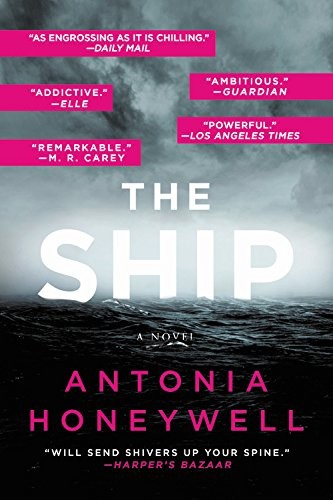
The Ship
Antonia Honeywell · 2015
Apocalyptic faith A protected teenager boards her father’s carefully selected ark and begins questioning his promised salvation
Closest The Bone Temple connection A charismatic father controls who is worthy, where the chosen are going and what survival is allowed to mean
Main difference A closed maritime dystopia without infected monsters
Best for Ark dystopia, father-daughter conflict, closed community, moral questioning and a self-contained novel
Lalla has grown up sheltered as London collapses under scarcity, violence and identity laws. Her father Michael Paul prepares a ship stocked for five hundred chosen people. Once aboard, routine replaces destination and gratitude becomes an expectation. Lalla’s questions threaten a community built around her father’s certainty.
Honeywell ranks second because the false prophet is intimate: salvation comes from a parent whose preparation is real, whose love may be genuine and whose authority permits no independent horizon. The ship functions like a floating temple, preserving abundance while narrowing moral choice. It is a close companion to any story about apocalypse converted into a leader’s private religion.
Know before you start. Includes authoritarian control, scarcity, death, reproductive expectations and a sheltered teenage viewpoint. The first UK publication was in 2015; later US editions may show 2017.
1
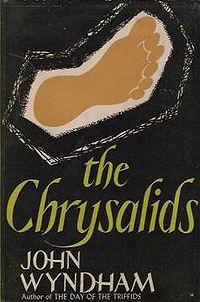
The Chrysalids
John Wyndham · 1955
Apocalyptic faith A post-nuclear community enforces genetic purity as divine law and hunts children who differ
Closest The Bone Temple connection Survivors turn fear of mutation into scripture, ritual punishment and inherited permission for violence
Main difference A mid-century coming-of-age classic whose threat is social persecution rather than zombies
Best for A concise dystopian classic, persecuted children, telepathy, religious authoritarianism and clear accessible prose
David Strorm grows up in Waknuk, where religious doctrine defines the approved human form and labels deviation an offense against God. He hides a telepathic ability shared with other children while witnessing the punishment of visible difference. Discovery forces the group to flee the community that raised them.
Wyndham takes first place because he shows a cult becoming a culture. Waknuk does not feel temporary to its children; doctrine is embedded in family, agriculture and language. The catastrophe’s surviving evidence is incomplete, which lets authority call prejudice preservation. That long afterlife of fear is exactly what makes violent faith more dangerous than one charismatic leader.
Know before you start. Includes child abuse, eugenics, forced sterilization, suicide and dated assumptions. Some later moral conclusions about evolutionary replacement deserve critical scrutiny.
Which Apocalyptic-Cult Novel Should You Read First?
Where to start. Start with The Chrysalids for the clearest, shortest study of catastrophe hardened into purity doctrine. Choose The Ship when you want one charismatic leader, a closed refuge and salvation whose destination cannot be questioned.
The Gospel of Z is the closest literal zombie-church match, while The Living Dead offers the broadest Romero-scale apocalypse. Read The Book of Koli for technology treated as sacred and Fever for a realistic community whose political conflict makes room for a religious opportunist.
Choose The Doloriad for extreme literary horror, The Country of Ice Cream Star for linguistic immersion and The Book of Etta for gender and reproduction controlled by post-plague institutions. The Gracekeepers is the gentlest route, showing ritual and exclusion in a beautifully imagined drowned world.
After catastrophe, explanation becomes infrastructure. It tells survivors which risks are meaningful, who may speak and whose suffering counts as necessary. A false prophet succeeds not merely by lying but by attaching that lie to food, safety, family and the fear that questioning authority will invite the end back in.
The Chrysalids wins because it follows the lie into a second generation, when emergency doctrine has become childhood common sense. The Ship and The Gospel of Z keep the leader and institution closer to view. Together, these novels make the cult angle of The Bone Temple more than colorful villainy: belief is one of the technologies survivors build, and it can be weaponized faster than it can be tested.