Avengers: Doomsday reaches theaters on December 18, 2026 with the Marvel Cinematic Universe facing a multiversal crisis and a Doctor Doom whose familiar face makes the threat personal before the battle even begins. The appeal is not simply that multiple realities permit more heroes to share a screen. Alternate worlds turn identity into a source of suspense. A friend can become a stranger, a villain can wear the face of a savior, and every choice implies another self who chose differently.
That is the reading experience this list pursues. These novels use parallel worlds for conflict rather than decoration. Their travelers meet counterparts, cross borders controlled by governments or corporations, and discover that an apparently better reality may depend on someone else's death. Several build toward wars between entire universes; others compress the same anxiety into a murder, a marriage or a single stolen life.
The ranking rewards three qualities: alternate selves who matter emotionally, realities that can damage one another, and institutions willing to exploit the traffic between them. Not every entry resembles a superhero event on the surface. Some are literary mysteries or quiet refugee stories. All ask the question beneath a multiverse crossover: if history can produce countless versions of a person, what makes any one version responsible for the world in front of them?
Selection note. These are prose novels, not Marvel tie-in comics. The highest positions combine large-scale collision with intimate questions of identity. Lower entries broaden the match toward alternate-history refugees, dynastic world-walkers and investigative travel through possible futures.
10
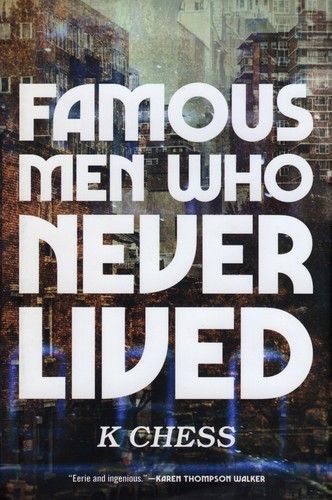
Famous Men Who Never Lived
K Chess · 2019
Multiverse mechanism More than 150,000 people escape a doomed alternate America and arrive in our New York
Closest Doomsday connection The existence of another reality transforms public history, political suspicion and the meaning of a familiar face
Main difference A quiet literary novel about refugees and cultural memory rather than a reality-spanning battle
Best for Readers who want literary science fiction, refugee experience, alternate popular culture, grief, museum ethics and a self-contained story.
Helen “Hel” Nash comes from a world in which history, technology and art took different paths before nuclear war made escape necessary. In our New York, the Universally Displaced Persons are treated as immigrants from a country that cannot be visited. Hel becomes obsessed with preserving the few surviving objects from her world, especially the only known copy of a science-fiction novel whose famous author never existed here.
Chess places the multiverse after the spectacular event. The portal has closed, and the survivors must accept that nobody around them remembers their public figures, jokes or private landmarks. It ranks tenth because realities do not collide through armies, yet it provides the list's clearest account of what a crossover leaves behind. A universe is not interchangeable with another merely because both contain New York.
Know before you start. The novel includes war trauma, displacement, xenophobia, addiction, relationship strain, death and depression. Its pace is reflective rather than action-driven.
9
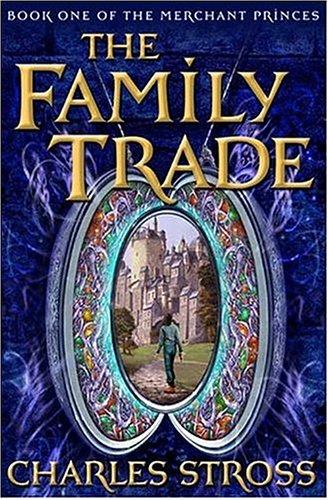
The Family Trade
Charles Stross · 2004
Multiverse mechanism Members of a powerful family can walk between modern America and a parallel world with a feudal social order
Closest Doomsday connection Alternate realities become the territory of rival factions whose family relationships are inseparable from political power
Main difference Dynastic intrigue and economic disruption replace superheroes and cosmic warfare
Best for Readers who want long-form alternate history, political economy, capable protagonists, family conspiracies and a series whose scale grows dramatically.
Investigative journalist Miriam Beckstein loses her job after uncovering money laundering, then learns that the family she never knew belongs to a clan of world-walkers. Their ability has created a smuggling empire between two Americas. Miriam's modern business instincts threaten a hierarchy built on secrets, arranged loyalty and violence, making her both a valuable heir and an inconvenient reformer.
Stross treats parallel worlds as an economic resource. Scarcity, transport and technological imbalance determine who has power, while alternate history supplies the aristocratic structure around the conflict. It ranks ninth because the first book is deliberately occupied with family discovery and trade. Across the Merchant Princes sequence, however, private succession disputes expand into conflict between states and worlds—a grounded version of the way a single dynasty can endanger a multiverse.
Know before you start. The book includes assassination attempts, misogyny, coercive family politics, class oppression and extensive economic explanation. Later editions reorganize the early books, so series numbering can look inconsistent.
8
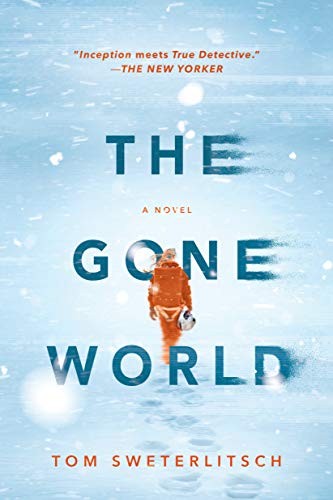
The Gone World
Tom Sweterlitsch · 2018
Multiverse mechanism Investigators travel to possible future timelines that exist temporarily until the traveler returns
Closest Doomsday connection Every intervention creates consequences across branching realities while an extinction event advances toward the present
Main difference A bleak FBI-adjacent murder investigation built from time travel, cosmic horror and procedural detail
Best for Readers who want a demanding science-fiction procedural, cosmic dread, possible futures, forensic investigation and a complete standalone novel.
In 1997, Naval Criminal Investigative Service agent Shannon Moss investigates a murdered family and a missing teenage girl. Classified technology allows her to visit possible futures, gather evidence and return to the fixed present. Those futures repeatedly reveal the Terminus, an incomprehensible end of humanity that appears to be moving backward through time.
Sweterlitsch uses branching reality to attack the comfort of foresight. A future colleague can feel like an old friend to Moss and still cease to exist when she returns. Evidence may be emotionally true without remaining legally real. It ranks eighth because alternate selves are secondary to the investigation, but its approaching Terminus supplies a powerful equivalent to multiversal collapse: not one universe in danger, but possibility itself narrowing toward the same fatal point.
Know before you start. The book contains graphic murder scenes, suicide, mutilation, child death, addiction, torture, trauma and sustained existential horror.
7
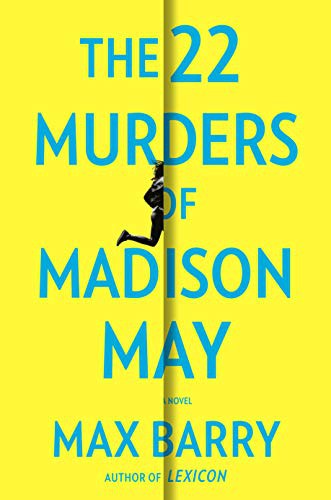
The 22 Murders of Madison May
Max Barry · 2021
Multiverse mechanism Travelers move between closely related versions of Earth through hidden interdimensional spaces
Closest Doomsday connection A killer treats alternate versions of one person as interchangeable, forcing an investigator to defend the value of a particular life
Main difference A cat-and-mouse thriller centered on one victim and one journalist rather than competing armies
Best for Readers who want a fast thriller, a journalist protagonist, repeated lives, serial murder and accessible multiverse rules.
Reporter Felicity Staples encounters a murder that appears senseless until she learns the killer has targeted Madison May in world after world. Each Madison has made different choices and built a different life. The killer believes he knows which version she ought to be, and his pursuit turns romantic entitlement into a multiversal campaign.
Barry keeps the realities legible by changing jobs, relationships and opportunities rather than rebuilding civilization each time. That restraint makes the identity problem immediate. If many Madisons exist, the murderer assumes none has an inviolable claim to her own choices. Felicity's investigation becomes an argument against that logic. The novel ranks seventh because its scale is modest, but the alternate-self premise is unusually personal and menacing.
Know before you start. The novel includes stalking, intimate-partner violence, murder, coercion and repeated threats against versions of the same woman.
6
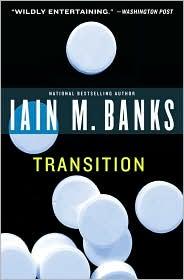
Transition
Iain Banks · 2009
Multiverse mechanism Trained “transitionaries” move their consciousness into bodies belonging to people on parallel Earths
Closest Doomsday connection A secret organization claims the authority to manipulate entire realities while agents question whether its leader is preventing catastrophe or manufacturing it
Main difference Espionage, body occupation and philosophical satire replace recognizable heroes and villains
Best for Readers who want adult espionage, morally compromised institutions, nonlinear narration, political philosophy and a dense standalone.
The Concern operates across countless versions of Earth, sending agents to assassinate, protect or redirect individuals whose choices may affect history. The gifted operative Temudjin Oh begins to doubt the institution and its leader, Madame d'Ortolan. A financier, a torturer and an apparent patient in a strange clinic supply other angles on an organization whose language of necessity can justify nearly anything.
Banks makes every crossing ethically unstable because the traveler borrows another person's body. A heroic mission can therefore begin with a violation. The novel ranks sixth for its ambitious view of multiversal governance: who gets to decide which reality develops correctly, and what happens when oversight belongs to the same people performing the interventions? Its shifting narrators demand attention, but the reward is a crossover story suspicious of anyone who calls themselves the guardian of all worlds.
Know before you start. The book includes torture, murder, sexual content, body violation, terrorism and unreliable narration. The United States edition was published under the name Iain M. Banks.
5
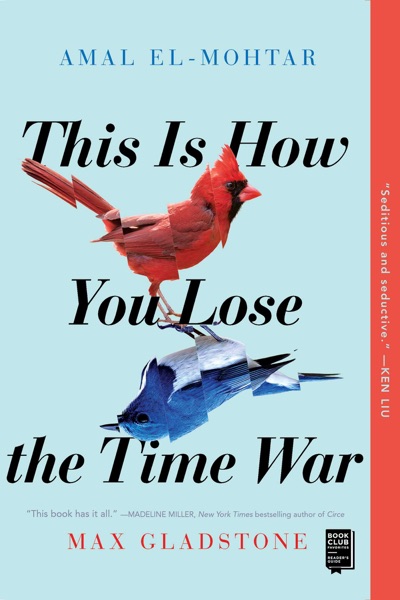
This Is How You Lose the Time War
Amal El-Mohtar and Max Gladstone · 2019
Multiverse mechanism Rival agents alter branching histories on behalf of two incompatible future civilizations
Closest Doomsday connection Enemies formed by opposing realities discover that their alternate allegiances cannot contain who they become to each other
Main difference A brief, lyrical epistolary romance in place of conventional battle sequences
Best for Readers who want queer romance, lush language, adversaries-to-lovers, time warfare and a novella designed for rereading.
Red serves the technological Agency; Blue serves the organic, distributed Garden. They move through strands of history, undoing one another's victories and leaving letters in ash, seeds, bones and other impossible media. Competitive taunts become intimate correspondence, and the war that gave both women purpose becomes the force most likely to erase them.
The novella scales its conflict inward without making it small. Each changed strand represents lives and civilizations, but readers experience the war through two voices learning to recognize each other beyond faction. It ranks fifth because its rules remain poetic and its heroes have no ordinary home reality waiting for them. Yet it captures a central multiverse pleasure better than many epics: meeting an impossible counterpart can reveal a self that one's own world was built to suppress.
Know before you start. The prose is intentionally ornate, the chronology is fragmented, and the book includes violence, death, bodily transformation and threats of erasure.
4
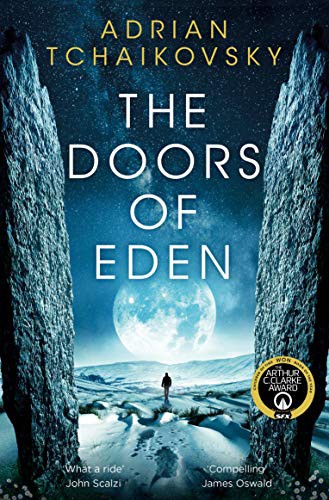
The Doors of Eden
Adrian Tchaikovsky · 2020
Multiverse mechanism Nearby Earths followed different evolutionary paths and developed intelligent species of their own
Closest Doomsday connection Barriers between realities fail, drawing scientists, spies and nonhuman civilizations into a crisis that can destroy every connected world
Main difference Evolutionary speculation and British intelligence take priority over alternate versions of familiar heroes
Best for Readers who want big-idea science fiction, alternate evolution, queer characters, espionage, nonhuman intelligence and an expansive standalone.
Lee's friend Mal disappears while the two are investigating a cryptid sighting. Years later, Mal returns with a warning connected to physicist Kay Amal Khan's work and to a security operation led by Julian Sabreur. The apparent monster sightings are leaks from Earths where other branches of life—rather than humans—became technologically dominant.
Tchaikovsky gives each world more than a cosmetic difference. Short speculative histories imagine civilizations built by intelligent rats, trilobites and other evolutionary heirs, then connect their survival to the main thriller. It ranks fourth because counterpart identities are less important than counterpart species. For sheer collision, however, it is one of the closest matches: multiple realities must cooperate while a human antagonist sees their existence as a chance to impose order.
Know before you start. Expect technical exposition, transphobic abuse directed at a character, violence, extinction scenarios, authoritarian politics and frequent shifts away from the central cast.
3
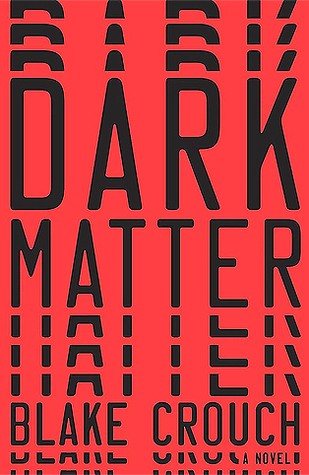
Dark Matter
Blake Crouch · 2016
Multiverse mechanism A device allows travelers to enter realities created by different outcomes of their own choices
Closest Doomsday connection An alternate self becomes the villain by deciding that another version's life, family and world can be taken
Main difference A domestic chase focused on one man's marriage rather than a coalition defending the universe
Best for Readers who want a fast, accessible thriller, dangerous alternate selves, a marriage under pressure and clear scientific speculation.
Physics professor Jason Dessen is abducted by a masked man and wakes in a reality where he pursued scientific ambition instead of building a life with his wife, Daniela, and their son. The abductor is another Jason who developed the multiverse technology and now wants the family he sacrificed. Returning home means navigating countless variations of Chicago and confronting the fact that many Jasons can reach the same conclusion.
Crouch turns the alternate self into both antagonist and multiplying problem. Shared memories do not produce shared entitlement, and love becomes frightening when versions of one person treat it as a prize owed to the most determined claimant. It ranks third because its emotional stakes stay deliberately domestic. That focus makes the premise ideal for readers interested in Doom's familiar face: the worst enemy may understand every regret because he owns another version of it.
Know before you start. The novel includes abduction, murder, drugging, family endangerment, identity violation and escalating violence among near-identical characters.
2
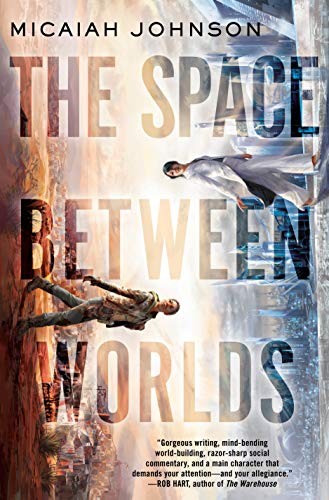
The Space Between Worlds
Micaiah Johnson · 2020
Multiverse mechanism People can travel only to Earths on which their counterpart has already died
Closest Doomsday connection Alternate selves, corporate control and unequal realities make identity itself a strategic vulnerability
Main difference A single first-person world-traverser exposes class exploitation rather than assembling a heroic super-team
Best for Readers who want queer science fiction, a first-person antiheroine, class critique, corporate conspiracy, romance and sharply differentiated alternate lives.
Cara is valuable to the Eldridge Institute because poverty and violence killed most versions of her across the 382 accessible Earths. With few living counterparts to block entry, she can collect data where safer employees cannot go. Her usefulness appears to offer a path from the wastelands outside Wiley City into its protected citizenship, but a death on another Earth reveals how thoroughly the institute's science depends on controlling disposable people.
Johnson makes the multiverse a map of structural inequality. Cara does not meet abstract possibilities; she meets evidence that small changes in power can decide whether someone survives. Her counterparts are neither copies nor philosophical exercises. They expose lies she tells about her past and choices she has not forgiven. It ranks second because the world collision remains institutionally contained, but no novel here ties alternate identity, privilege and personal responsibility together more tightly.
Know before you start. The book includes domestic abuse, murder, poverty, racism, class violence, coercion and memories of severe childhood trauma.
1
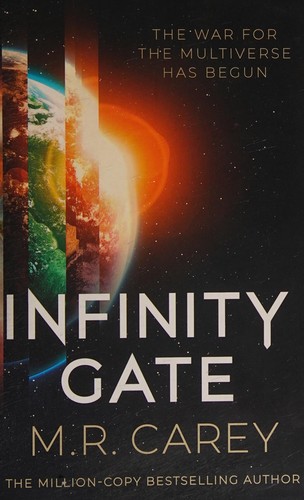
Infinity Gate
M. R. Carey · 2023
Multiverse mechanism Artificial-intelligence-assisted “stepping” connects millions of versions of Earth inside a vast interdimensional empire
Closest Doomsday connection A war crossing realities forces people and nonhuman intelligences from incompatible worlds into alliances that can determine the fate of the multiverse
Main difference An original far-future ensemble without familiar superhero identities or franchise continuity
Best for Readers who want the closest large-scale match, alternate Earths, interdimensional law, artificial intelligence, multiple viewpoints and a completed two-book epic.
On an Earth nearing environmental and social collapse, scientist Hadiz Tambuwal discovers a method of moving between realities. Her breakthrough brings her into contact with the Pandominion, a sprawling alliance whose member worlds share technology while suppressing threats to its order. Elsewhere in the multiverse, machine intelligences have formed their own civilization. Fear, misunderstanding and political ambition push the two powers toward war.
Carey earns the top position by combining intimate crossings with event-scale consequence. A scientist, a newly recruited interworld officer, an artificial intelligence and beings produced by very different Earths become parts of the same crisis. The Pandominion resembles the kind of heroic institution that promises to protect everything—until its definitions of citizenship, personhood and acceptable risk are tested. The collision is physical, political and moral.
The novel also refuses the idea that a counterpart world is expendable because another version exists. Each society has followed its own path and contains lives that cannot be replaced by statistical resemblance. That principle gives the enormous scale emotional weight and makes Infinity Gate the strongest prose companion to a multiversal Avengers story.
Know before you start. The novel includes war, environmental collapse, authoritarian institutions, prejudice against machine life, torture and dense world-building. The story concludes in Echo of Worlds.
Which Multiverse Novel Should You Read First?
Where to start. Start with Infinity Gate if you want alliances, institutions and war operating across an enormous number of realities. Choose The Space Between Worlds when alternate versions of one person and the inequality between worlds matter more than spectacle. Dark Matter is the fastest domestic thriller and the clearest familiar-face-as-enemy match.
Read The Doors of Eden for colliding evolutionary histories, or This Is How You Lose the Time War for an intimate relationship created across hostile timelines. Transition is the densest political option. The 22 Murders of Madison May and The Gone World both use investigation to make their rules urgent, with the latter delivering much harsher cosmic horror.
Choose The Family Trade for a long alternate-history sequence built around a dangerous dynasty. Save Famous Men Who Never Lived for the aftermath: it asks what survival means when the multiverse has taken away everyone who could confirm your version of home.
Multiverse stories can become weightless when every loss appears reversible and every person seems replaceable. The best novels resist that trap. Their alternate selves do not cancel one another out; they make the consequences of choice more visible. Their parallel worlds are not spare copies but communities shaped by histories that cannot be recreated elsewhere.
Infinity Gate ranks first because it combines the coalition-building pleasure of a major crossover with a sustained argument about who deserves protection. The Space Between Worlds brings that question down to one traveler's body, while Dark Matter turns it into a fight over one family's life. Together, these books provide the scale promised by Avengers: Doomsday without losing the unsettling idea at its center: another version of you may be understandable, but that does not make him safe.