Ranked · Cyberpunk
The Top 10 Cyberpunk Mystery Novels About Aging Detectives and Artificial Memories Like Blade Runner 2099
by E. M. Larkin
A ranked guide to compromised investigators, synthetic citizens, edited consciousness, corporate crime, unreliable evidence, dying partners, and cities whose official stories cannot explain their bodies
Blade Runner 2099 arrives on Prime Video on November 25, 2026, with a particularly useful hook for readers. The limited series pairs Cora, a fugitive who assumes the identity of a Blade Runner, with Olwen, a replicant nearing the end of her life. Their hunt for a runaway unfolds in a Los Angeles where the old hierarchy between humans and replicants has been overturned. That creates a narrower and more interesting reading need than another generic list of neon cyberpunk classics.
The books below are mysteries about people whose bodies, memories or professional identities have become unreliable. They feature exhausted investigators, artificial citizens, corporate states, edited consciousness and crimes that cannot be solved without asking who gets counted as human. Some are rain-soaked noir; others replace neon alleys with virtual cities, police states or an approaching apocalypse. Every selection, however, gives investigation real structural importance.
The ranking favors the specific tension promised by 2099: a detective who is already compromised, a partner whose personhood is politically contested and a case that exposes the system employing them. Familiar cyberpunk landmarks are omitted when they offer atmosphere without a genuine mystery. All ten ranked books come from different authors, and none has appeared as a ranked selection in the earlier Website lists.
Selection note. The ranking rewards investigative structure, compromised identity, artificial memory and institutional corruption before surface-level cyberpunk imagery. The books are not ranked by fame or technological plausibility.
10
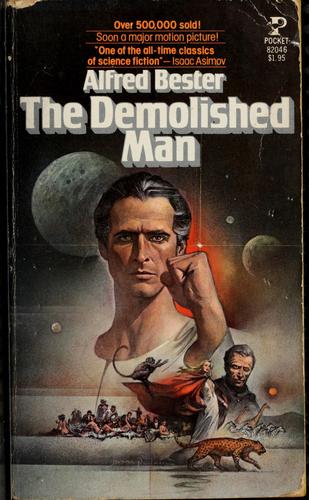
The Demolished Man
Alfred Bester · 1953
Investigative core A police prefect must prove murder in a society where telepaths have made premeditated killing nearly impossible
Closest 2099 connection Detection becomes a contest over private thought, social power and whether technology has really eliminated crime
Main difference A foundational, highly stylized science-fiction procedural rather than modern cyberpunk noir
Best for Readers who want a fast, inventive classic, psychic detection, corporate rivalry and the conceptual roots of science-fiction noir.
Ben Reich is a powerful industrialist who decides to murder a business rival even though trained telepaths can detect criminal intention. Police Prefect Lincoln Powell knows who is responsible, but knowledge is not the same as admissible proof. The pursuit becomes a duel between corporate privilege and an investigator who can enter minds yet still has to reconstruct physical action.
Bester earns a place because he understood early that better surveillance does not produce equal justice. Reich can purchase expertise, manipulate institutions and turn other people into instruments. Powell’s abilities make him formidable, but they also raise questions about mental autonomy that later cyberpunk would inherit. The novel ranks tenth because its psychology, typography and gender politics show their age, and artificial people are not central. Its essential idea remains potent: when a society claims technology has solved crime, the most revealing case is the one its assumptions cannot explain.
Know before you start. The prose uses experimental layouts and abrupt transitions. The novel includes murder, coercion, dated sexual attitudes and invasive manipulation of memory and personality.
9
Mindstar Rising
Peter F. Hamilton · 1993
Investigative core A former military psychic investigates industrial sabotage in a climate-damaged, privatized Britain
Closest 2099 connection An altered investigator works for wealthy interests while discovering that the case is also a struggle over the future political order
Main difference Near-future corporate thriller with psychic abilities rather than replicants and synthetic memory
Best for Readers who want a brisk mystery, psychic tradecraft, corporate sabotage, political reconstruction and a protagonist with military damage rather than glamorous cool.
Greg Mandel has left military service carrying a neural implant that sharpens his intuition and lets him sense emotional states. A powerful family hires him when sabotage threatens its technology company. The suspects include workers, rivals and members of the family itself, while postauthoritarian Britain is being remade by corporations faster than democratic institutions can recover.
Hamilton combines a private-eye structure with a transition economy in which the people funding an investigation are also accumulating dangerous power. Greg is neither a clean outsider nor an obedient company agent; his augmentation makes him useful and permanently separates him from ordinary life. The book ranks ninth because some character treatment and sexual politics feel conspicuously early-1990s, and its final scale is smaller than 2099’s social inversion. The procedural movement, damaged veteran perspective and corporate family intrigue nevertheless make it a revealing bridge between classic detective fiction and later cyberpunk.
Know before you start. The novel includes violence, sexual content, drug use and dated gender writing. It begins a trilogy but resolves its central investigation.
8
The Fortunate Fall
Raphael Carter · 1996
Investigative core A wired journalist pursues a historical atrocity while a remote editor experiences and alters her perceptions
Closest 2099 connection Memory is both evidence and contested territory in a state that can revise identity from inside the mind
Main difference A dense political media novel whose investigator is a reporter rather than a police officer
Best for Readers who want queer cyberpunk, media control, surveillance, unreliable memory and a demanding standalone that rewards rereading.
Maya Andreyeva reports from a future Russia through technology that transmits her senses to a “screener” who shapes the finished story. Her investigation into massacres, disappearances and forbidden research gradually reveals how thoroughly the state has engineered acceptable memory. The person sharing Maya’s mind may be her most intimate ally, another censor or both.
Few cyberpunk novels make mediation feel so physically invasive. Maya cannot simply gather facts; she must decide whether her own perceptions survive the systems converting experience into public narrative. That makes the mystery inseparable from intimacy and political terror. It ranks eighth because the plot can feel deliberately disorienting, and readers seeking a clean case-and-solution rhythm may struggle with its compression. For Blade Runner fans interested in implanted recollection as a political technology rather than a single character twist, it is one of the list’s most intellectually exact matches.
Know before you start. The book includes torture, genocide, sexual violence, state persecution and psychological manipulation. Important information arrives through implication rather than exposition.
7
Century Rain
Alastair Reynolds · 2004
Investigative core An archaeologist and a hardboiled detective investigate a murder across two versions of Earth
Closest 2099 connection A noir partnership reveals that the apparent city, historical record and identity of the victim are all politically manufactured
Main difference Alternate-history space opera with jazz-age Paris in place of a future Los Angeles
Best for Readers who want alternate history, archaeology, homicide investigation, cosmic scale and a patient mystery that expands dramatically.
Wendell Floyd is an expatriate detective working in an alternate 1950s Paris where fascist politics are rising and a seemingly minor death refuses to fit. Far in the future, archaeologist Verity Auger enters a preserved version of that world through a hidden portal. Their investigations converge around technology capable of destabilizing more than one civilization.
Reynolds uses the detective story to make two genres interrogate each other. Floyd believes he inhabits ordinary history; Auger approaches his world as an artifact. Each perspective turns the other into something dangerously close to a constructed person. The novel ranks seventh because its sprawling explanation eventually moves beyond noir into large-scale science fiction, and artificial memory matters less than artificial history. The partnership, melancholy city and conspiracy hidden inside the architecture make it a rewarding companion to 2099’s rebuilt Los Angeles.
Know before you start. The novel includes murder, fascism, war and extended technical exposition. Its middle section is slower than its opening investigation suggests.
6
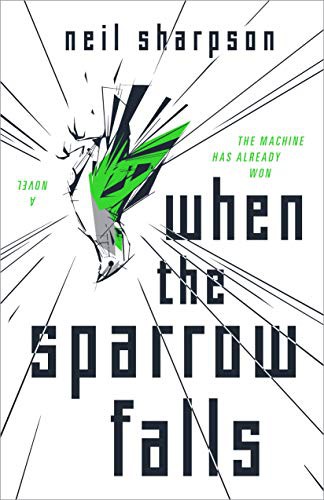
When the Sparrow Falls
Neil Sharpson · 2021
Investigative core A secret-police investigator examines the impossible death of a dissident in the last state to reject artificial intelligence
Closest 2099 connection The case destabilizes every legal boundary between a human self, a copied mind and a politically useful identity
Main difference A surveillance-state spy mystery driven more by ideology than street-level noir
Best for Readers who want political science fiction, secret police, copied consciousness, dry humor and an emotionally serious standalone.
Nikolai South works for the security apparatus of Caspian, an isolated dictatorship that defines itself through resistance to artificial intelligence. When an activist dies, the state orders South to escort the dead woman’s widow into the country. The widow is an artificial copy of the woman herself, a fact that turns routine protection into a crisis of law, grief and doctrine.
Sharpson’s premise reverses the familiar cyberpunk assumption that AI power is already normalized. Caspian’s prohibition has not protected human dignity; it has given the regime another category of treason. South is tired, observant and implicated in the institution he increasingly distrusts. The novel ranks sixth because it has fewer noir textures and action sequences than 2099, but the partnership between a compromised investigator and an illegal consciousness is exceptionally close. Its mystery asks whether continuity of memory creates a person when the state insists that it creates contraband.
Know before you start. The book includes suicide, execution, authoritarian violence, surveillance and grief. The tone balances bleak politics with restrained absurdity.
5
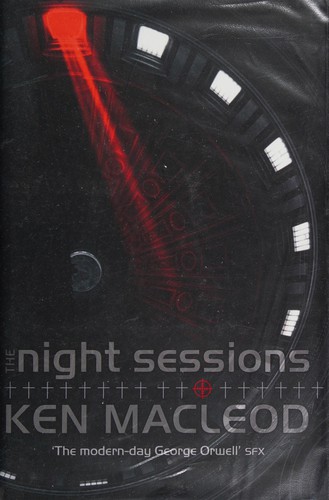
The Night Sessions
Ken MacLeod · 2008
Investigative core Edinburgh detectives investigate the bombing of a minister in a secular future shaped by wars involving faith and robotics
Closest 2099 connection Human police and self-aware machines pursue a case that exposes the prejudices built into their supposedly rational society
Main difference A conventional police procedural set in a postreligious Britain rather than a neon corporate dystopia
Best for Readers who want a rigorous police investigation, robot personhood, religion and secularism, political argument and a complete standalone.
Detective Inspector Adam Ferguson and his team initially confront what looks like religious terrorism. The evidence leads toward combat robots, underground believers and machines whose legal position remains uncertain after being used as expendable soldiers. A robot named Skulk becomes especially important to understanding what the human investigators cannot see.
MacLeod gives the machinery of detection real weight: interviews, evidence, departmental assumptions and political pressure all shape the answer. The robots are not metaphors waiting for humans to interpret them; they possess histories formed by military exploitation. Ferguson’s blind spots matter as much as his competence. The book ranks fifth because its world is cleaner and more daylight-bound than Blade Runner, and its philosophical debates sometimes interrupt suspense. It offers one of the strongest procedural treatments of police working beside beings their society has not decided to respect.
Know before you start. The novel includes terrorism, religious bigotry, war trauma, murder and ideological debate. Some readers may find its treatment of belief intentionally abrasive.
4
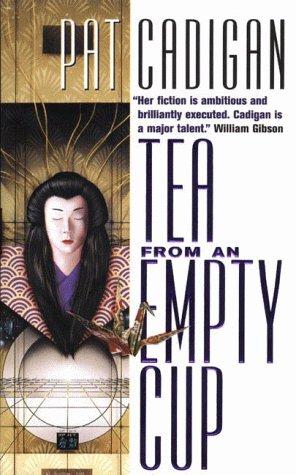
Tea from an Empty Cup
Pat Cadigan · 1998
Investigative core A detective investigates a death in artificial reality while another woman searches for a missing person inside the same network
Closest 2099 connection Identities are worn, traded and falsified in a city whose digital reconstruction may be more powerful than the lost original
Main difference Virtual-reality mystery with punk fragmentation rather than a physically grounded replicant hunt
Best for Readers who want women investigators, immersive worlds, punk style, identity play and a mystery that treats virtual space as culture rather than scenery.
Detective Dore Konstantin examines a death that occurred while the victim was connected to an immersive environment. Yuki, meanwhile, enters artificial reality looking for her vanished boyfriend. Both trails lead toward a simulated Japan assembled after disaster, where users adopt identities whose relationship to the physical world is deliberately unstable.
Cadigan makes investigation difficult for a reason: the environment has no neutral camera angle. Avatars lie, locations are coded experiences and even a dead body does not prove where the decisive act happened. Konstantin’s skepticism supplies the procedural spine while Yuki exposes the emotional seduction of choosing a more convincing self. The novel ranks fourth because its terminology and fractured transitions require adjustment, but that difficulty reinforces the theme. Like 2099, it imagines a future city rebuilt through the desires of people who cannot agree on what counts as authentic.
Know before you start. The book includes murder, addiction, sexual exploitation and disorienting shifts between realities. It is the first Dore Konstantin novel.
3
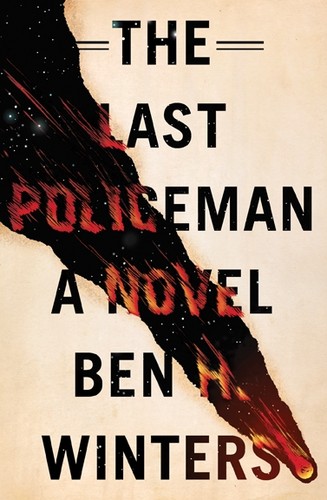
The Last Policeman
Ben H. Winters · 2012
Investigative core A newly promoted detective insists on investigating an apparent suicide months before an asteroid is expected to destroy Earth
Closest 2099 connection An investigator near the end of his world keeps asking what the job means when the institution and future sustaining it are disappearing
Main difference Contemporary-feeling preapocalyptic crime fiction with no artificial intelligence or cybernetic bodies
Best for Readers who want melancholy noir, an honorable but obsessive detective, social collapse and a completed trilogy with escalating emotional stakes.
Detective Hank Palace finds a man hanging in a fast-food restaurant bathroom. Suicides have become common since astronomers confirmed the coming impact, but details at the scene bother him. While colleagues, witnesses and entire industries abandon ordinary obligations, Hank treats the suspicious death as if legal continuity still matters.
The technological resemblance to Blade Runner 2099 is minimal; the existential resemblance is exact. Olwen’s approaching death gives the new series a partner with limited time, while Hank’s whole civilization lives under the same pressure. His procedural stubbornness can look noble, ridiculous or psychologically evasive. The novel ranks third because it strips science-fiction detection to its moral core: is solving one death worthwhile when everyone will die? The answer unfolds across a trilogy, but this first case reaches a satisfying resolution while changing the meaning of Hank’s commitment.
Know before you start. The novel includes suicide, murder, addiction, family estrangement and pervasive anticipatory grief.
2
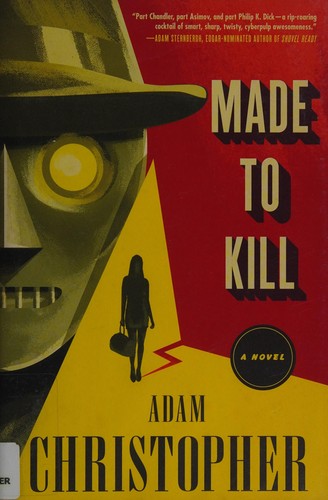
Made to Kill
Adam Christopher · 2015
Investigative core The world’s last robot works as both private detective and contract killer in 1960s Los Angeles
Closest 2099 connection An artificial investigator navigates a city that uses his labor while denying him equal personhood and controlling his memory
Main difference Playful alternate-history pulp with Hollywood satire and Cold War conspiracy
Best for Readers who want robot noir, Hollywood intrigue, fast chapters, dry humor and a completed trilogy of compact mysteries.
Raymond Electromatic has a twenty-four-hour memory tape, a computer handler and two linked businesses: investigation and assassination. A missing-person job involving a film star places him inside a plot of spies, studios and technology. Each day’s memory limit makes evidence management inseparable from identity; Raymond survives through records curated by a machine whose priorities may not match his own.
Christopher captures the pleasures of a classic Los Angeles private eye without treating the robot premise as decoration. Raymond can imitate the professional voice of noir, but he cannot assume that yesterday’s self will still be available tomorrow. His employment turns the usual replicant question sideways: he is permitted to kill because clients view him as a tool, not because they recognize his moral agency. The book ranks second for its artificial detective, controlled memory and entertainment-industry conspiracy. Its buoyant pulp tone keeps it from matching 2099’s likely gravity.
Know before you start. The novel includes assassination, murder and period sexism filtered through deliberate pulp pastiche.
1
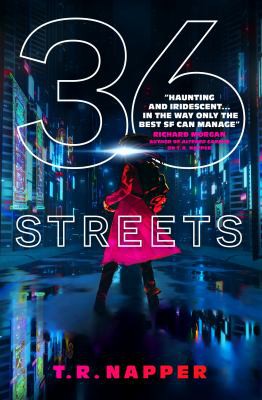
36 Streets
T. R. Napper · 2022
Investigative core A gangster and former soldier searches for a missing man in a Chinese-occupied future Hanoi shaped by addictive memory technology
Closest 2099 connection A compromised woman investigates on behalf of competing powers while memory, citizenship and loyalty are technologically unstable
Main difference A politically grounded Vietnamese-Australian cyberpunk novel centered on occupation and diaspora
Best for Readers who want violent noir, occupied cities, virtual memory, morally compromised women, Vietnamese history and cyberpunk with genuine political specificity.
Linh Dam works the thirty-six streets of Hanoi’s Old Quarter for a criminal organization. Her violence, military history and Australian upbringing make her both insider and outsider in a Vietnam transformed by Chinese power. An Englishman hires her to find a missing person connected to a virtual technology capable of making constructed experience more desirable than present life.
Napper earns first place because every familiar cyberpunk element has historical pressure behind it. Occupation is not a moody backdrop, and memory technology is not merely a puzzle device. Both intensify Linh’s uncertainty about which culture, employer and version of herself can claim her. The investigation moves through gang loyalties, state power and personal betrayal while preserving the hardboiled force of a protagonist who expects every alliance to carry a price.
The novel also makes the strongest companion to 2099’s inverted Los Angeles. Each city has been remade after political rupture, and each detective works inside a hierarchy that turns identity into documentation. Linh is younger than Olwen, but she carries the exhaustion of someone who has already outlived several selves.
Know before you start. The book includes war trauma, torture, addiction, racism, colonial violence, organized crime and graphic combat. Vietnamese dialogue and history are integral rather than ornamental.
Which Blade Runner 2099 Read-Alike Should You Read First?
Where to start. Start with 36 Streets for the best overall match: a compromised investigator, a city altered by occupation and technology that makes memory politically valuable. Choose Made to Kill if the artificial detective is the essential attraction and you want a faster, funnier noir.
Read The Last Policeman for an investigator facing literal expiration, or When the Sparrow Falls for the closest partnership between a state officer and an illegal copied consciousness. Tea from an Empty Cup is the choice for virtual cities and female investigators; The Night Sessions offers the most conventional police procedure involving robot personhood.
Pick The Fortunate Fall when you want memory manipulation at its most politically unsettling. Choose Century Rain for expansive alternate history, Mindstar Rising for corporate sabotage and The Demolished Man to see one of the genre’s earliest arguments that perfect surveillance cannot create justice.
The enduring Blade Runner question is not whether an artificial being can imitate a person. It is who benefits from pretending the answer is uncertain. The best novels here place that question inside a case, where recognition determines who may testify, own memory, receive protection or be murdered without consequence.
36 Streets makes memory part of occupation. Made to Kill gives a robot the detective’s voice while limiting his access to his own past, and The Last Policeman removes cybernetics entirely to reveal the profession’s existential core. These books do more than reproduce rain, neon and trench coats. They understand that noir begins when a city’s official account cannot explain the bodies it leaves behind.