Ranked · Superhero Fiction
The Top 10 Superhero Novels About Corporate Heroes, Celebrity Power, and Cover-Ups Like The Boys
by E. M. Larkin
A ranked prose guide to branded saviors, managed scandals, disposable sidekicks, villain labor, public relations, secret agencies, and ordinary people trapped beneath profitable heroism
The fifth and final season of The Boys concluded on Prime Video in May 2026, leaving a large audience searching for similarly vicious treatments of superhero celebrity. Search results remain dominated by comics such as Watchmen, Invincible and Irredeemable. That creates a useful prose-fiction gap: novels about heroes whose images, missions and collateral damage are controlled by institutions with more interest in market share than justice.
The ten books below use superhero conventions in prose rather than simply borrowing a caped aesthetic. They include public identities, teams, agencies, branded villains, henchpeople or the workers who clean up after spectacular battles. Not every world is as nihilistic as Vought’s; several are comic or hopeful. The common thread is attention to the labor and power behind hero mythology.
Higher entries expose systems—media, corporations, governments or narrative franchises—rather than relying on one secretly evil champion. Lower choices may focus on a villain, a marginal employee or a younger resistance group. Graphic novels and tie-ins are excluded, and every author is different.
Selection note. Books are ranked for corporate control, celebrity performance, institutional cover-up and the gap between heroic branding and lived consequence. Darkness alone was not enough.
10
Starter Villain
John Scalzi · 2023
Story engine An ordinary man inherits a relative’s global supervillain business and its hostile corporate rivals
Closest The Boys connection Villainy operates through boards, labor disputes, branding, technology and negotiations rather than theatrical evil alone
Main difference A breezy comic caper with no superheroes and intentionally low emotional weight
Best for Readers who want fast humor, clever animals, labor jokes and a standalone palate cleanser.
Substitute teacher Charlie Fitzer expects little from his estranged uncle’s death until he inherits an island base, sentient spy cats, unionized dolphins and membership in a consortium of ruthless technology magnates. Competitors assume Charlie understands the rules of inherited villainy; surviving requires learning which absurd conventions conceal real financial violence.
Scalzi supplies the corporate machinery missing from many superhero novels. Secret lairs require staff, intellectual property and risk management, while grandiose rivals behave like executives protecting a cartel. The book closes the ranking because caped hero culture is absent, but its central joke matches Vought perfectly: world-threatening spectacle is often just predatory business with better scenery.
The book takes position #10 because it is the lightest and least superheroic entry, but the corporate-villain satire is precise.
Know before you start. The novel includes murder, kidnapping and corporate violence, presented in a light comic tone.
9
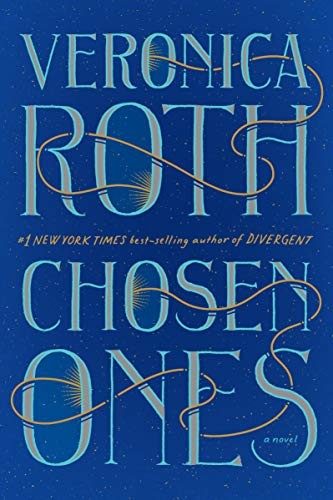
Chosen Ones
Veronica Roth · 2020
Story engine Former teenage saviors discover that the institution which trained them concealed the nature of their victory
Closest The Boys connection Public fame, trauma and managed history follow heroes long after the official enemy is defeated
Main difference A portal-and-magic thriller focused on aftermath rather than a functioning celebrity corporation
Best for Readers who want adult former chosen ones, prickly women, institutional secrets and a complete standalone.
Ten years after five teenagers defeated the Dark One, Sloane Andrews remains angry, traumatized and suspicious of the government program that selected them. A death reunites the group, and evidence about classified training leads into another world where their celebrated story has a different political use.
Roth begins where a franchise finale usually ends. Interviews, exhibitions and public gratitude cannot repair what the chosen children endured, and official secrecy protects the adults who shaped them. Sloane’s hostility is not a failure to appreciate hero status; it is evidence that status was imposed. The second-world plot is conventional, but the opening critique of manufactured saviors is strong.
The book takes position #9 because it belongs for its treatment of post-hero trauma, though celebrity satire recedes as the fantasy plot expands.
Know before you start. The book includes suicide, PTSD, child soldiers, death, substance use and emotional abuse.
8
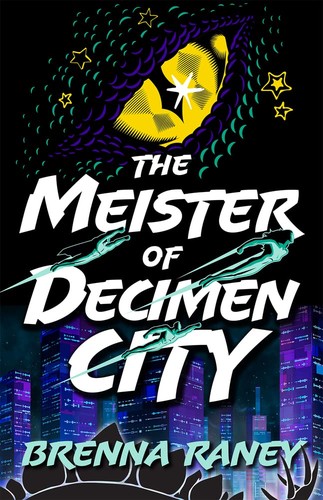
The Meister of Decimen City
Brenna Raney · 2023
Story engine A queer supergenius branded as a villain tries to stop her brother while caring for genetically engineered dinosaurs
Closest The Boys connection Public labels, hero oversight and spectacular inventions turn moral identity into performance
Main difference A warm, eccentric character comedy rather than systemic corporate horror
Best for Readers who want adult queer characters, mad science, dinosaurs, family conflict and superhero comedy.
Rex has created weapons, dinosaurs and enough disasters to earn quasi-villain status, though she would rather avoid both heroes and governments. Her brother Last Dance becomes a genuine threat to Decimen City, forcing Rex to repair an old failure while misleading the sanctioned champions who assume they understand her role.
Raney’s satire depends on the gap between reputation and intention. Rex’s inventions create real risks, yet the hero-villain bureaucracy prefers a stable label to complicated accountability. Her dinosaurs and awkward relationships give the book an affectionate center. It ranks eighth because its institutions remain comic scenery, but readers exhausted by The Boys’ despair may welcome a world where damaged people can choose repair.
The book takes position #8 because its queer supervillain perspective is distinctive even when the plot becomes deliberately silly.
Know before you start. The novel includes violence, family trauma and dangerous experiments; humor is quirky and highly subjective.
7
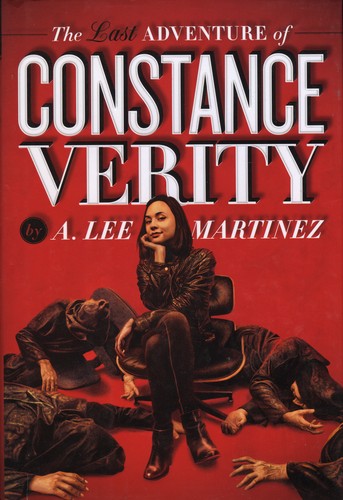
The Last Adventure of Constance Verity
A. Lee Martinez · 2016
Story engine A woman destined for endless world-saving adventures tries to end the narrative machinery controlling her life
Closest The Boys connection Heroism functions like a franchise that consumes the performer while treating escalating danger as normal content
Main difference A comic meta-adventure without a Vought-like corporation or political cruelty
Best for Readers who want comedy, genre parody, a hyper-competent woman and the start of a trilogy.
Constance Verity has fought cults, monsters and cosmic threats since childhood because a fairy blessing made adventure inevitable. She wants ordinary adulthood. Attempting to remove the blessing reveals how many enemies, allies and universal systems depend on her remaining the heroine everyone expects.
Martinez turns franchise obligation into literal fate. Constance is competent enough to save the world but lacks the freedom to decide whether doing so should be her identity. The cheerful pace conceals a sharp question about who benefits from a hero’s permanent availability. It belongs beside The Boys less for corruption than for seeing heroic spectacle as an industry that cannot allow its star to stop.
The book takes position #7 because its meta-fictional critique is clever, though far gentler than the screen anchor.
Know before you start. The book includes violence and repeated danger but maintains a light, adventurous tone.
6
The Astounding Antagonists
Rafael Chandler · 2014
Story engine Supervillains become the protagonists in a world where celebrated heroes protect a compromised order
Closest The Boys connection Public categories of hero and villain conceal institutional violence and self-serving mythology
Main difference Pulpier, more explicit and more interested in villain-team action than corporate detail
Best for Readers who want adult supervillains, violent action, moral inversion and independent genre fiction.
A group of costumed antagonists confronts the heroes, governments and personal histories that defined them as threats. Their abilities and motives differ, but each has reason to distrust the official account of justice. The resulting alliance turns a collection of genre villains into a team capable of exposing what sanctioned champions defend.
Chandler reverses perspective without pretending every villain is secretly innocent. The useful match is narrative control: institutions possess the cultural power to name resistance criminal before any battle begins. The novel’s independent-publishing roughness and graphic excess keep it below more polished entries, but its anger at heroic legitimacy is a direct fit.
The book takes position #6 because it is the hardest-edged villain-team novel here, with corresponding tonal and stylistic caveats.
Know before you start. The book includes graphic violence, sexual content, profanity and deliberately abrasive characters.
5
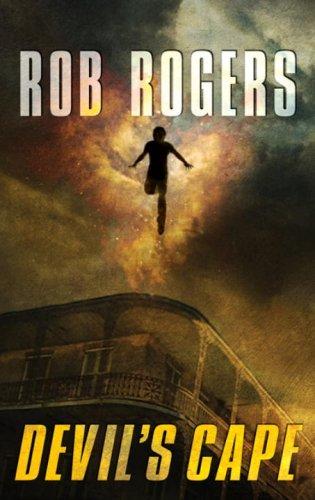
Devil’s Cape
Rob Rogers · 2008
Story engine Costumed figures, criminals and residents collide in a corrupt Gulf Coast city
Closest The Boys connection A heroic team emerges from people whom official institutions and respectable society have failed
Main difference A dense ensemble origin with urban-fantasy elements and less focus on mass media
Best for Readers who want a large cast, Southern Gothic atmosphere, crime families and a standalone team origin.
Devil’s Cape is a Louisiana city whose history of pirates, corruption and catastrophe has produced its own mythology. Multiple residents—including a doctor, a fighter and people touched by supernatural forces—move toward a public confrontation with organized crime and civic power. Their separate stories reveal who benefits when the city labels some violence heroic and some criminal.
Rogers treats the city as the corporation: reputation, policing and old money determine which extraordinary people can act openly. The ensemble structure gives victims and workers space before the team coheres. It lacks the concentrated celebrity satire of higher entries, but its morally mixed civic world feels inhabited rather than designed only to stage fights.
The book takes position #5 because it is a rewarding adult superhero mosaic whose complexity also slows the opening.
Know before you start. The novel includes sexual violence, murder, racism, corruption and graphic combat.
4
Playing for Keeps
Mur Lafferty · 2007
Story engine People with apparently useless powers gather at a bar while famous heroes and villains overlook them
Closest The Boys connection The hierarchy of marketable heroism turns ordinary powered workers into collateral until they organize themselves
Main difference Warm, comedic and community-minded rather than brutal or cynical
Best for Readers who want underdog powers, bar-community found family, humor and a brisk standalone.
Keepsie Branson owns a bar for people whose abilities never qualified them for elite hero status. Her own power prevents anyone from taking what belongs to her. When a supervillain entrusts her with an object and the city’s sanctioned heroes demand it, Keepsie and her friends discover how little protection the official system extends to people it considers minor.
Lafferty looks at superhero society from the service entrance. The protagonists know the celebrities’ reputations because they clean, pour drinks and survive street-level consequences. Their supposedly trivial powers become formidable when applied collectively. That labor perspective is ideal for The Boys readers, even though the novel believes community can answer corruption without becoming equally monstrous.
The book takes position #4 because its D-list ensemble supplies the best humane counterpoint to Vought’s ranking system.
Know before you start. The book includes violence, kidnapping and manipulation; its indie origins show in a few rough edges.
3
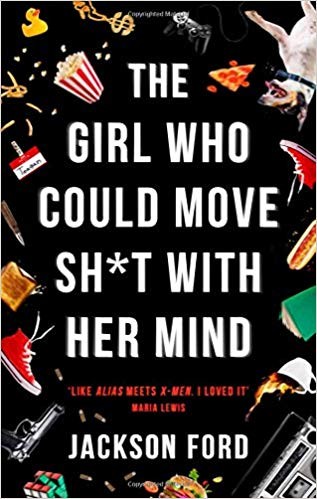
The Girl Who Could Move Sh*t with Her Mind
Jackson Ford · 2019
Story engine A telekinetic operative works for a deniable government team and is framed for murder
Closest The Boys connection Handlers, secret funding and damage control matter as much as the power being sold as public protection
Main difference More irreverent conspiracy thriller than celebrity satire
Best for Readers who want a first-person voice, telekinesis, found-team dynamics and a completed urban science-fiction series.
Teagan Frost wants a normal life, but the government uses her telekinesis for covert break-ins under threat of imprisonment. When a body is found murdered in a way only she appears capable of producing, Teagan has hours to clear her name. Her investigation exposes another powered person and the secrets behind the program that controls her team.
Ford makes superpower employment feel like precarious labor. Teagan receives missions, restrictions and blame without meaningful consent; supervisors protect the program before the people performing its work. Her team’s abrasive loyalty gives the novel heart while Los Angeles infrastructure becomes part of the action. The tone is lighter than The Boys, but its distrust of official ownership is close.
The book takes position #3 because it balances powered action, institutional coercion and team banter better than most prose series.
Know before you start. The novel includes murder, coercive employment, body horror, addiction references and frequent profanity.
2
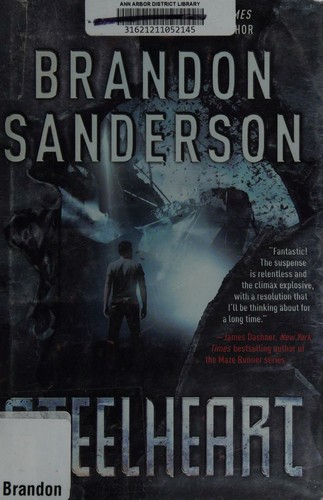
Steelheart
Brandon Sanderson · 2013
Story engine People granted superpowers become tyrants, and ordinary specialists study their weaknesses
Closest The Boys connection A resistance team treats invulnerable celebrity rulers as systems that can be researched, exposed and killed
Main difference A young-adult action novel with cleaner morality and little corporate workplace satire
Best for Readers who want quick action, tactical puzzles, evil superheroes and a completed trilogy.
After a celestial event creates Epics, the most powerful seize cities. Steelheart rules Newcago from a blackened tower after killing David Charleston’s father. David spends years collecting evidence about Epic weaknesses and forces his way into the Reckoners, ordinary humans who use planning and technology to assassinate superpowered dictators.
Sanderson begins from the suspicion at the heart of The Boys: power and public worship are a dangerous combination. The Reckoners resemble a more idealistic Boys team, complete with surveillance, improvised weapons and disagreement about acceptable risk. Weakness puzzles provide satisfying structure. It ranks high despite its YA simplicity because the premise remains literal and the resistance earns victories through knowledge rather than matching powers.
The book takes position #2 because it is the clearest full-length thriller about ordinary people hunting corrupt supers.
Know before you start. The book includes mass killing, authoritarian rule, parental death and gun violence, but little graphic sexual content.
1
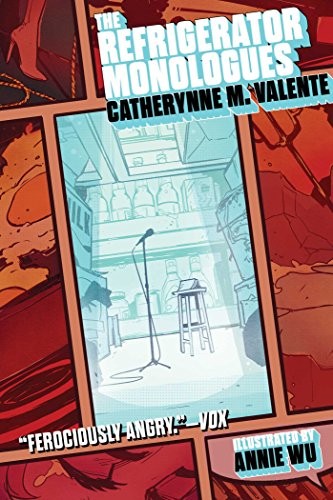
The Refrigerator Monologues
Catherynne M. Valente · 2017
Story engine Dead women from superhero stories tell how famous men converted their suffering into motivation and myth
Closest The Boys connection Celebrity hero culture depends on controlling the narratives of partners, sidekicks and victims it treats as disposable
Main difference A linked story collection focused on gendered genre critique rather than one continuous conspiracy
Best for Readers who want feminist satire, linked monologues, recognizable archetypes and a short adult read.
In Deadtown, women modeled on familiar comic-book figures gather to tell their own stories. A brilliant partner is institutionalized, a girlfriend is killed to propel a hero, a cosmic woman becomes too powerful for her franchise, and a rebellious teen is reduced to a cautionary tale. Their voices expose the editorial logic that made celebrated men central.
Valente attacks the story factory beneath the superhero corporation. The injustice is not only what happened to these women; it is who receives authorship afterward. That makes the book a precise prose companion to The Boys, where public myth converts victims into usable content. Anger, humor and stylistic variety keep the collection from becoming a lecture, though familiarity with superhero archetypes deepens the effect.
The book takes position #1 because it offers the most concentrated and literarily inventive critique of heroic branding.
Know before you start. The book includes murder, sexual violence, institutionalization, suicide, abuse and repeated misogyny.