Finding books like The Broken Earth is difficult because N. K. Jemisin's trilogy does not separate its marvels from its wounds. The Stillness is a triumph of geological worldbuilding, but its earthquakes matter because people have built law, caste, family, education, and cruelty around surviving them. Orogeny is a spectacular magic system, but it is also the reason human beings are collared, bred, trained, feared, and murdered.
Then there is the form. The Fifth Season uses second person and three apparently separate narratives to make identity itself part of the revelation. Later volumes expand toward deep history, engineered peoples, the Moon, and a conflict in which saving the world may require deciding what kind of world deserves to survive. The trilogy is simultaneously intimate and planetary: a story about a mother and daughter whose arguments can alter the Earth.
This list ranks books by how well they reproduce or complicate those qualities. Some are climate apocalypses. Some are fantasies of colonial power and weaponized bodies. Some carry collective trauma through formally ambitious narration. A few have no geological magic at all, yet understand Jemisin's central achievement: catastrophe is never merely natural once a society decides who will be protected from it.
The top entries are the closest overall emotional and political matches. Lower entries may isolate one element—memory, empire, ecological transformation, fractured identity, or rage—and pursue it in a different genre.
10
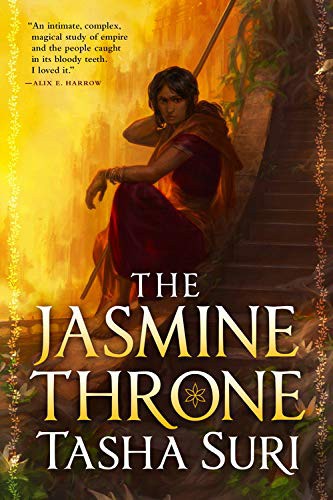
The Jasmine Throne
Tasha Suri · 2021 · The Burning Kingdoms, Book 1
Closest Broken Earth Connection Empire, women with dangerous power,
Main Difference It is a lush secondary-world political fantasy
ecological magic, suppressed cultures, bodily transformation, and love entangled with revolution
rather than an apocalypse narrative
Princess Malini has been imprisoned by her emperor brother for refusing to submit to ritual death. Priya, a maidservant with a hidden past, belongs to a people whose sacred knowledge and magical history the empire has tried to erase. Their meeting creates an alliance in which desire, political necessity, faith, and revenge refuse to remain separate.
Suri's magic is vegetal rather than geological. The yaksa, the sacred Hirana, a spreading rot, and transformations of human bodies tie political history to the living world. Empire does not merely occupy territory. It renames gods, destroys institutions, controls which forms of knowledge count as truth, and then treats the damage it caused as evidence of the conquered people's disorder.
That logic will be familiar to readers of The Broken Earth. The Fulcrum defines orogenes as dangerous while depending on their labor. Parijatdvipa suppresses Ahiranyi power while fearing what survives beneath official history. In both worlds, women make morally difficult choices because every available institution was designed to use them.
The Jasmine Throne is more courtly, romantic, and expansive. Its many viewpoints slow the opening, and its ecological consequences emerge gradually across the trilogy. It lacks Jemisin's formal shock and immediate planetary crisis. Choose it for the politics of stolen magic, the intimacy of two women deciding whether they can use one another without reproducing the empire they hate, and a world in which the land has not forgotten conquest.
We reviewed this: read our full review of The Jasmine Throne →
9
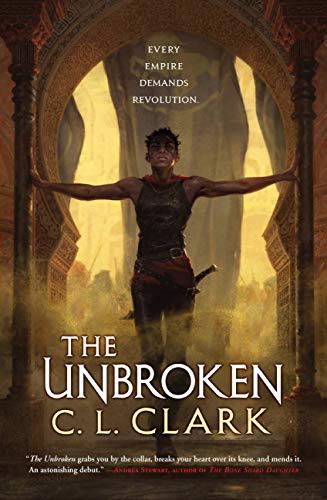
The Unbroken
C. L. Clark · 2021 · Magic of the Lost, Book 1
Closest Broken Earth Connection Colonial rule, weaponized children,
Main Difference It is a military-political fantasy focused on
divided identity, institutional violence, rebellion, and power the empire needs but cannot truly own
occupation rather than environmental catastrophe
Touraine was stolen from her homeland as a child and raised as a soldier of the Balladairan Empire. Sent back with other conscripts to suppress rebellion, she discovers that the culture she was trained to forget has not forgotten her. Princess Luca, meanwhile, needs control of the colony to secure her own claim to the throne and believes reform can preserve the empire.
The novel's strongest connection to The Broken Earth is institutional motherhood. The empire takes children, reshapes their loyalties, rewards obedience, and presents the resulting damage as proof that they belong nowhere else. Touraine's body, training, language, and friendships are products of a system that calls itself civilization. Like a Fulcrum-trained orogene, she is valuable because she has survived the process designed to break her.
Clark refuses to make identity a clean homecoming. The rebels have legitimate reasons to distrust Touraine. Luca can be sincere about reducing harm while remaining committed to the structure creating it. Love does not solve the political contradiction between them; it gives that contradiction a pulse.
The magic is understated in this first volume, and readers seeking obelisks, seismic spectacle, or narrative experimentation will not find them. The pacing can also feel caught between romance, military fantasy, and political argument. It belongs here because it understands one of Jemisin's hardest truths: surviving an abusive institution does not leave a person outside it. Survival makes the institution part of the self that must decide what liberation means.
8

The Deep
Rivers Solomon, with Daveed Diggs, William Hutson, and · 2019 · Standalone novella
Closest Broken Earth Connection Collective memory, inherited
Main Difference It is a compact underwater novella rather than a
Jonathan Snipes
trauma, altered descendants, ecological devastation, and one person forced to carry a people's unbearable history
multi-volume epic
The wajinru are water-breathing descendants of pregnant African women thrown overboard during the transatlantic slave trade. Their society survives by placing the full memory of that origin into a single historian. Yetu carries generations of grief so everyone else can live without being consumed by it. The role is sacred, necessary, and destroying her.
The connection to The Broken Earth is immediate at the level of memory. Jemisin's characters inherit a world built from violence whose official stories conceal responsibility. Essun carries personal losses that become inseparable from planetary history. Yetu carries history as a bodily condition. Both works ask whether a community can survive by making one person contain the pain everyone else refuses to hold.
Solomon's shifting voice moves between Yetu's individuality and the collective "we" of her people. That formal movement is not ornament. It asks where the self ends when memory, survival, and obligation have been distributed unequally. The ocean also performs the work geology performs in Jemisin: environment, body, history, and myth become a single system.
Because it is short, The Deep cannot offer the political breadth or slow revelation of The Broken Earth. Its premise carries enormous historical weight, and some readers may wish the society had more room to develop. What it delivers is concentrated and emotionally exact: a story about the cost of remembering, the violence of forgetting, and the possibility that shared history must actually be shared before it can become anything other than a wound.
7
The Power
Naomi Alderman · 2016 · Standalone
Closest Broken Earth Connection A feared biological power, gendered
Main Difference It is near-future speculative fiction with
violence, social upheaval, multiple viewpoints, apocalyptic history, and institutions reorganizing around who can hurt whom
satirical distance and no secondary-world magic
Teenage girls develop the ability to release electrical force from their bodies. The change spreads to older women and overturns a fundamental assumption behind gendered violence. Alderman follows people across politics, religion, crime, journalism, and family as a new capacity for harm rearranges the world.
Like orogeny, the power is both physical fact and social meaning. It does not arrive with a moral program. Institutions decide how to train it, worship it, criminalize it, sell it, and use it. People who have lived under threat experience the capacity to retaliate as liberation; people gaining authority discover how quickly protection becomes permission.
The novel's frame presents the main story as a historical manuscript from a later social order. That distance changes how every apparent revolution is read. The Broken Earth also uses narrative position to complicate the meaning of catastrophe: who is speaking, from which future, and with what assumptions matters as much as what occurred.
Alderman's argument is colder and more schematic than Jemisin's. Characters sometimes function as routes through a thought experiment, and the reversal of power can flatten differences among women's lives. There is also no ecological worldbuilding to match the Stillness. Read it if the Fulcrum, the Guardians, and the social construction of dangerous bodies were the parts of The Broken Earth you found most provocative.
6
The City in the Middle of the Night
Charlie Jane Anders · 2019 · Standalone
Closest Broken Earth Connection A hostile planetary environment,
Main Difference It is science fiction on a tidally locked alien
rigid survival cultures, revolution, queer relationships, nonhuman intelligence, and societies mistaking adaptation for permanence
planet rather than post-apocalyptic science fantasy on Earth
Humanity survives on January, a planet with one face locked toward its sun. Civilization occupies the narrow habitable region between lethal day and lethal night. Xiosphant regulates time, behavior, and movement with authoritarian precision; Argelo celebrates freedom while disguising its own hierarchies. Neither city is as stable as its citizens need to believe.
Sophie is exiled into the night and encounters the planet's native inhabitants, beings humans have treated as monsters because recognizing intelligence would complicate settlement. Mouth, a trader and survivor of a destroyed culture, carries a different form of dislocation. Their stories converge around revolution, failed friendship, communication, and the question of whether humanity can change before January makes the decision for it.
The planet is not a backdrop. Light, temperature, migration, food, architecture, and political control form one structure. As in the Stillness, survival rules acquire sacred authority because catastrophe is real. The danger begins when a community mistakes the rules that once saved it for proof that no other life is possible.
Anders is messier and more openly hopeful than Jemisin. The relationships can be frustrating, the political movements sometimes develop unevenly, and the ending leaves important futures unresolved. The book earns its place through ecological imagination and its refusal to let humans remain the only interpreters of the world. It asks what the Stillness also asks: what if the supposedly hostile planet is not the thing refusing to communicate?
5
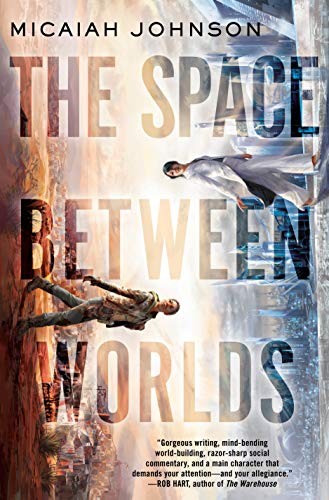
The Space Between Worlds
Micaiah Johnson · 2020 · The Space Between Worlds, Book 1
Closest Broken Earth Connection Fractured identity, systemic
Main Difference It is a multiverse thriller rather than climate
inequality, repeated selves, trauma, scientific power, and a protagonist whose disposability makes her uniquely valuable
fantasy
Multiverse travel is possible only when a traveler's counterpart on the destination world is dead. Cara can visit hundreds of Earths because hundreds of versions of her did not survive. A corporation values her precisely because poverty, violence, and geography made people like her disposable across reality.
That premise has the brutal elegance of orogeny. A social order identifies a marginalized person's survival as a resource while refusing to confront the conditions that endangered her. Cara receives status, housing, and proximity to power, but her value depends on the deaths of selves the dominant city would never have considered valuable on their own.
Johnson uses alternate Caras to explore identity without treating trauma as destiny. Similar people make different choices when power, love, and opportunity change. The novel's movement between worlds creates a structural equivalent to Jemisin's divided narratives: the reader keeps asking which differences matter and which stories authority has trained Cara to tell about herself.
The plotting is faster and more conventional than The Fifth Season, with corporate secrets and thriller reversals driving the middle. Its world is socially sharp but less environmentally complete than the Stillness. Choose it if the revelation connecting Essun, Damaya, and Syenite made you want another speculative novel where form, identity, and oppression converge—and where the person labeled expendable becomes the only one who can see the entire system.
4
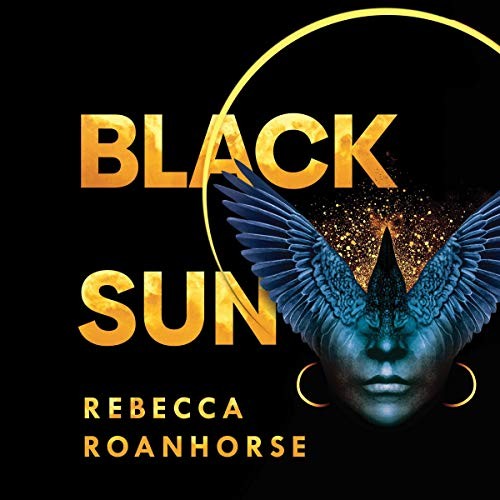
Black Sun
Rebecca Roanhorse · 2020 · Between Earth and Sky, Book 1
Closest Broken Earth Connection Suppressed peoples, divine power
Main Difference It is an Indigenous Americas-inspired epic fantasy
embodied in damaged humans, political institutions, cyclical history, multiple viewpoints, and catastrophe approaching on a known calendar
organized around celestial prophecy rather than geology
In the city of Tova, a solar eclipse approaches during a politically charged festival. A blind young man named Serapio travels toward it after a childhood ritual transformed him into the vessel of a god. A disgraced ship captain carries him across dangerous waters, while a priest of the ruling Watchers tries to hold together an institution built over older violence.
Roanhorse constructs history through competing accounts of massacre, faith, law, and revenge. The ruling order presents itself as peace. Those whose ancestors paid for that peace remember conquest. Serapio's body is simultaneously weapon, sacred text, family project, and person—roles that echo the way orogenes are made to carry everyone else's need for safety.
The approaching eclipse gives the novel the pressure of a Season. Everyone knows the date; no one agrees about what will happen or who deserves to survive it. Multiple viewpoints reveal how institutions manufacture normality while the excluded preserve another chronology beneath it.
Black Sun is more conventionally epic and its first volume ends at the point of convergence, requiring the sequels for consequence. Its magic is divine and celestial, not scientific in the way Jemisin gradually makes orogeny scientific. Yet readers who loved the collision of personal trauma, ancient injustice, and world-changing power will recognize the force of a body trained by one generation to become the next generation's catastrophe.
3
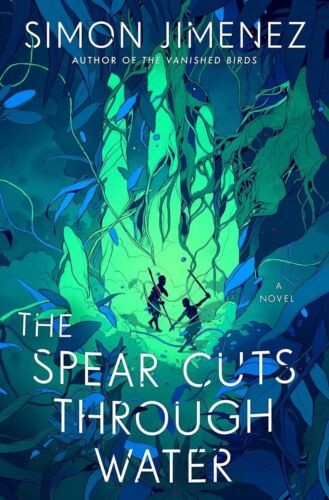
The Spear Cuts Through Water
Simon Jimenez · 2022 · Standalone
Closest Broken Earth Connection Formal experimentation, inherited
Main Difference It is a mythic journey rather than a geological
violence, empire, gods in mortal bodies, queer love, shifting perspective, and storytelling as a structure of survival
apocalypse
At the center is a seemingly familiar story: two warriors escort a dying goddess across a land ruled by her tyrannical sons. Around that journey is a theater outside ordinary time, a grandchild listening to family history, and a chorus of voices that can enter a paragraph for a sentence before disappearing again.
Jimenez makes narrative form part of the world's moral argument. First person, second person, third person, stage direction, memory, and dream overlap without collapsing into randomness. The story keeps reminding the reader that epics are built from the lives they usually treat as background. A guard, servant, victim, or passerby may briefly seize the narrative and reveal what heroic history costs.
That is why the comparison to The Broken Earth is stronger than the plot summary suggests. Jemisin's second person turns trauma and divided identity into grammar. Jimenez uses perspective to challenge the ownership of myth. Both novels reward the moment when an initially disorienting structure becomes the only truthful way the story could have been told.
The book requires surrender to its rhythm. Readers seeking a transparent magic system or efficient quest may find it ornate, violent, and deliberately unstable. It also lacks the ecological systems that define the Stillness. Choose it if what amazed you most about Jemisin was not simply the worldbuilding, but the discovery that an epic fantasy could rearrange the reader's position inside the story.
We reviewed this: read our full review of The Spear Cuts Through Water →
2
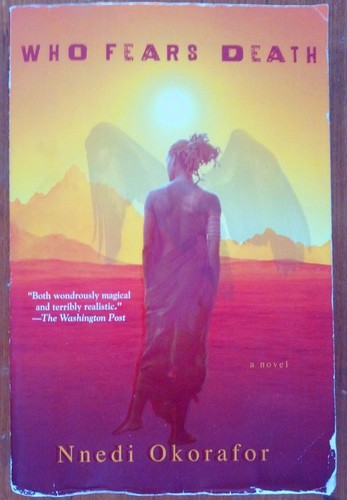
Who Fears Death
Nnedi Okorafor · 2010 · Standalone; connected to The Book of Phoenix and the She
Closest Broken Earth Connection Post-apocalyptic Africa, a
Main Difference It is a single, mythic quest with more explicit
Who Knows novellas
persecuted woman with immense power, ethnic oppression, bodily violence, prophecy, transformation, and rage directed at the stories sustaining a society
spiritual magic
Onyesonwu is born in a post-apocalyptic Sudan where the Nuru oppress the Okeke and use sexual violence as a weapon of conquest. Her name means "Who fears death?" She grows into magical abilities that make her a threat to the social order and to the sorcerer whose violence shaped her birth.
Okorafor brings technology, desert survival, traditional belief, shapeshifting, prophecy, and political atrocity into the same world without asking the reader to sort them into separate genres. Like orogeny, Onyesonwu's power is bodily, feared, socially interpreted, and impossible to separate from the violence directed at her identity.
The novel is furious about texts and the authority to rewrite them. Oppression persists not only through force but through stories declared sacred, natural, and permanent. Onyesonwu's struggle therefore becomes a battle over whether inherited law can be changed at its source. Jemisin likewise turns deep history into an active weapon: the world cannot be repaired until the story of how it broke is recovered.
This is a harrowing recommendation. It contains rape, female genital cutting, war, racism, and violence against children. Some elements of the gender politics are also more essentialist than Jemisin's. For prepared readers, however, Who Fears Death is one of the closest emotional matches: a woman the world has marked as monstrous discovers that anger may be the most rational response to a civilization built on her erasure.
1
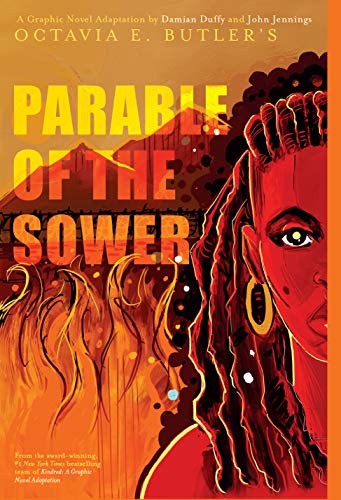
Parable of the Sower
Octavia E. Butler · 1993 · Earthseed, Book 1
Closest Broken Earth Connection Climate collapse, migration,
Main Difference It contains no magic; its apocalypse is
community survival, inherited inequality, a Black woman shaping the future, parent-child conflict, and adaptation as both necessity and belief
frighteningly ordinary
Lauren Olamina grows up in a walled California community as climate change, corporate power, fire, drugs, and economic collapse make the surrounding world increasingly dangerous. She has hyperempathy, a condition that makes her feel the pain she witnesses. She also develops Earthseed, a belief system founded on the conviction that change is the only lasting truth.
Butler offers no earthquake-controlling power or buried obelisk. That absence makes the resemblance sharper. Disaster reorganizes food, travel, family, work, trust, religion, and violence. Communities survive through practical knowledge, yet rules that preserve one generation can imprison the next. Lauren's father believes in defending the existing walls. Lauren believes survival requires preparing to leave them.
The parallel to The Broken Earth is not a sequence of plot points but a theory of apocalypse. Collapse does not erase hierarchy. It intensifies the question of whose pain counts, who receives protection, who is treated as labor, and who is permitted to imagine a future. Lauren's response is neither solitary toughness nor chosen-one destiny. She builds a group while understanding that community is difficult, dangerous work.
The diary form is direct where Jemisin is structurally deceptive. The speculative elements are minimal, the violence is intimate, and the world feels only a few institutional failures away. For readers who loved the Stillness because its catastrophe exposed the systems already harming people, Parable of the Sower is the essential next book. Jemisin changes the world with geology; Butler shows how little the world needs to change before the ground beneath ordinary life gives way.